




























Views
Downloads

Essential Electric Circuits Worksheet | Grade 3 Science

Paste this activity's link or code into your existing LMS (Google Classroom, Canvas, Teams, Schoology, Moodle, etc.).
Students can open and work on the activity right away, with no student login required.
You'll still be able to track student progress and results from your teacher account.
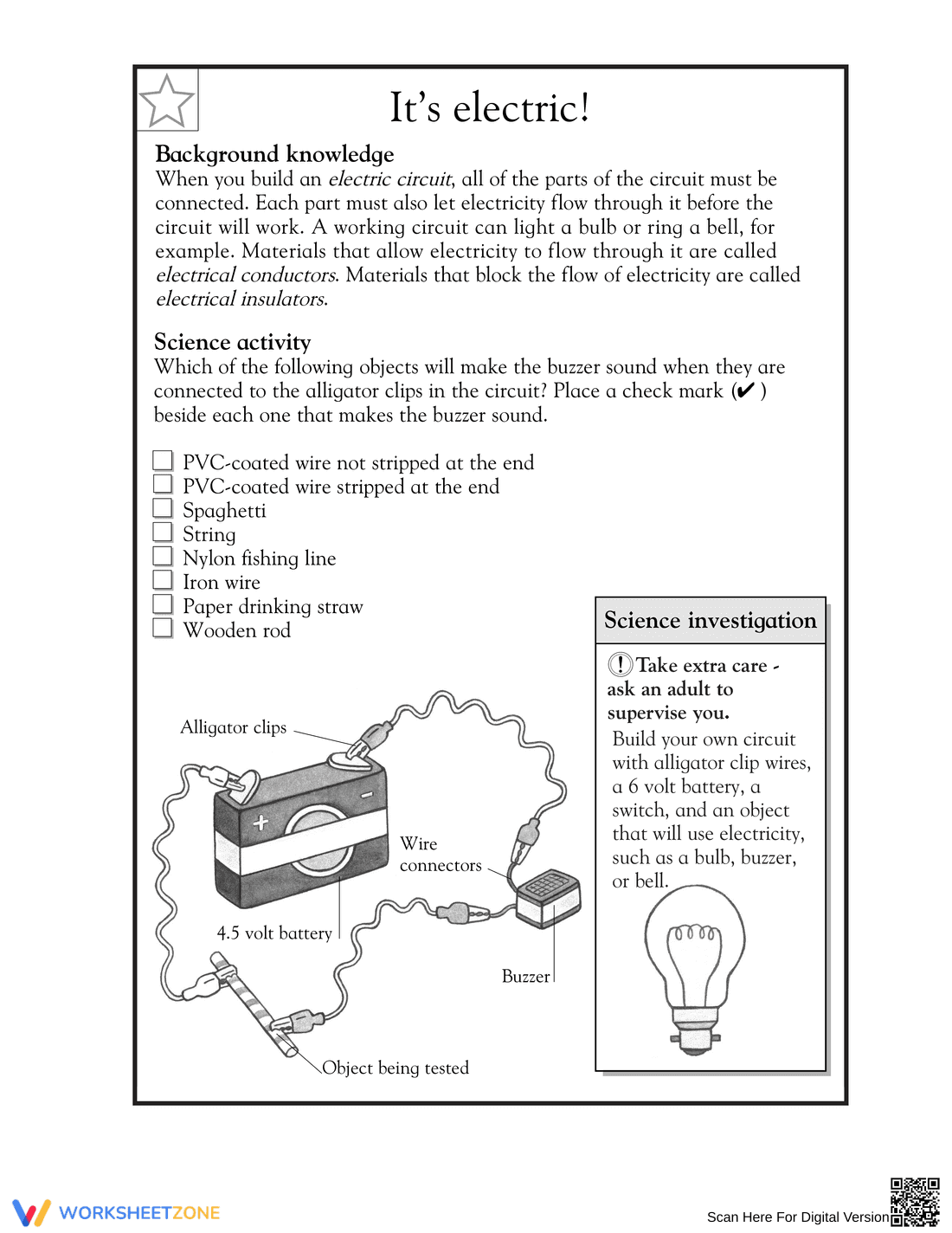
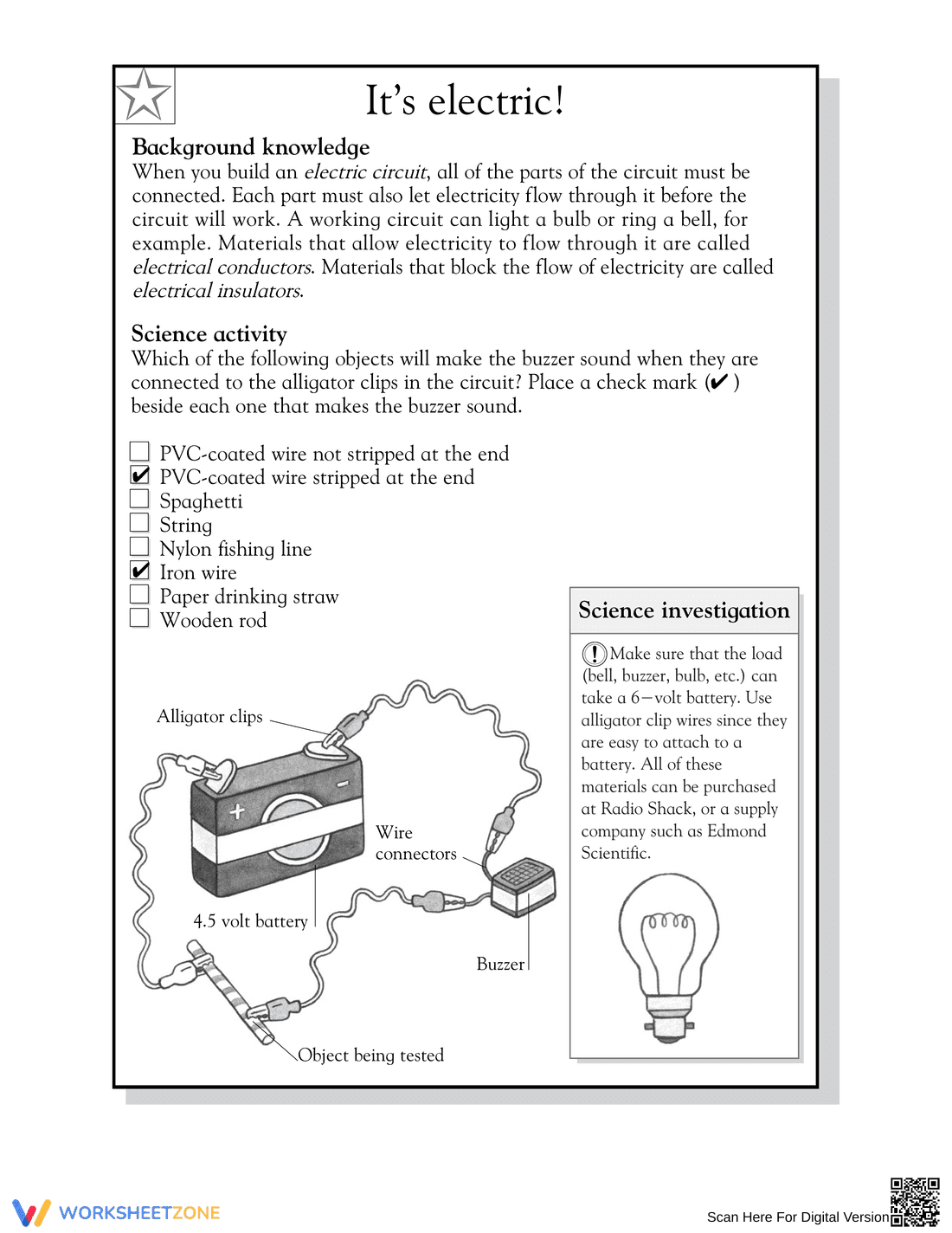
Students master the fundamentals of energy transfer with this comprehensive electric circuits worksheet. By exploring the physical properties of common materials, learners identify the functional difference between conductors and insulators. This resource transforms abstract electrical concepts into observable evidence, ensuring students understand how a closed loop facilitates current flow to power devices like buzzers or bulbs.
At a Glance
- Grade: 3 · Subject: Science
- Standard:
4-PS3-2— Observe how energy transfers via electric currents to identify conductive and insulating materials- Skill Focus: Conductors, insulators, and simple circuits
- Format: 1 page · 8 problems · Answer key included · PDF
- Best For: Introduction to physical science and electricity
- Time: 20–30 minutes
This worksheet features a dedicated background knowledge section that defines electric circuits, conductors, and insulators in student-friendly language. The primary activity challenges students to predict and verify the conductivity of eight distinct materials, ranging from iron wire to spaghetti. A supplemental "Science Investigation" section provides step-by-step instructions for building a hands-on circuit with a 6-volt battery, alligator clips, and a load.
Teachers can implement this lesson with a streamlined three-step workflow. Print the single-page worksheet and answer key (30 seconds). Distribute copies for students to complete the reading and prediction activity (15 minutes). Review correct answers and discuss the investigation steps (10 minutes). This resource requires zero setup, making it ideal for substitute plans.
Aligned to standard `4-PS3-2`, this resource requires students to make observations to provide evidence that energy can be transferred from place to place by electric currents. It specifically addresses the role of materials in completing a circuit, a foundational concept for understanding energy transformation. Both standard codes can be copied directly into lesson plans, IEP goals, or district curriculum mapping tools.
Use this worksheet as a guided practice tool during your science unit. After lecturing on current flow, have students categorize the eight listed materials. Utilize the investigation guide to set up a conductance station where students test items in real-time. Observe whether students correctly identify the need for stripped wire ends to ensure metal-to-metal contact.
This resource is designed for Grade 3 but works for Grade 2 enrichment or Grade 4 review. Differentiation is supported through clear diagrams and vocabulary help. It pairs well with an anchor chart on electrical safety. The simple layout ensures English Language Learners focus on scientific diagrams and core terminology without being overwhelmed by text.
Research from the RAND AIRS 2024 study emphasizes that hands-on scientific modeling significantly improves retention of physical science concepts in elementary learners. By identifying 4-PS3-2 aligned materials that facilitate or block energy transfer, students build a mental framework for electricity that extends beyond rote memorization. This worksheet encourages the specific skill of using evidence-based observations to define the properties of conductors and insulators, a key requirement for meeting national science benchmarks. The inclusion of a practical investigation guide ensures that students move from passive reading to active scientific inquiry, a transition that Fisher & Frey (2014) identify as critical for mastery. Educational analysts suggest that early exposure to circuit logic prepares students for more complex engineering tasks in middle school. This resource provides the necessary scaffolding to bridge the gap between simple observations and complex system analysis, ensuring all learners meet proficiency goals in energy transfer units.


