


























Views
Downloads

December Traditions Worksheet (3 Levels) | Grade 1 Ready
Paste this activity's link or code into your existing LMS (Google Classroom, Canvas, Teams, Schoology, Moodle, etc.).
Students can open and work on the activity right away, with no student login required.
You'll still be able to track student progress and results from your teacher account.
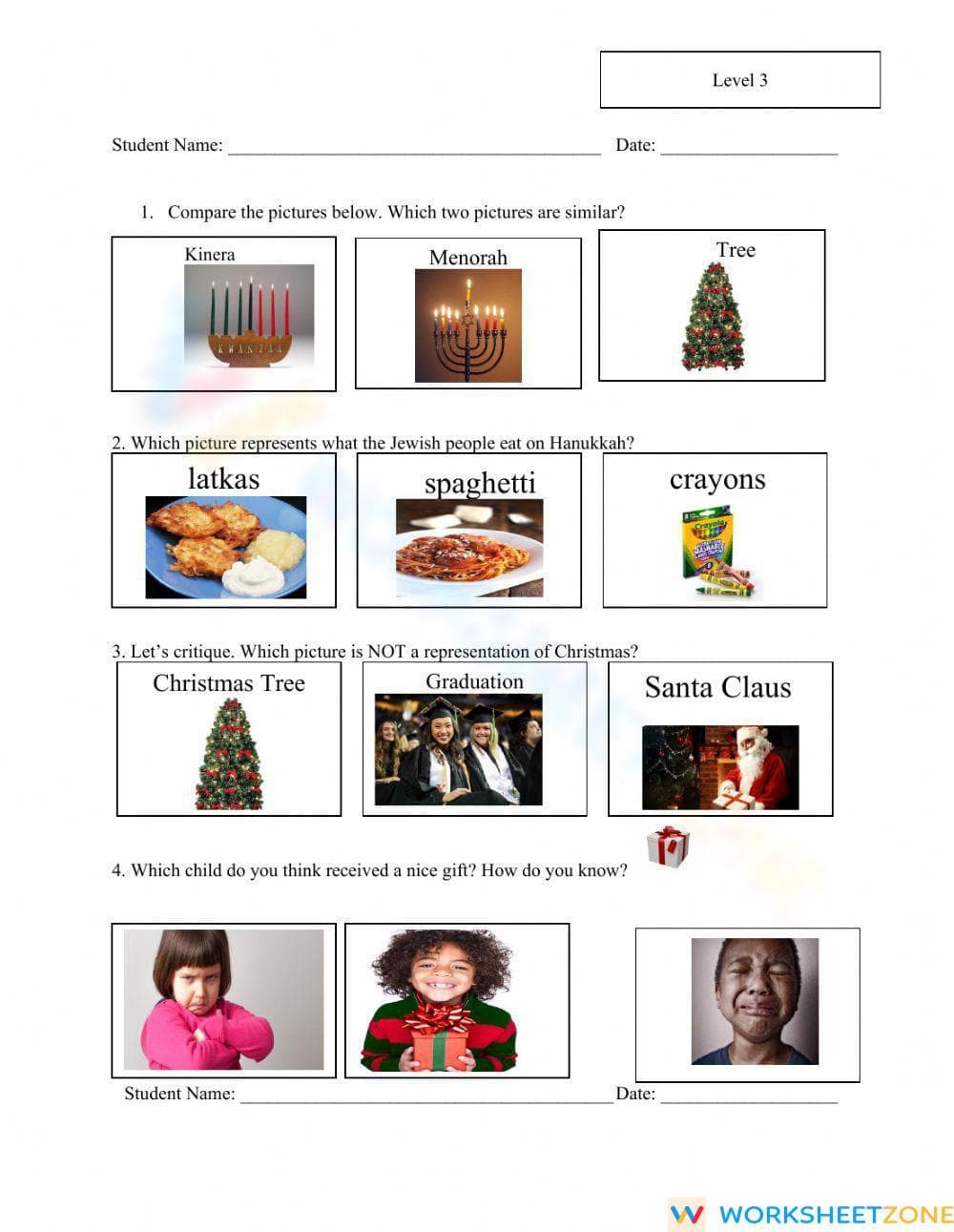
This Grade 1 December ELA assessment Level 3 focuses on cultural literacy and critical thinking through visual analysis. Students compare holiday symbols, identify traditions, and infer emotions from visual evidence. It serves as a comprehensive tool to evaluate comprehension and observational skills in a seasonal context, ensuring students master foundational informational text standards.
At a Glance
- Grade: 1 · Subject: ELA
- Standard:
CCSS.ELA-LITERACY.RI.1.9— Identify basic similarities in and differences between two cultural representations in visual formats- Skill Focus: Cultural Literacy & Inferencing
- Format: 1 page · 4 problems · Answer key included · PDF
- Best For: End-of-unit assessment or pre-test evaluation
- Time: 15–20 minutes
The worksheet features a high-quality single-page layout with four assessment tasks. It uses clear photographs representing Hanukkah, Kwanzaa, and Christmas. The structure includes multiple-choice, logic-based "critique" questions, and an open-ended inferencing prompt requiring students to justify their reasoning. A full answer key is included for rapid grading.
- Below Grade (Level 1): Focuses on basic identification with significant visual scaffolding and reduced vocabulary.
- On Grade (Level 2): Requires students to match objects to names and identify simple relationships between two distinct cultural symbols.
- Above Grade (Level 3): Challenges students to critique representations, compare three items simultaneously, and provide written justifications for emotional inferences.
Aligned to CCSS.ELA-LITERACY.RI.1.9, this worksheet focuses on identifying similarities and differences between representations on the same topic. By comparing a Kinera, Menorah, and Christmas tree, students engage in high-level categorization. Task 4 supports CCSS.ELA-LITERACY.RI.1.1 by requiring answers based on visual details. Both standard codes can be copied directly into lesson plans or IEP goals.
How to Use It
Use this as a summative assessment after a unit on world holidays. Administer it in mid-December to gauge mastery of comparison skills. Observe students during Task 4 to see if they can verbally explain their reasoning before writing. Expected completion time is 15 to 20 minutes for Grade 1 students.
Who It's For
Designed for Grade 1, this "Level 3" version is ideal for advanced learners or Grade 2 students. It is effective for English Language Learners due to the heavy reliance on visual cues. Pair this with an anchor chart of world traditions to provide a reference point during direct instruction.
Effective literacy instruction in early elementary grades increasingly relies on visual literacy to bridge the gap between decoding and deep comprehension. According to the RAND AIRS 2024 report on primary education, integrating multi-modal assessments that combine imagery with textual cues improves engagement and retention in students from diverse cultural backgrounds. This worksheet aligns with the Fisher & Frey (2014) gradual release of responsibility model by moving from simple visual identification to complex inferencing based on evidence. By utilizing standard CCSS.ELA-LITERACY.RI.1.9, this tool ensures that students are not just identifying objects, but are actively analyzing the relationships between cultural symbols. This rigorous approach to cultural literacy provides teachers with actionable data on a student's ability to categorize, critique, and infer—skills that are essential for future success in both literature and informational text analysis across all primary grade levels.


