


























Views
Plays

Grade 8 Economics Review — Printable No-Prep Worksheet
Paste this activity's link or code into your existing LMS (Google Classroom, Canvas, Teams, Schoology, Moodle, etc.).
Students can open and work on the activity right away, with no student login required.
You'll still be able to track student progress and results from your teacher account.
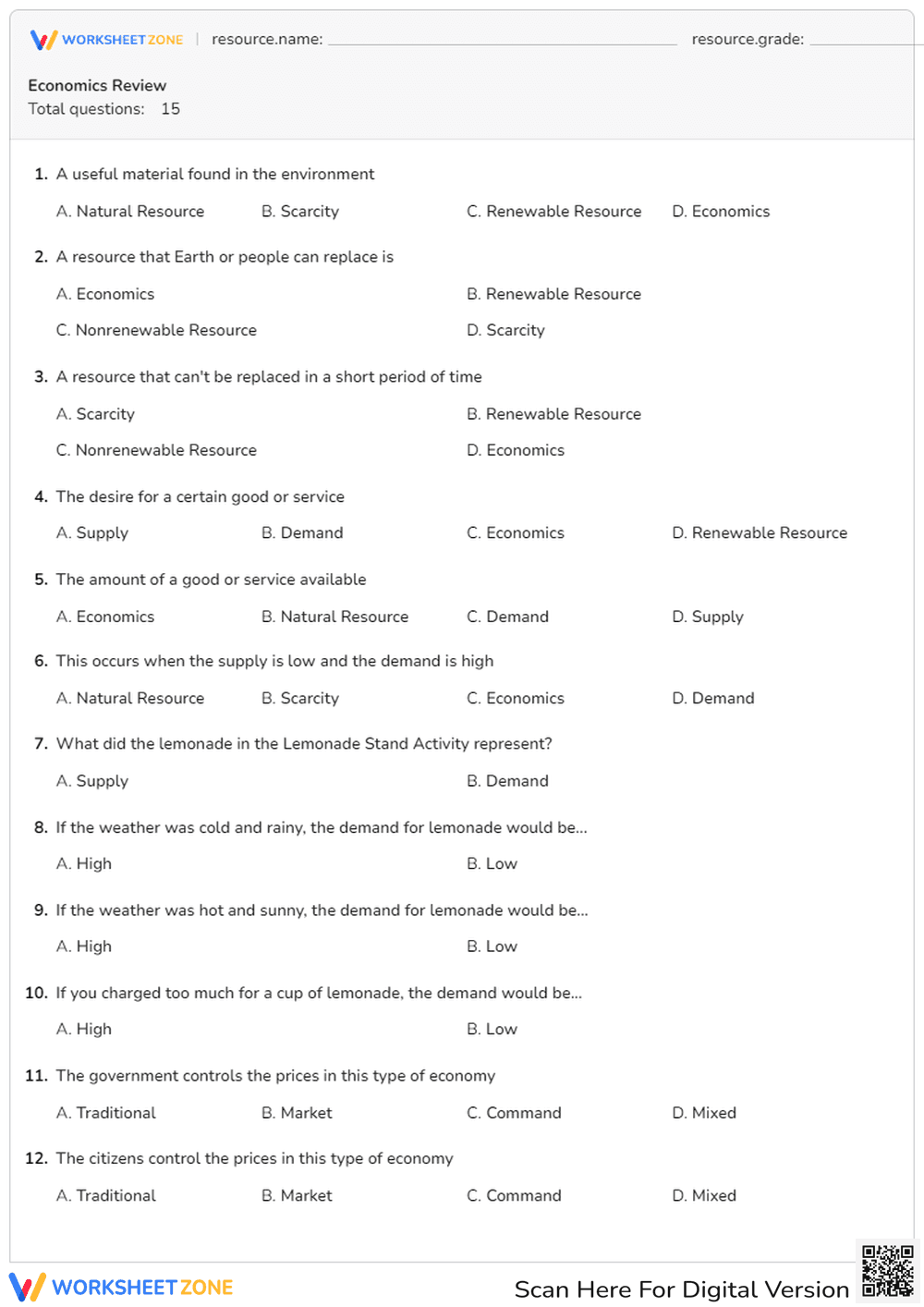
This ready-to-use economics review worksheet helps middle school students master essential vocabulary related to resources, supply, demand, and economic systems. By completing this multiple-choice quiz, students demonstrate their understanding of how scarcity and market structures impact pricing and societal decision-making.
At a Glance
- Grade: 8 · Subject: Social Studies
- Standard:
CCSS.ELA-LITERACY.RH.6-8.4— Determine the meaning of domain-specific vocabulary- Skill Focus: Economics Vocabulary
- Format: 2 pages · 15 problems · Answer key included · PDF
- Best For: End-of-unit review or assessment
- Time: 15–20 minutes
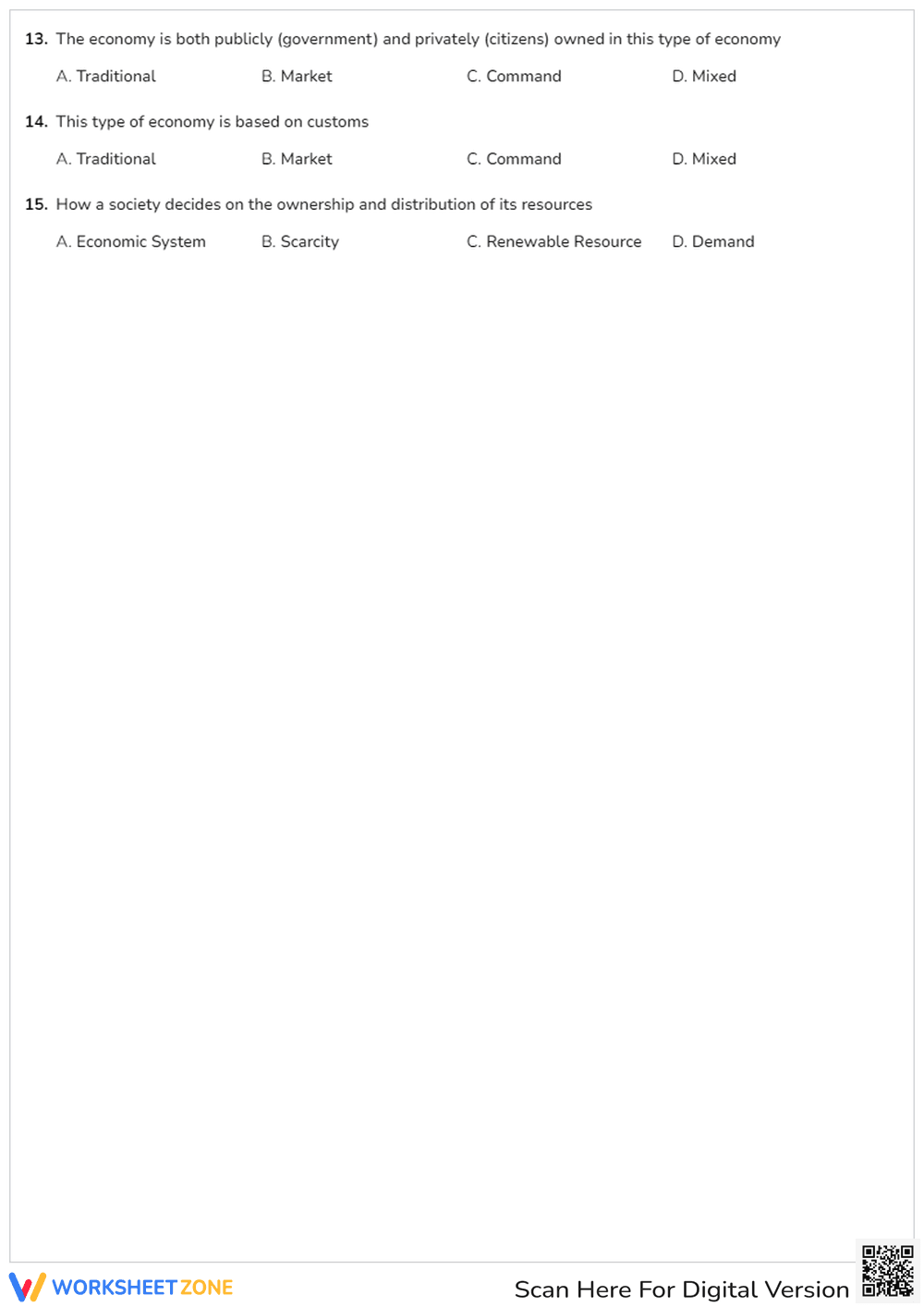
Inside this comprehensive assessment, educators will find a two-page, 15-question multiple-choice quiz that covers foundational economic concepts. The task types require students to identify definitions for natural, renewable, and nonrenewable resources, as well as differentiate between traditional, market, command, and mixed economies. A clear layout with distinct options makes it accessible for all learners, and a complete answer key is provided for rapid grading.
Zero-Prep Workflow
- Print (1 minute): Simply download the PDF and print a class set. No special formatting or cutting is required.
- Distribute (1 minute): Hand out the two-page assessment to students as a standalone quiz or review activity.
- Review (3 minutes): Use the included answer key to quickly score the 15 multiple-choice questions or review them together as a class.
Total teacher prep time is under two minutes, making this an ideal resource for emergency sub plans or last-minute formative assessments.
Standards Alignment
Aligned to CCSS.ELA-LITERACY.RH.6-8.4, this resource ensures students can determine the meaning of words and phrases as they are used in a text, including vocabulary specific to domains related to history and social studies. It also supports cross-curricular connections to environmental science discussions on resource management. Both standard codes can be copied directly into lesson plans, IEP goals, or district curriculum mapping tools.
How to Use It
This worksheet functions perfectly as an independent end-of-unit assessment after direct instruction on economic systems. Alternatively, teachers can use it as a pre-assessment to gauge prior knowledge before beginning a unit on global markets or environmental resources. As a formative assessment observation tip, monitor which specific questions students struggle with—such as confusing command and mixed economies—to guide targeted reteaching sessions. Expected completion time ranges from 15 to 20 minutes.
Who It's For
Designed primarily for middle school students in grades 6 through 8, this resource is excellent for general education social studies or environmental science classrooms. For differentiation, teachers can read the questions aloud to students with accommodations or eliminate one incorrect multiple-choice option to reduce cognitive load. It pairs naturally with introductory anchor charts on supply and demand or a direct instruction lesson on global economic structures.
Mastering domain-specific terminology is a critical component of reading comprehension in the content areas. This resource aligns with CCSS.ELA-LITERACY.RH.6-8.4 by requiring students to determine the meaning of domain-specific vocabulary related to economics and resource management. According to Fisher & Frey (2014), explicit vocabulary instruction and repeated exposure to academic language significantly improve students' ability to engage with complex informational texts. By assessing terms like scarcity, supply, demand, and market economies through structured multiple-choice questions, educators can accurately measure foundational knowledge. This targeted practice ensures learners possess the necessary vocabulary to participate in higher-order discussions about societal resource distribution and government economic policies. The straightforward format provides immediate data on student comprehension, supporting evidence-based instructional adjustments.


