


























Views
Plays



Economics of Australia Review | Grade 6 Essential
Paste this activity's link or code into your existing LMS (Google Classroom, Canvas, Teams, Schoology, Moodle, etc.).
Students can open and work on the activity right away, with no student login required.
You'll still be able to track student progress and results from your teacher account.
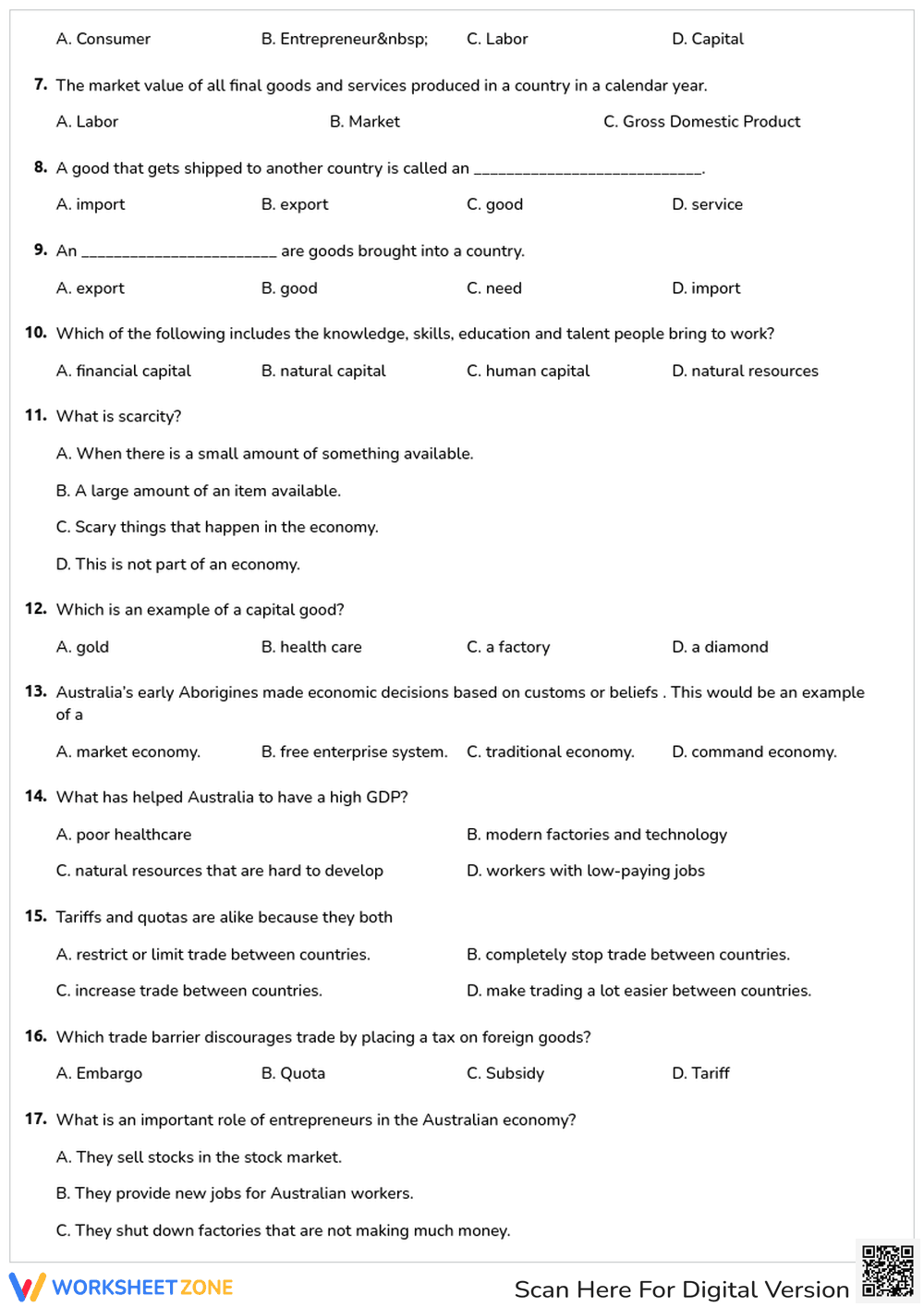
This Economics of Australia Review worksheet provides a comprehensive assessment of middle school economic concepts within the context of the Australian continent. Students demonstrate mastery of mixed economies, trade barriers, and the four factors of economic growth. By completing these 20 targeted questions, learners solidify their understanding of how human capital and entrepreneurship drive national prosperity.
At a Glance
- Grade: 6 · Subject: Economics
- Standard:
CCSS.ELA-LITERACY.RH.6-8.4— Determine the meaning of domain-specific words and phrases in a social studies context- Skill Focus: Economic Systems & Growth Factors
- Format: 3 pages · 20 problems · Answer key included · PDF
- Best For: Unit review or formative assessment
- Time: 25–35 minutes
What's Inside
This three-page PDF features 20 multiple-choice questions designed to mirror standardized test formats. The content spans foundational vocabulary like scarcity and GDP to complex analysis of trade barriers. It includes a visual data analysis task involving an economic continuum chart, helping students transition from rote memorization to conceptual application.
Zero-Prep Workflow
This resource is designed for immediate classroom implementation with a total teacher prep time of under 2 minutes. First, print the three-page document (30 seconds). Next, distribute the worksheets to students for independent or partner work (30 seconds). Finally, use the included answer key for a rapid whole-class review or individual grading (1 minute). Its self-contained nature makes it an ideal emergency sub plan.
Standards Alignment
The primary focus is `CCSS.ELA-LITERACY.RH.6-8.4`, which requires students to determine the meaning of symbols, key terms, and other domain-specific words and phrases as they are used in a specific context relevant to grades 6-8 texts and topics. It also supports general economic literacy by requiring students to analyze how Australia's mixed economy functions. Both standard codes can be copied directly into lesson plans, IEP goals, or district curriculum mapping tools.
How to Use It
Use this worksheet as a summative review at the end of a unit on Oceania. Alternatively, assign it as a structured homework task following direct instruction. During the activity, observe if students can correctly identify the relationship between literacy rates and GDP. This serves as a critical formative-assessment indicator. Completion typically takes 30 minutes.
Who It's For
This resource is tailored for Grade 6 social studies students but is effective for Grade 5 or 7 learners. It serves general education classrooms and students with IEPs needing focused practice. Pair this with a map of Australian trade routes or an anchor chart on the factors of production for maximum impact.
The Economics of Australia Review is a rigorous instructional tool designed to bridge the gap between theoretical economic concepts and regional geographic study. By focusing on standard CCSS.ELA-LITERACY.RH.6-8.4, the worksheet ensures students can articulate the nuances of a mixed economy and the impact of trade barriers like tariffs. According to the RAND AIRS 2024 report, high-quality social studies curriculum materials that integrate domain-specific vocabulary and data analysis significantly improve student retention of complex global systems. This resource addresses the need for structured practice in identifying the four factors of economic growth—natural resources, human capital, capital goods, and entrepreneurship—which are essential for secondary social studies success. The 20-question format provides sufficient data points for teachers to identify specific misconceptions regarding GDP and scarcity. This alignment with evidence-based pedagogical practices ensures that students develop the critical thinking skills necessary for informed global citizenship and economic literacy.


