


























Views
Plays

Essential Scarcity and Choice Worksheet | Grade 3 Econ
Paste this activity's link or code into your existing LMS (Google Classroom, Canvas, Teams, Schoology, Moodle, etc.).
Students can open and work on the activity right away, with no student login required.
You'll still be able to track student progress and results from your teacher account.
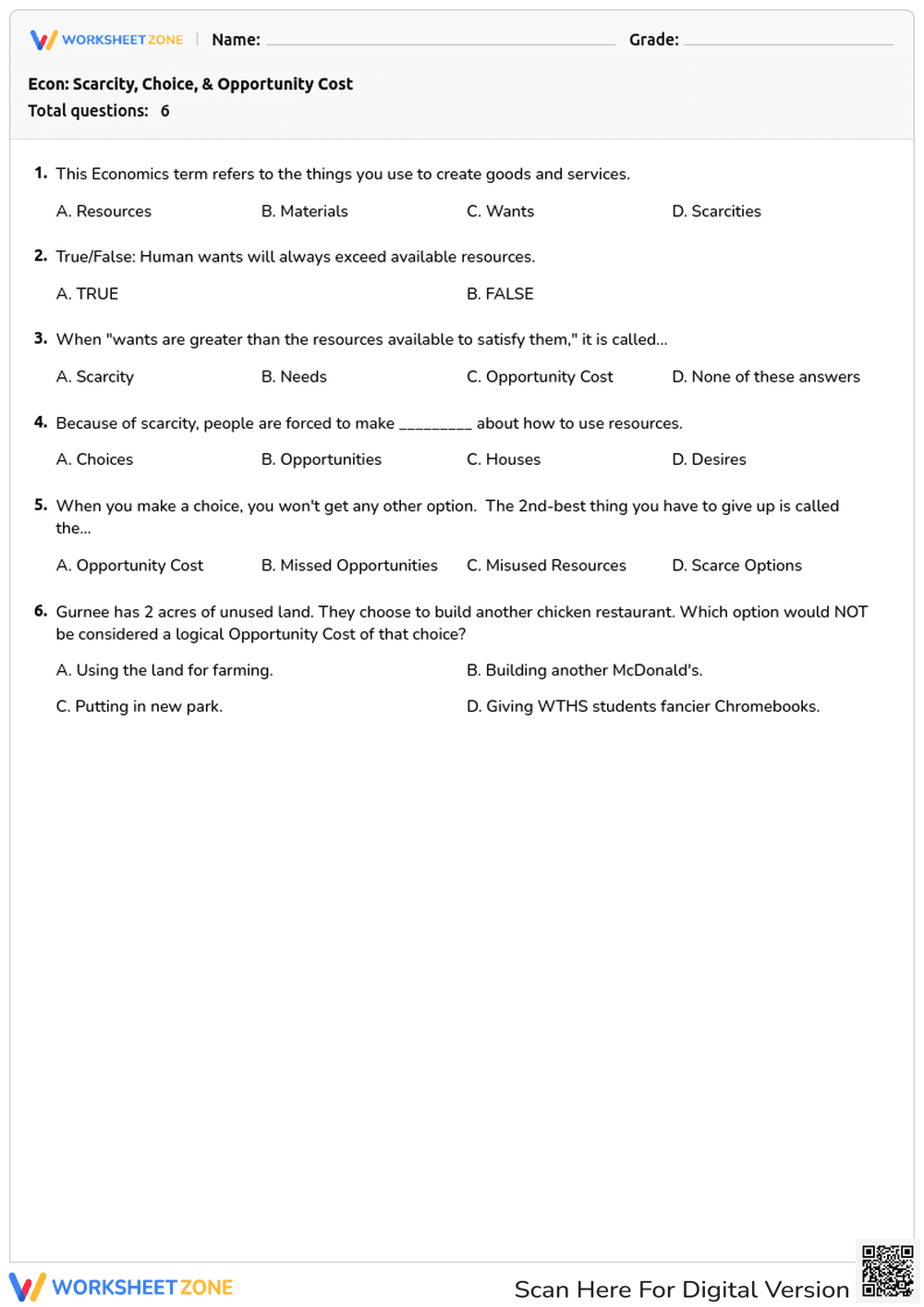
This Grade 3 Social Studies worksheet helps students grasp fundamental economic concepts through a structured 6-question assessment. By identifying the relationship between limited resources and unlimited wants, learners develop a foundational understanding of how individuals and communities make decisions. It provides a clear path to mastering the concept of opportunity cost in real-world scenarios.
At a Glance
- Grade: 3 · Subject: Social Studies
- Standard:
SS.3.E.1.1— Explain how scarcity and choice influence the decisions made by individuals- Skill Focus: Scarcity, Choice, and Opportunity Cost
- Format: 1 page · 6 problems · Answer key included · PDF
- Best For: Quick formative assessment or exit ticket
- Time: 10–15 minutes
What's Inside
This single-page PDF features six targeted questions designed to evaluate student comprehension of core economic vocabulary. The layout includes multiple-choice and true/false formats, covering definitions of resources, the nature of human wants, and the logic of opportunity cost. A specific scenario involving land use provides a practical application of these abstract concepts, ensuring students can apply their knowledge beyond simple rote memorization.
Zero-Prep Workflow
The zero-prep workflow for this resource is designed for maximum efficiency. First, print the single-page document (30 seconds). Next, distribute the worksheet to students as a quiet independent activity (1 minute). Finally, review the answers using the included key (2 minutes). Total teacher prep time is under 2 minutes, making it an ideal choice for emergency sub plans or quick checks.
Standards Alignment
This resource is aligned with SS.3.E.1.1, which requires students to analyze how scarcity and choice influence decisions. It specifically addresses the tension between limited resources and unlimited wants. The worksheet also supports introductory economics goals by defining opportunity cost as the next best alternative foregone. Both standard codes can be copied directly into lesson plans, IEP goals, or district curriculum mapping tools.
How to Use It
Use this worksheet as a formative assessment after an introductory lesson on resources and wants. It works best during the independent practice phase of a gradual release model. Teachers should observe students during question six, as it requires higher-order thinking to identify what is not a logical opportunity cost. Expect students to complete the assessment in approximately 12 minutes, followed by a brief class discussion.
Who It's For
This resource is tailored for third-grade students but is highly effective for second-grade enrichment or fourth-grade review. It is particularly useful for English Language Learners (ELLs) due to its clear, concise language and focused vocabulary. Pair this worksheet with a visual anchor chart depicting the choice-scarcity-opportunity cost cycle for a comprehensive instructional experience.
Economic literacy in early elementary grades is critical for developing informed decision-making skills. According to the RAND AIRS 2024 report, structured practice with foundational concepts like scarcity and opportunity cost significantly improves a student's ability to apply logical reasoning to financial and civic problems later in life. This worksheet addresses the core requirements of standard SS.3.E.1.1 by requiring students to distinguish between resources and wants while identifying the consequences of choice. By utilizing a mix of definitional questions and scenario-based applications, the resource ensures that learners move beyond surface-level recognition toward conceptual mastery. Research from Fisher & Frey (2014) emphasizes that short, focused assessments are vital for checking for understanding before moving to complex economic models. This 6-question tool provides the necessary data points for teachers to adjust instruction in real-time, ensuring no student is left behind in the social studies curriculum.


