


























Views
Downloads

Easter Picture Addition Practice | Essential Grade 1 Math
Paste this activity's link or code into your existing LMS (Google Classroom, Canvas, Teams, Schoology, Moodle, etc.).
Students can open and work on the activity right away, with no student login required.
You'll still be able to track student progress and results from your teacher account.
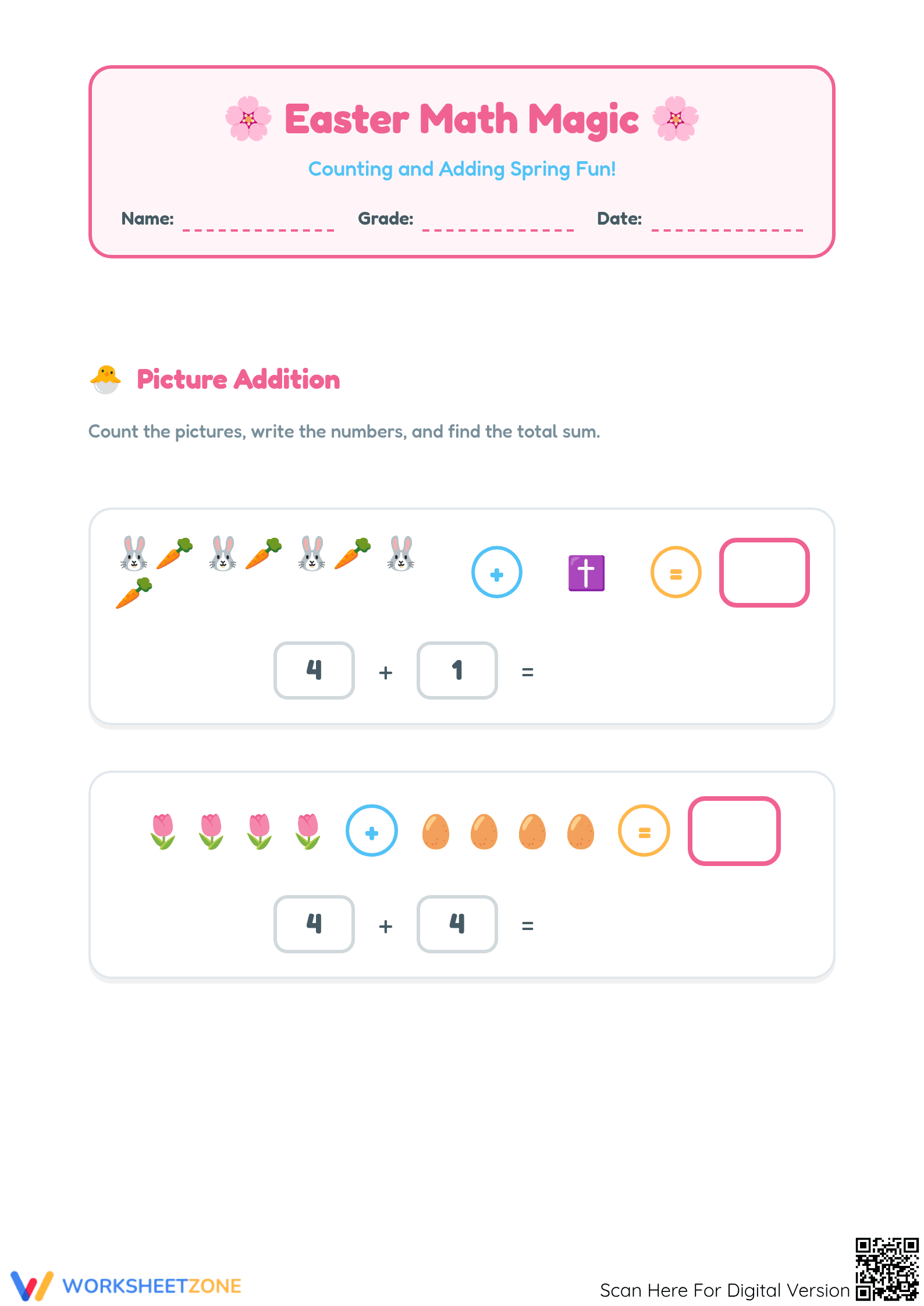
This Grade 1 Easter addition worksheet helps young learners master basic sums through engaging visual representations. Students count spring-themed objects like bunnies, eggs, and flowers to build a concrete understanding of addition within 10. By bridging the gap between counting and symbolic math, this resource ensures students develop a strong foundation in algebraic thinking.
At a Glance
- Grade: Kindergarten · Subject: Math
- Standard:
CCSS.MATH.CONTENT.K.OA.A.2— Add and subtract within 10 using objects or drawings to represent problems- Skill Focus: Picture addition and counting
- Format: 3 pages · 12 problems · Answer key included · PDF
- Best For: Holiday-themed math centers and morning work
- Time: 15–20 minutes
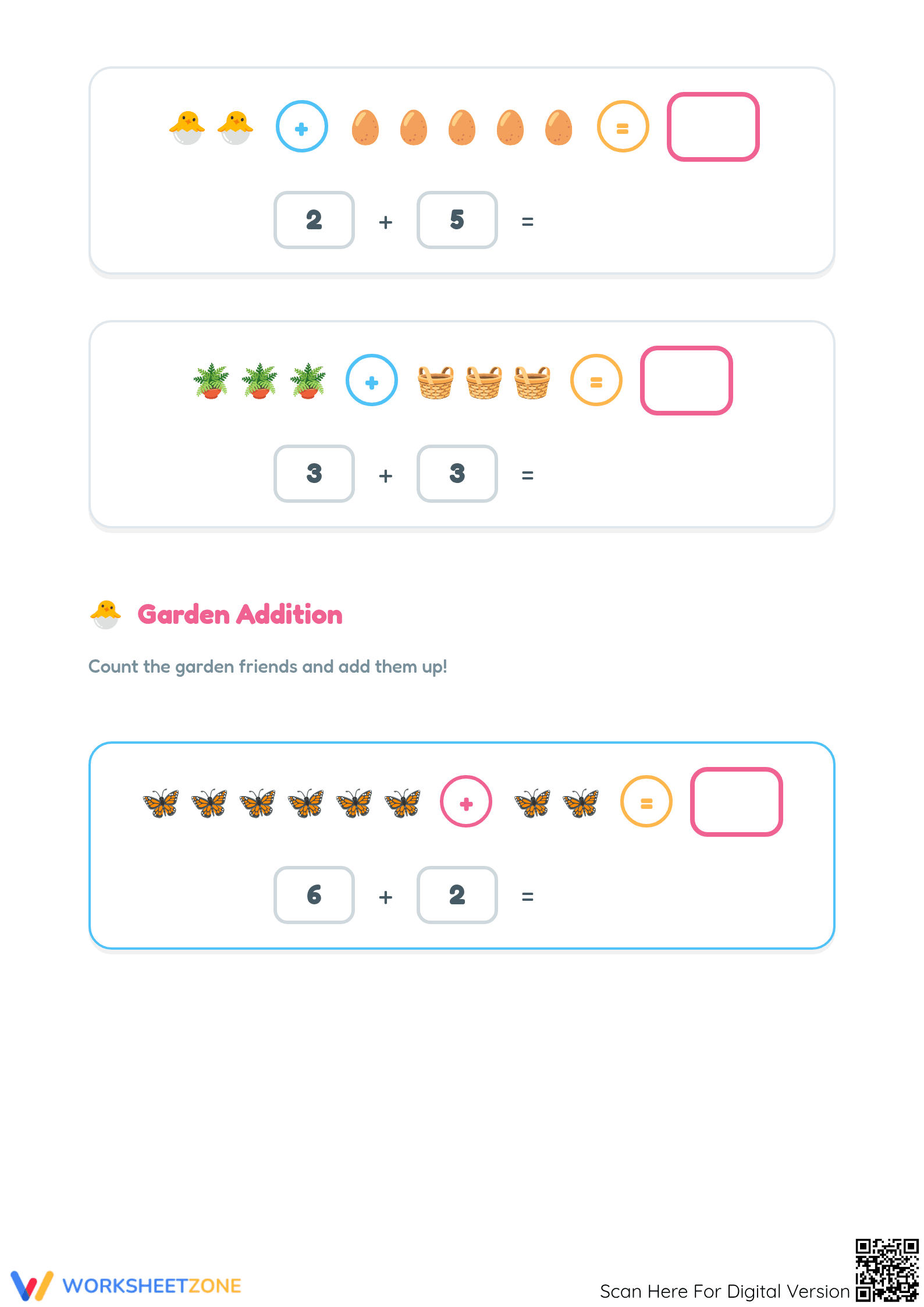
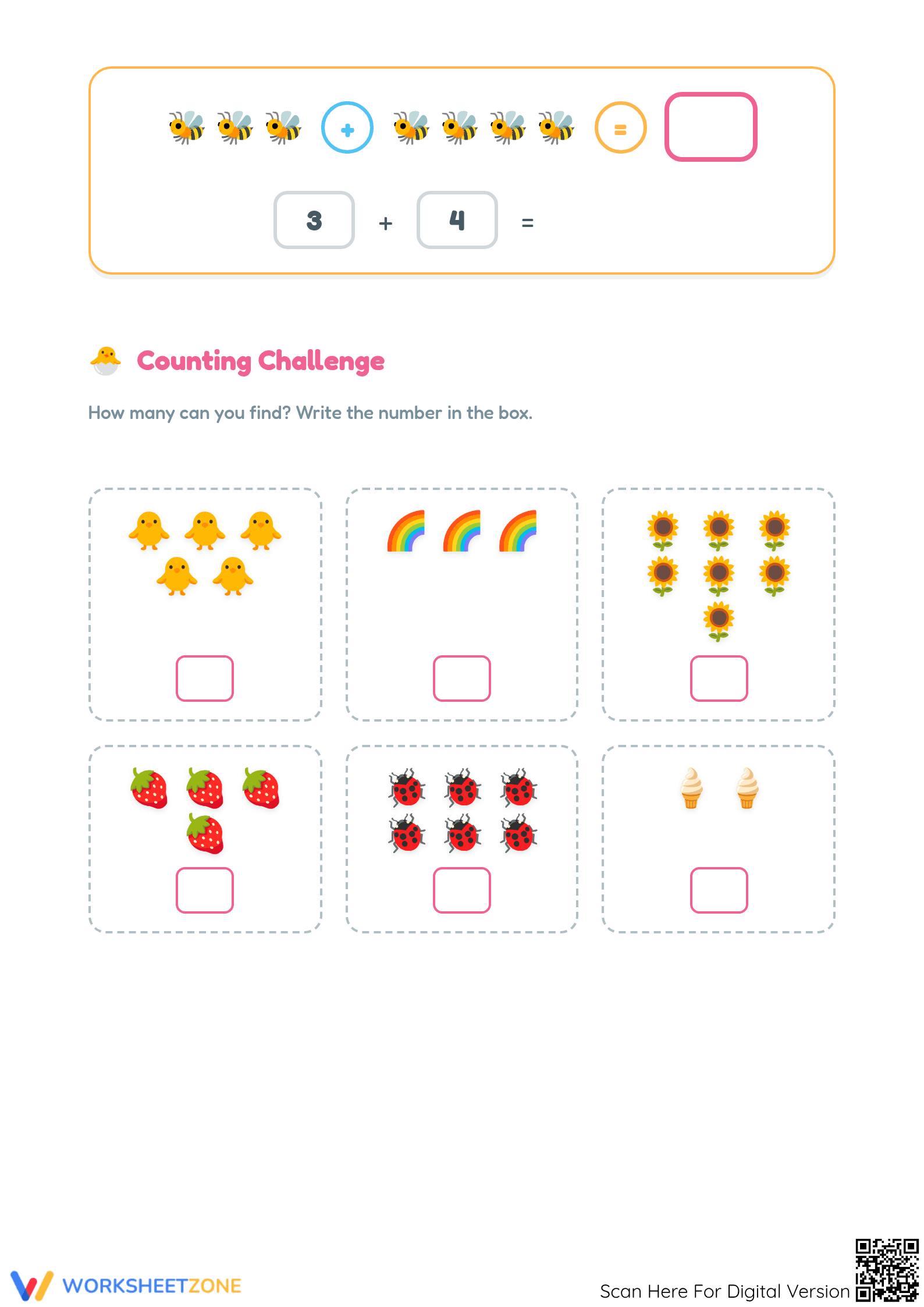
What's Inside: This comprehensive 3-page PDF includes 6 dedicated picture addition problems and 6 counting challenge tasks. The layout features large, clear icons of Easter eggs, chicks, and garden friends to support visual learners. Each addition problem provides structured boxes for students to write the addends and the final sum. A complete answer key is provided for rapid grading or student self-correction.
Zero-Prep Workflow
- Print: Select the three-page set and print enough copies for your class in under 30 seconds.
- Distribute: Hand out the worksheets as a standalone holiday activity or part of a seasonal math packet.
- Review: Use the included answer key to review results or display on a projector for a whole-class check in 1 minute.
This resource is an ideal sub-plan component because it requires no teacher setup and provides clear, self-explanatory instructions for students.
Standards Alignment: The primary focus is CCSS.MATH.CONTENT.K.OA.A.2, which requires students to solve addition and subtraction word problems, and add and subtract within 10, e.g., by using objects or drawings to represent the problem. This worksheet specifically targets the using drawings portion of the standard. Both standard codes can be copied directly into lesson plans, IEP goals, or district curriculum mapping tools.
How to Use It: Use this worksheet during the independent practice phase of a gradual release lesson on addition strategies. It serves as an excellent formative assessment tool; observe if students are counting every object individually or if they are beginning to count on from the first number. The expected completion time is 15 to 20 minutes, making it perfect for a focused math center rotation.
Who It's For: This resource is tailored for Kindergarten and Grade 1 students, particularly those who benefit from visual scaffolding. It is highly effective for English Language Learners (ELLs) because the mathematical concepts are conveyed through universal imagery rather than heavy text. Pair this with a physical manipulative activity using plastic Easter eggs for a multi-sensory learning experience.
Research by Fisher & Frey (2014) emphasizes the importance of visual representations in early numeracy, noting that scaffolded visual supports allow students to internalize abstract mathematical operations before moving to purely symbolic notation. This worksheet aligns with these findings by providing clear, thematic icons that represent the standard CCSS.MATH.CONTENT.K.OA.A.2. By requiring students to count and then write the corresponding digits, the resource reinforces the connection between quantity and numeral. This dual-coding approach is a proven method for increasing retention in early childhood mathematics. Furthermore, the inclusion of a counting challenge ensures that students maintain prerequisite skills while advancing toward operational mastery. Educators can confidently integrate this tool into evidence-based instructional frameworks, knowing it supports the developmental progression from concrete to representational math while maintaining high student engagement through seasonal themes.


