


























Views
Downloads
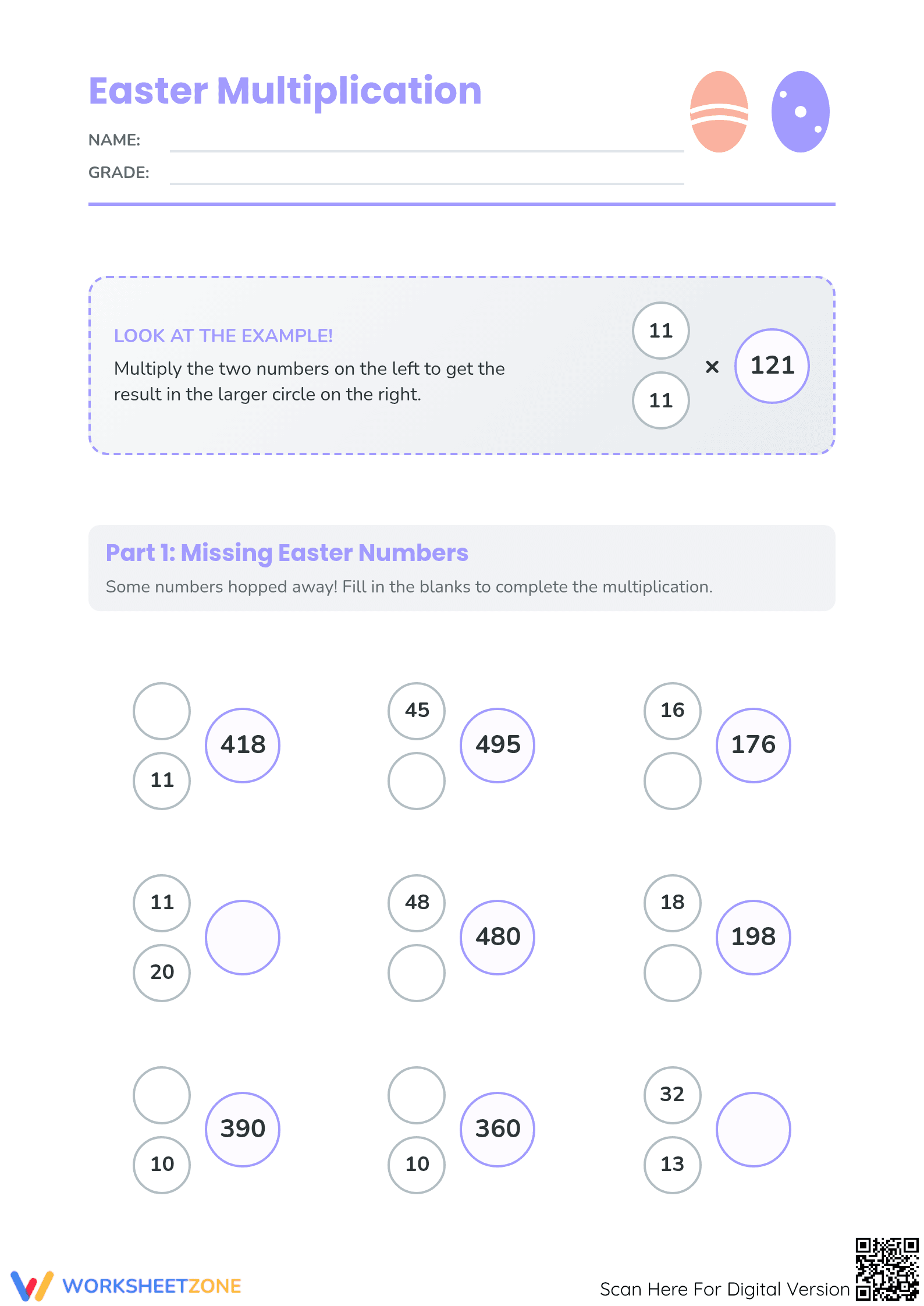


Printable 2-Digit Multiplication Worksheet | Grade 4 Math
Paste this activity's link or code into your existing LMS (Google Classroom, Canvas, Teams, Schoology, Moodle, etc.).
Students can open and work on the activity right away, with no student login required.
You'll still be able to track student progress and results from your teacher account.
This Easter-themed math worksheet helps fourth-grade students master two-digit by two-digit multiplication. By solving missing factor puzzles and real-world word problems, learners build computational fluency and algebraic thinking skills. The engaging holiday format keeps students motivated while they practice essential multi-digit arithmetic.
At a Glance
- Grade: 4 · Subject: Math
- Standard:
CCSS.MATH.CONTENT.4.NBT.B.5— Multiply two two-digit numbers using strategies based on place value.- Skill Focus: 2-Digit by 2-Digit Multiplication
- Format: 2 pages · 17 problems · Answer key included · PDF
- Best For: Independent practice and holiday review
- Time: 20–30 minutes
This two-page resource features 17 sequenced multiplication tasks in three sections. Parts one and two challenge students to find missing factors or products within visual number bonds, reinforcing multiplication and division relationships. Part three presents two Easter word problems requiring students to apply calculation skills to real-world scenarios. A complete answer key ensures quick grading.
- Guided practice: The worksheet opens with a clear visual example demonstrating how to multiply the two numbers on the left to find the product on the right.
- Supported practice: Students complete 15 visual puzzles calculating either the missing product or a missing two-digit factor, building algebraic reasoning.
- Independent practice: The final section requires learners to read two word problems, set up the equation, and solve independently.
This gradual-release approach moves students from straightforward calculation to applied problem-solving.
This resource aligns to CCSS.MATH.CONTENT.4.NBT.B.5: Multiply two two-digit numbers using strategies based on place value and properties of operations. It supports algebraic thinking by having students solve for unknown factors. Both standard codes can be copied directly into lesson plans, IEP goals, or district curriculum mapping tools.
Deploy this worksheet during the weeks leading up to Easter as independent practice following direct instruction on the standard algorithm. It serves as an excellent math center or homework assignment. As a formative assessment tip, observe if students struggle finding missing factors; this indicates a need to review inverse operations. Expected completion time is 20 to 30 minutes.
Designed for fourth-grade students, this is also effective for fifth graders needing multi-digit multiplication review. For students requiring accommodations, provide a multiplication chart or whiteboard to map out the area model. Pair this activity with a mini-lesson on using the standard algorithm.
Mastering multi-digit arithmetic requires consistent, targeted practice that moves beyond simple rote memorization. This resource targets CCSS.MATH.CONTENT.4.NBT.B.5, helping students multiply two two-digit numbers using strategies based on place value. By incorporating missing factor problems alongside standard calculation tasks, the worksheet encourages deeper mathematical reasoning. According to EdReports 2024, high-quality instructional materials must provide students with opportunities to connect procedural skill and fluency with application in problem-solving contexts. The progression from visual number puzzles to applied word problems in this worksheet ensures learners are not just memorizing steps, but truly understanding the relationship between numbers. This balanced approach to computational fluency helps solidify the foundational skills necessary for advanced mathematics, ensuring students are fully prepared for the rigorous demands of middle school algebra and beyond.


