




























Views
Downloads


Printable Easter Multiplication Worksheet | Grade 3 Math

Paste this activity's link or code into your existing LMS (Google Classroom, Canvas, Teams, Schoology, Moodle, etc.).
Students can open and work on the activity right away, with no student login required.
You'll still be able to track student progress and results from your teacher account.
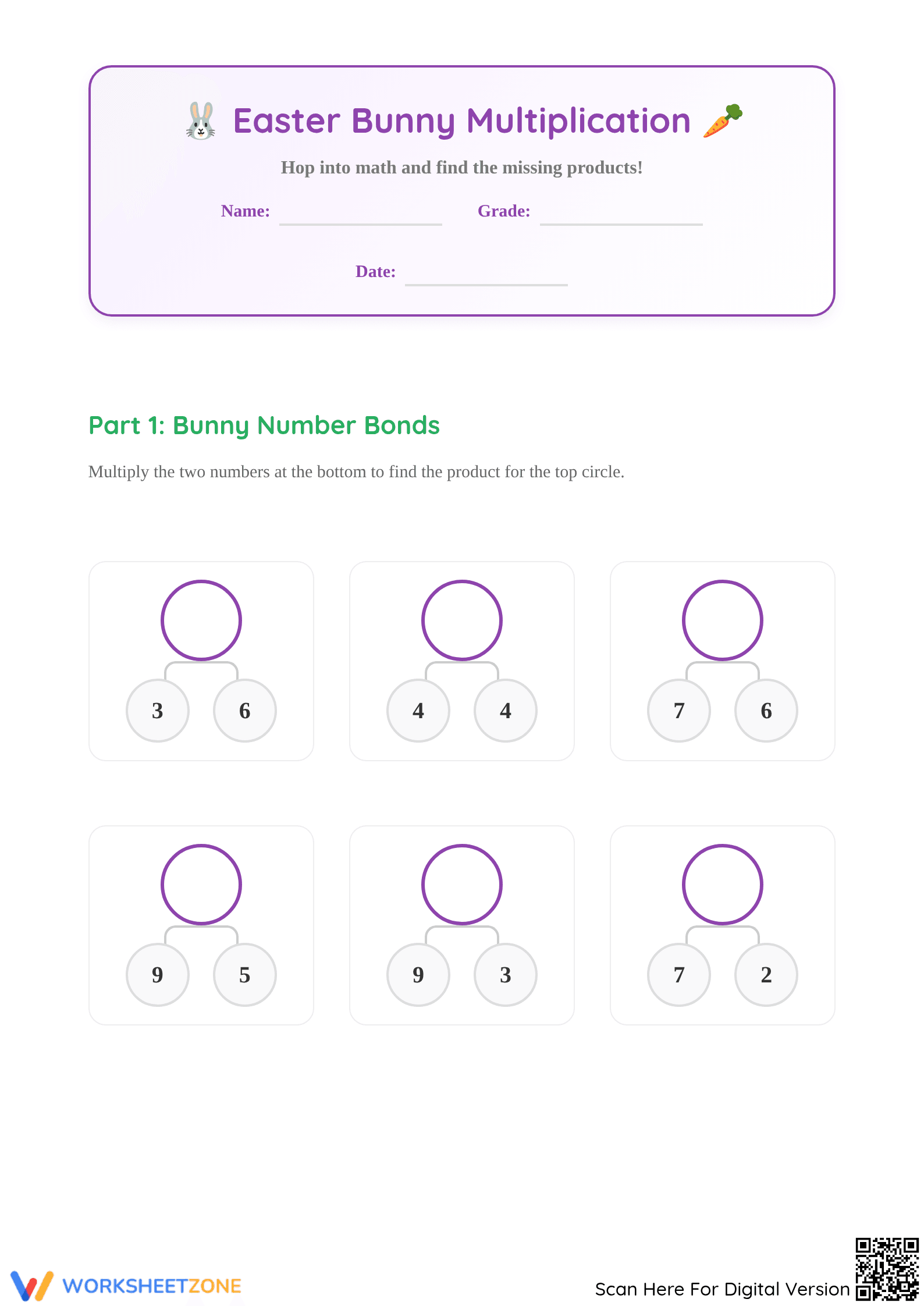
This Easter-themed multiplication worksheet helps students build fluency with basic math facts through engaging number bonds and matching activities. By solving these seasonal puzzles, learners strengthen mental math capabilities and develop a deeper understanding of factor-product relationships, preparing them for advanced arithmetic.
At a Glance
- Grade: 3 · Subject: Math
- Standard:
CCSS.MATH.CONTENT.3.OA.C.7— Fluently multiply within 100 using mental strategies- Skill Focus: Multiplication facts and number bonds
- Format: 3 pages · 23 problems · PDF
- Best For: Independent practice and holiday centers
- Time: 15–20 minutes
This three-page packet features 23 tasks divided into three sections. Students complete "Bunny Number Bonds" by multiplying bottom numbers to find the top product, tackle "Mega Bunny Multiplication" with factors up to 12, and finish with a "Bunny Matching" activity connecting multiplication sentences to products. The clean layout keeps students focused.
- Guided practice: The first section introduces basic number bonds with familiar factors, allowing students to warm up their mental math skills with straightforward calculations.
- Supported practice: The "Mega Bunny" section increases the cognitive load by introducing larger factors (11 and 12), challenging students to apply strategies to complex facts.
- Independent practice: The matching section requires evaluating multiple expressions simultaneously, reinforcing fact fluency. This gradual-release approach ensures students build confidence through the I Do, We Do, You Do framework.
Aligned to CCSS.MATH.CONTENT.3.OA.C.7: Fluently multiply and divide within 100, using strategies such as the relationship between multiplication and division. By the end of Grade 3, know from memory all products of two one-digit numbers. Both standard codes can be copied directly into lesson plans, IEP goals, or district curriculum mapping tools.
Deploy this worksheet during independent math centers or as festive morning work. It serves as an excellent formative assessment tool after direct instruction. Teachers can observe students completing the number bonds to identify which specific fact families require additional review. Expected completion time ranges from 15 to 20 minutes.
Designed for third and fourth-grade students mastering multiplication tables. The visual nature of the number bonds provides built-in differentiation for visual learners. Pair this activity with a multiplication anchor chart or manipulatives for students who need concrete support before moving to abstract calculations.
Developing automaticity with multiplication facts is a critical milestone in elementary mathematics that lays the groundwork for future success in algebra and fractions. According to research by Fisher & Frey (2014), structured practice that incorporates visual models significantly improves long-term retention of mathematical concepts. This worksheet aligns directly with CCSS.MATH.CONTENT.3.OA.C.7, requiring students to fluently multiply within 100 using mental strategies. By utilizing number bonds, the activity visually represents the relationship between factors and products, moving beyond rote memorization to foster true conceptual understanding. The progression from basic facts to larger numbers ensures that learners build cognitive endurance over time. Furthermore, integrating thematic elements like the Easter bunny increases student engagement, which is directly correlated with improved academic outcomes during independent practice sessions. This resource provides the targeted, meaningful repetition necessary for students to achieve mathematical fluency and confidently approach more complex problem-solving tasks.


