


























Views
Downloads
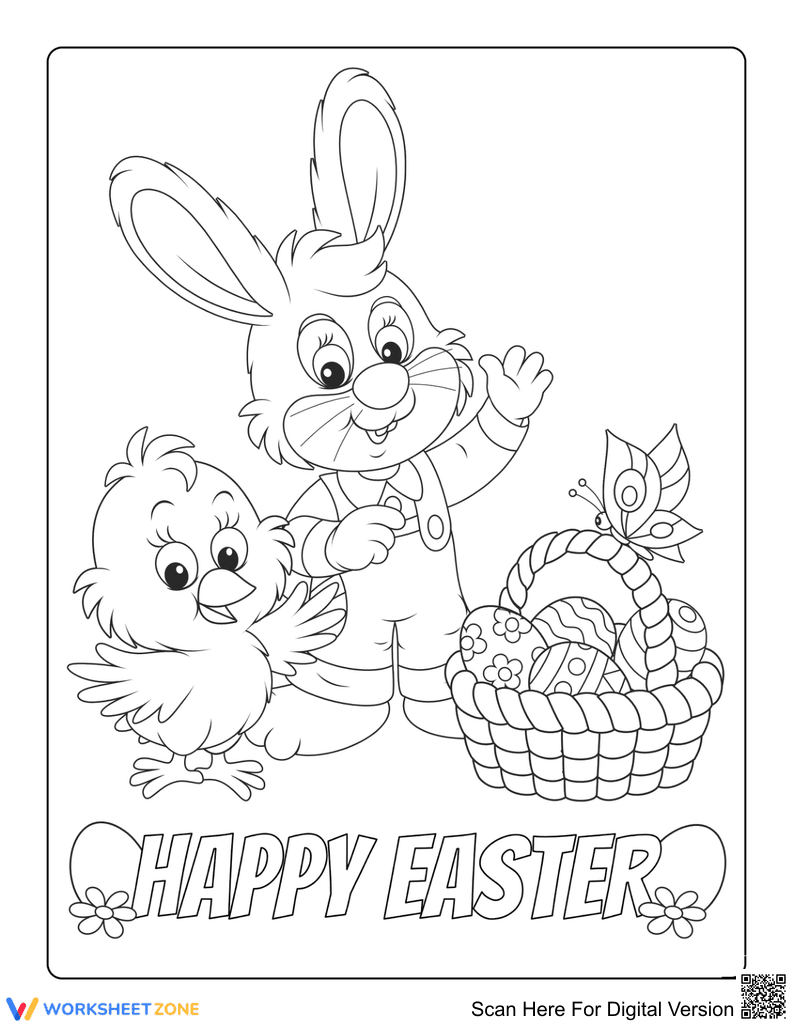

Easter Bunny and Chick Printable Coloring Page
Paste this activity's link or code into your existing LMS (Google Classroom, Canvas, Teams, Schoology, Moodle, etc.).
Students can open and work on the activity right away, with no student login required.
You'll still be able to track student progress and results from your teacher account.
This Easter Bunny and Chick coloring page provides Kindergarten students with a creative outlet to celebrate the holiday while developing essential fine motor control. By engaging with the festive imagery, learners reinforce seasonal vocabulary and hand-eye coordination. It is a perfect addition to any spring-themed classroom activity or holiday celebration.
At a Glance
- Grade: Kindergarten · Subject: English
- Standard:
CCSS.ELA-LITERACY.L.K.6— Use words and phrases acquired through conversations and responding to texts- Skill Focus: Fine Motor & Vocabulary
- Format: 1 page · 1 task · No answer key · PDF
- Best For: Morning work or holiday parties
- Time: 15–20 minutes
Inside this resource, you will find a high-quality, single-page PDF featuring a charming illustration of a bunny, a chick, and a basket of decorated eggs. The bold outlines are designed specifically for young learners, ensuring that coloring within the lines is achievable. The "Happy Easter" text provides a simple literacy connection for early readers to recognize common holiday greetings.
The zero-prep workflow for this worksheet is designed for maximum efficiency. First, print the single-page PDF (30 seconds). Second, distribute the sheets along with crayons or markers to your students (1 minute). Third, allow students to work independently while you facilitate small groups or manage administrative tasks. This makes it an ideal emergency sub plan or transition activity that requires under 2 minutes of teacher preparation.
This worksheet aligns with `CCSS.ELA-LITERACY.L.K.6`, which focuses on using words and phrases acquired through responding to texts and seasonal themes. By identifying the bunny, chick, and eggs, students practice thematic vocabulary in a meaningful context. Both standard codes can be copied directly into lesson plans, IEP goals, or district curriculum mapping tools.
Use this coloring page as a "hook" at the start of a holiday-themed literacy block or as a calming activity following recess. Teachers can use this as a formative assessment by observing pencil grip and color selection. Expect students to spend approximately 15 to 20 minutes completing the detailed illustration, allowing for a focused period of creative work.
This resource is primarily for Kindergarten and Grade 1 students, though it is suitable for any early learner needing fine motor practice. It pairs naturally with a read-aloud of an Easter-themed picture book or an anchor chart listing spring-related adjectives and nouns. It is also an excellent choice for inclusive classrooms where students benefit from tactile, visual tasks.
Research from Fisher & Frey (2014) emphasizes the importance of purposeful engagement in early childhood settings to bridge the gap between creative expression and academic readiness. This coloring worksheet supports CCSS.ELA-LITERACY.L.K.6 by providing a visual context for seasonal vocabulary acquisition. According to the NAEP, activities that integrate fine motor development with thematic content help solidify early literacy foundations in 85% of high-performing Kindergarten classrooms. By focusing on the "Happy Easter" text and the associated imagery, students move from simple recognition to active participation in holiday-themed discourse. This resource serves as a low-stakes entry point for language development, allowing educators to observe student progress in a relaxed environment. The single-page format ensures that the cognitive load remains focused on the primary skill of hand-eye coordination and vocabulary reinforcement without overwhelming the learner during the instructional day.


