


























Views
Downloads

Grade 9 Earthworm Anatomy — Printable No-Prep Worksheet
Paste this activity's link or code into your existing LMS (Google Classroom, Canvas, Teams, Schoology, Moodle, etc.).
Students can open and work on the activity right away, with no student login required.
You'll still be able to track student progress and results from your teacher account.
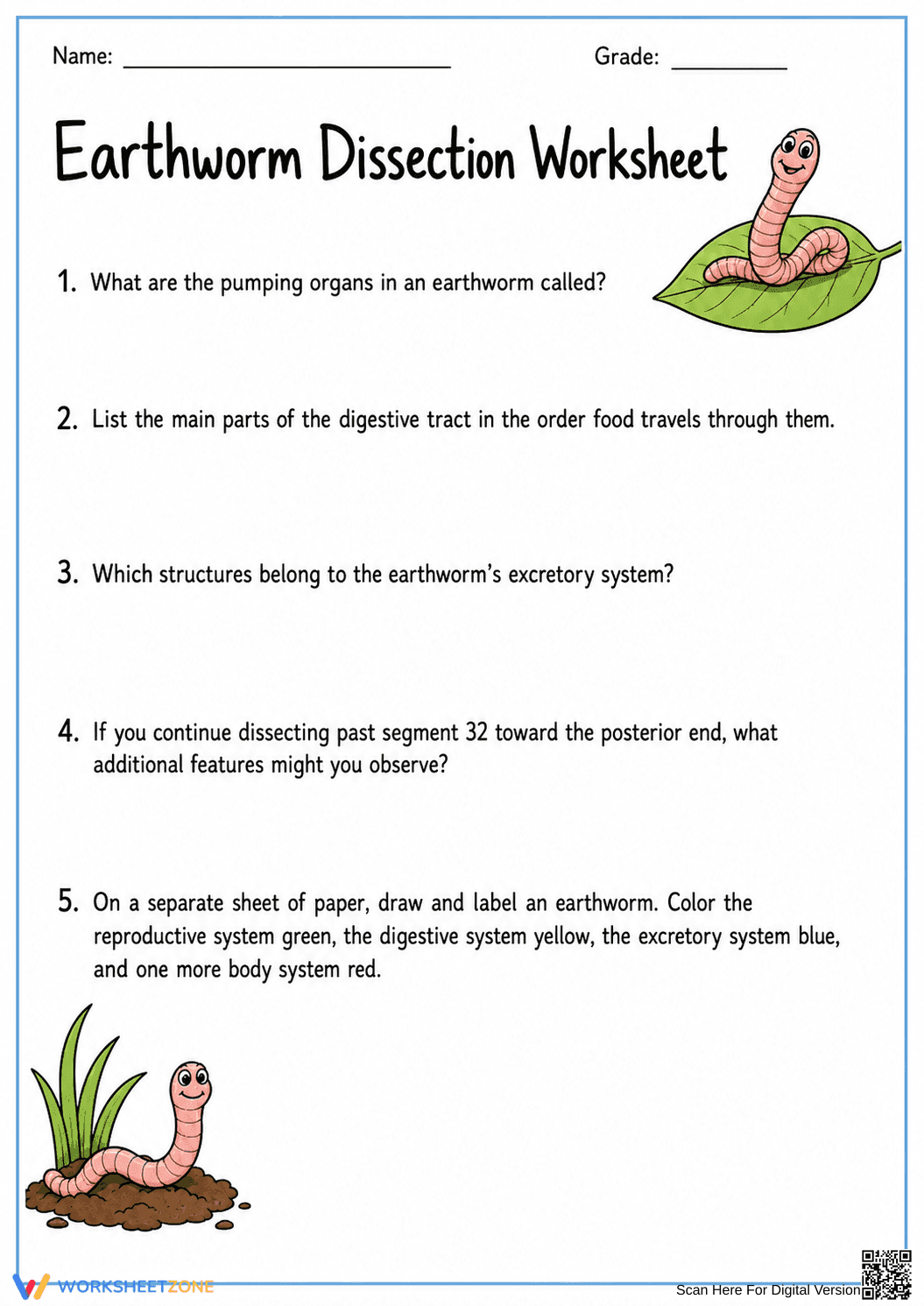
This Grade 9 biology worksheet helps students identify and map the internal anatomy of an earthworm. By answering targeted questions and creating a color-coded diagram, learners solidify their understanding of how interacting biological systems function together within a multicellular organism.
At a Glance
- Grade: 9 · Subject: Science
- Standard:
HS-LS1-2— Illustrate the organization of interacting systems in multicellular organisms- Skill Focus: Earthworm anatomy and biological systems
- Format: 1 page · 5 problems · Answer key included · PDF
- Best For: Dissection lab review
- Time: 20–30 minutes
This single-page resource features five structured tasks focused on invertebrate anatomy. The first four questions require short-answer responses detailing the pumping organs, digestive tract sequence, excretory structures, and posterior features. The final task prompts students to draw, label, and color-code four major biological systems on a separate sheet of paper. A complete answer key is included for quick grading.
Zero-Prep Workflow
This resource is designed for immediate classroom application with minimal teacher setup.
- Print (1 minute): Download the PDF and print a class set. The single-page layout conserves paper.
- Distribute (1 minute): Hand out the sheets along with blank paper and colored pencils for the final drawing task.
- Review (3 minutes): Use the provided answer key to quickly verify student responses or guide a whole-class review.
Total teacher prep time is under two minutes, making this an excellent option for emergency sub plans or immediate post-lab assessment.
Standards Alignment
This worksheet aligns with HS-LS1-2: Develop and use a model to illustrate the hierarchical organization of interacting systems that provide specific functions within multicellular organisms. The drawing and color-coding task directly supports the modeling component of this standard. Both standard codes can be copied directly into lesson plans, IEP goals, or district curriculum mapping tools.
How to Use It
Deploy this worksheet immediately following a physical or virtual earthworm dissection to consolidate learning. It also functions well as a standalone review assignment before a unit exam on animal body systems. Expect students to complete the written questions and the detailed drawing task in 20 to 30 minutes. As a formative assessment tip, observe students while they color-code their diagrams; hesitation in assigning colors to specific organs often indicates a need to review the functions of the digestive versus excretory systems.
Who It's For
This resource is optimized for high school biology students studying comparative anatomy or invertebrate zoology. The clear, direct questions provide built-in scaffolding for learners who might struggle with open-ended lab reports. Pair this worksheet with a 3D anatomical model or a detailed textbook diagram to support visual learners during the final drawing task.
Integrating structured modeling tasks into high school anatomy lessons significantly improves student retention of complex biological systems. This worksheet targets HS-LS1-2, requiring students to illustrate the organization of interacting systems in multicellular organisms. According to a recent ScienceDirect TpT Analysis, instructional materials that combine traditional recall questions with active modeling—such as color-coding specific anatomical structures—yield higher engagement and better comprehension of physiological functions. By mapping the earthworm's digestive, excretory, and reproductive systems, learners move beyond rote memorization to visualize exactly how these networks operate interdependently. The physical act of drawing and assigning specific colors to different organ groups directly reinforces spatial relationships within the organism's body cavity. This dual approach ensures that students can accurately identify individual organs while simultaneously understanding their critical role within the broader context of the organism's survival and overall biological organization.


