


























Views
Downloads
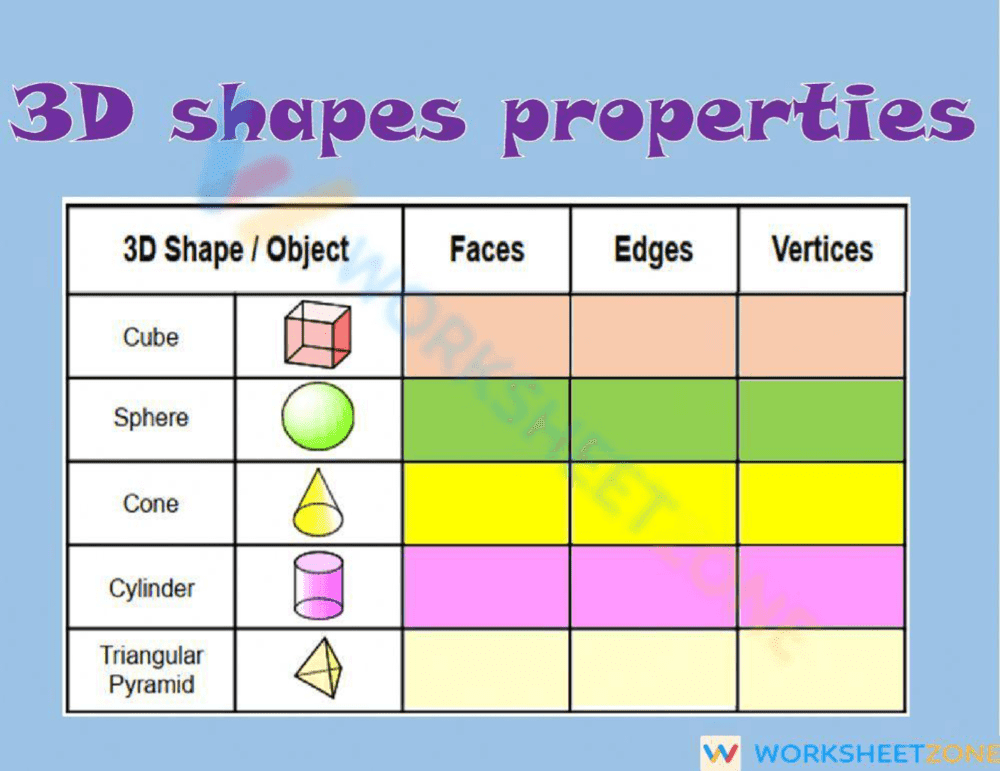

3D Shapes Properties Worksheet | Grade 2-4 Essential
Paste this activity's link or code into your existing LMS (Google Classroom, Canvas, Teams, Schoology, Moodle, etc.).
Students can open and work on the activity right away, with no student login required.
You'll still be able to track student progress and results from your teacher account.
This Grade 2-4 geometry worksheet helps students master the fundamental properties of three-dimensional solids by identifying faces, edges, and vertices. By completing the structured table, learners develop the spatial reasoning skills necessary to distinguish between different geometric figures. This resource ensures students can accurately describe the physical attributes of common objects they encounter in the real world.
At a Glance
- Grade: 2-4 · Subject: Mathematics
- Standard:
CCSS.MATH.CONTENT.2.G.A.1— Recognize and describe shapes by their specific attributes like faces and vertices- Skill Focus: 3D Shape Properties
- Format: 1 page · 15 tasks · Answer key included · PDF
- Best For: Quick formative assessment or math centers
- Time: 10–15 minutes
The worksheet features a clean, one-page table layout containing five distinct 3D shapes: a cube, sphere, cone, cylinder, and triangular pyramid. Each shape is accompanied by a clear visual illustration to assist with counting. Students are required to fill in 15 total data points across three columns, focusing on the number of faces, edges, and vertices for each object. A full answer key is provided for rapid grading.
This resource is designed for a zero-prep classroom workflow. First, print the single-page PDF for your class or small group. Second, distribute the sheets during your geometry block as a quiet independent practice activity. Finally, review the answers as a whole group to address common misconceptions, such as the lack of vertices on a sphere or the circular faces of a cylinder. This makes it an ideal sub-plan or morning work task.
This activity is directly aligned with CCSS.MATH.CONTENT.2.G.A.1, which asks students to recognize and draw shapes having specified attributes, such as a given number of equal faces. It also supports Grade 3 and 4 geometry standards by reinforcing the vocabulary needed to categorize shapes based on shared properties. These standard codes can be copied directly into lesson plans, IEP goals, or district curriculum mapping tools.
Use this worksheet as a mid-lesson check for understanding after introducing 3D solids with physical manipulatives. It also functions perfectly as a "Ticket out the Door" to assess which students can independently identify attributes. During the activity, observe if students are confusing edges with vertices, which provides a valuable formative assessment data point. Expect completion within 15 minutes.
This resource is ideal for elementary students in grades 2 through 4 who are beginning their study of solid geometry. It is particularly helpful for visual learners who benefit from seeing the shape alongside the property table. This worksheet pairs naturally with physical 3D shape blocks or a classroom anchor chart that defines faces, edges, and vertices with clear diagrams.
The CCSS.MATH.CONTENT.2.G.A.1 standard requires students to recognize and describe shapes based on specific attributes, such as the number of faces, edges, and vertices. This worksheet facilitates this by providing a structured visual table for five common 3D solids: cubes, spheres, cones, cylinders, and triangular pyramids. According to Fisher & Frey (2014), the use of graphic organizers and structured tables in mathematics helps students internalize geometric vocabulary and spatial relationships through a gradual release of responsibility. By isolating the three primary properties of three-dimensional objects, learners can build a concrete foundation for more complex volume and surface area calculations in later grades. This resource serves as a reliable tool for formative assessment, allowing educators to quickly identify misconceptions regarding curved surfaces versus flat faces. The clear layout ensures that students focus on the mathematical properties without cognitive overload, making it an effective addition to any elementary geometry unit or math center.


