


























Views
Downloads
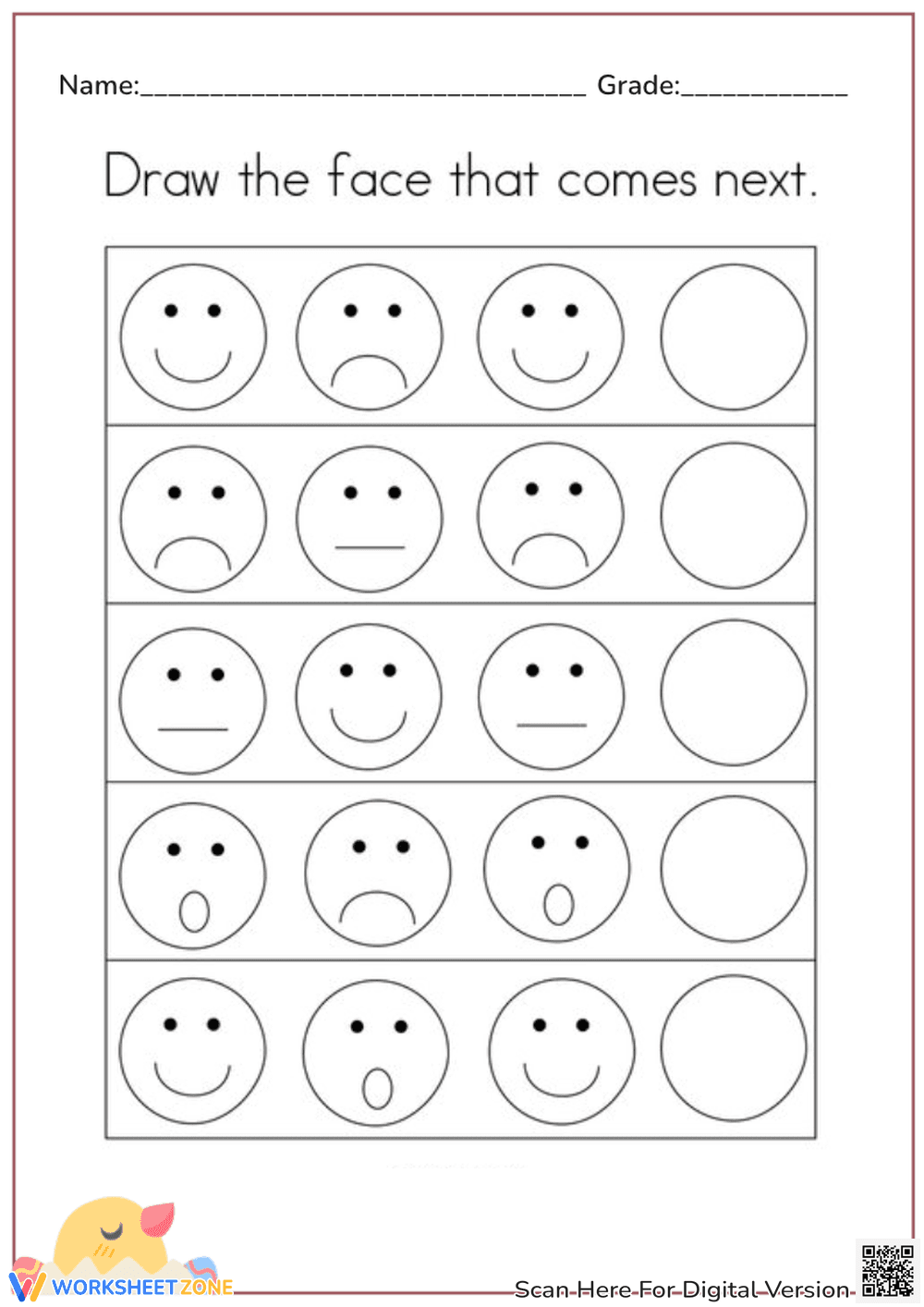

Draw The Faces Worksheet | Essential Grade K SEL
Paste this activity's link or code into your existing LMS (Google Classroom, Canvas, Teams, Schoology, Moodle, etc.).
Students can open and work on the activity right away, with no student login required.
You'll still be able to track student progress and results from your teacher account.
This Kindergarten emotion feeling worksheet helps young learners recognize and predict social-emotional patterns. By identifying facial expressions like happy, sad, and surprised, students develop both logical reasoning and emotional intelligence. It provides a clear, visual way to practice sequence completion while reinforcing the vocabulary of feelings in a structured format.
At a Glance
- Grade: Kindergarten · Subject: Behavior & Emotions
- Standard:
CCSS.MATH.CONTENT.K.MD.B.3— Classify objects and count the number of objects in categories- Skill Focus: Emotion Pattern Recognition
- Format: 1 page · 5 problems · Answer key included · PDF
- Best For: Morning work or SEL centers
- Time: 10–15 minutes
Inside this resource, you will find a single-page PDF featuring five distinct pattern rows. Each row presents a sequence of three hand-drawn facial expressions followed by an empty circle. The layout is clean and distraction-free, specifically designed for early childhood learners who are still developing fine motor skills and visual discrimination.
The zero-prep workflow is designed for busy educators. First, print the single-page PDF (30 seconds). Next, distribute the sheets to students along with pencils or crayons (1 minute). Finally, review the completed patterns as a whole group to discuss the specific emotions depicted (5 minutes). Total teacher preparation time is under 2 minutes, making this an ideal sub plan or transition activity.
This worksheet aligns with CCSS.MATH.CONTENT.K.MD.B.3, focusing on the ability to classify objects into categories—in this case, emotional expressions—and identify the repeating unit in a sequence. It also supports social-emotional learning goals regarding the identification of self and others' feelings. Both standard codes can be copied directly into lesson plans, IEP goals, or district curriculum mapping tools.
Use this worksheet during a "Feelings" unit or as a quick formative assessment after a read-aloud about emotions. It works best during independent station time where students can focus on the visual cues. Teachers should observe if students can name the emotion before drawing it to check for verbal-visual integration. Completion typically takes 10 to 15 minutes depending on drawing speed.
This resource is ideal for Preschool and Kindergarten students, including those receiving speech-language services or social skills intervention. It pairs naturally with an "Emotions Anchor Chart" or a mirror activity where students practice making the faces they see on the page. The simple black-and-white design also allows for coloring once the patterns are finished.
Research from Fisher & Frey (2014) emphasizes the importance of visual scaffolds in early childhood to bridge the gap between concrete observation and abstract reasoning. This worksheet utilizes the CCSS.MATH.CONTENT.K.MD.B.3 standard to integrate mathematical logic with social-emotional literacy. By requiring students to draw the "next" face, the task moves beyond simple identification into predictive analysis. According to the NAEP framework, early exposure to pattern recognition is a significant predictor of later success in algebraic thinking. This 5-task activity provides the necessary repetition for mastery without overwhelming the learner. The inclusion of diverse facial expressions ensures that students are practicing fine motor control alongside cognitive categorization. This dual-purpose approach is a hallmark of effective early childhood instruction, ensuring that developmental milestones are met across multiple domains simultaneously.


