


























Views
Downloads
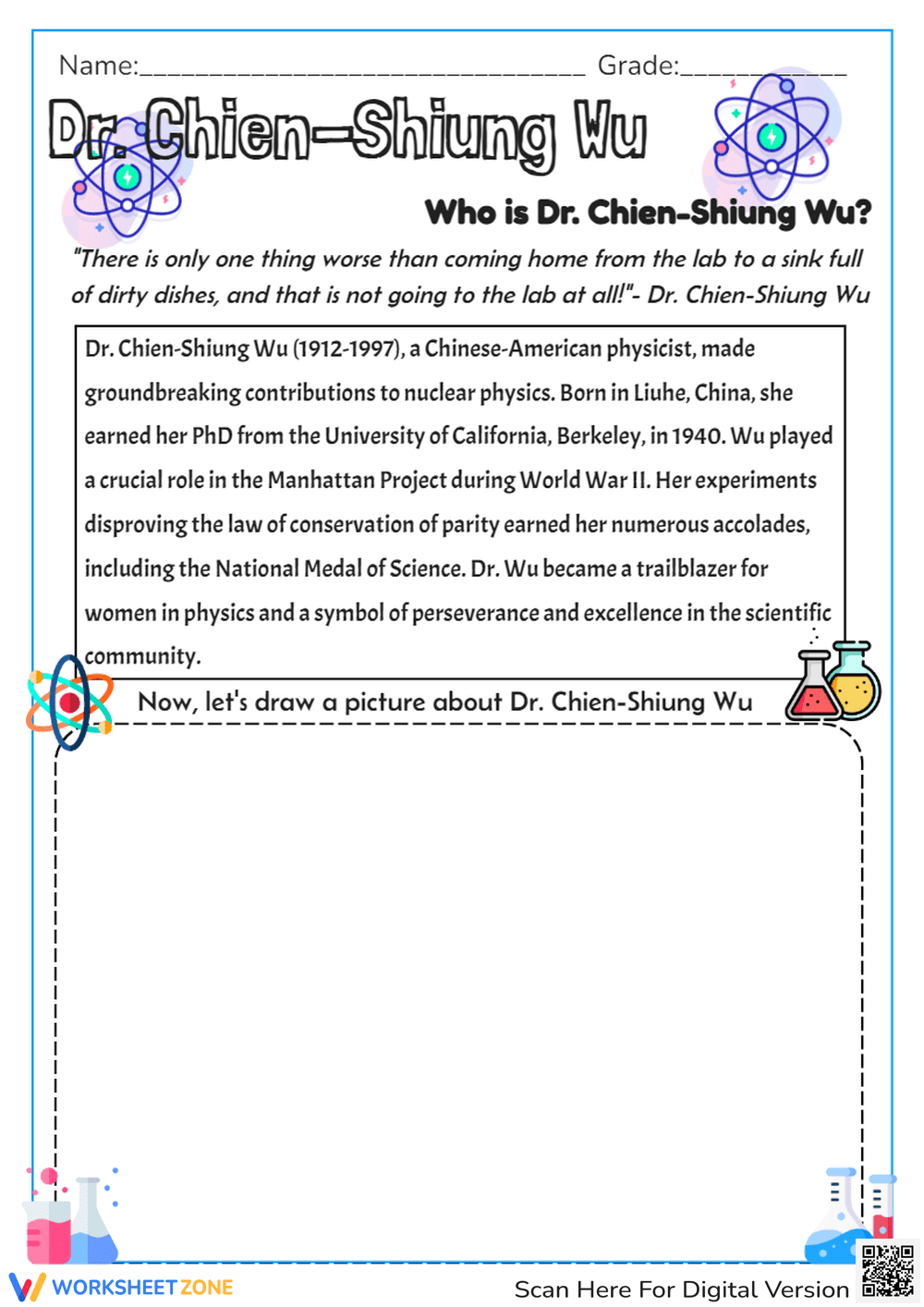

Dr. Chien-Shiung Wu Biography | Essential Grade 5-7 Science
Paste this activity's link or code into your existing LMS (Google Classroom, Canvas, Teams, Schoology, Moodle, etc.).
Students can open and work on the activity right away, with no student login required.
You'll still be able to track student progress and results from your teacher account.
This Dr. Chien-Shiung Wu biography worksheet introduces middle school students to the "First Lady of Physics" through a concise informational text and creative response prompt. Students analyze her contributions to the Manhattan Project and nuclear physics while celebrating Asian Pacific American Heritage Month. It provides an accessible entry point into the history of science.
At a Glance
- Grade: 5-7 · Subject: Science
- Standard:
CCSS.ELA-LITERACY.RI.6.1— Cite textual evidence to support analysis of what the text says explicitly- Skill Focus: Biography analysis and creative synthesis
- Format: 1 page · 1 task · No answer key required · PDF
- Best For: Asian Pacific American Heritage Month activity
- Time: 15–20 minutes
The worksheet features a high-interest biographical passage detailing Dr. Wu's journey from China to the University of California, Berkeley, and her pivotal role in the Manhattan Project. It includes an inspiring quote from the scientist and a dedicated creative space for students to illustrate her achievements. The single-page PDF layout is optimized for quick distribution and clear readability.
Zero-Prep Workflow:
- Print: Select the single-page PDF and print enough copies for your class (30 seconds).
- Distribute: Hand out the worksheets as a warm-up or transition activity (1 minute).
- Review: Facilitate a brief discussion on Dr. Wu's impact on nuclear physics and the law of conservation of parity (5 minutes).
Total teacher preparation time is under 2 minutes, making it an ideal sub plan or holiday supplement.
Standards Alignment
This resource aligns with `CCSS.ELA-LITERACY.RI.6.1`, requiring students to cite textual evidence to support their understanding of a historical figure's contributions. It also supports RI.5.3 by explaining the relationships between Dr. Wu's experiments and her recognition in the scientific community. Both standard codes can be copied directly into lesson plans, IEP goals, or district curriculum mapping tools.
How to Use It
Use this worksheet as a bell-ringer during Asian Pacific American Heritage Month to spark interest in STEM careers. It also serves as an excellent formative assessment for reading comprehension; observe how students translate the text's details into their drawings to gauge their understanding of her scientific work. Completion typically takes 15 to 20 minutes.
Who It's For
This activity is designed for Grade 5, 6, and 7 students, particularly those in general science or social studies classrooms. It is highly effective for English Language Learners (ELLs) due to the visual response component. Pair this worksheet with a short video clip of the Manhattan Project or an anchor chart featuring famous women in science.
According to Fisher & Frey (2014), integrating literacy with creative expression helps middle school students synthesize complex informational texts more effectively. This worksheet focuses on the standard CCSS.ELA-LITERACY.RI.6.1, which emphasizes citing evidence from a text to support analysis. By reading about Dr. Chien-Shiung Wu, students engage with the plain-English skill of identifying key scientific contributions and personal perseverance within a historical context. The inclusion of a drawing prompt allows for a non-linguistic representation of knowledge, a strategy proven to increase retention in diverse learners. This resource provides a structured yet flexible way to meet curriculum requirements while honoring the diversity of the scientific community. It is a practical tool for teachers looking to bridge the gap between science history and reading proficiency without extensive preparation or specialized materials.


