


























Views
Downloads
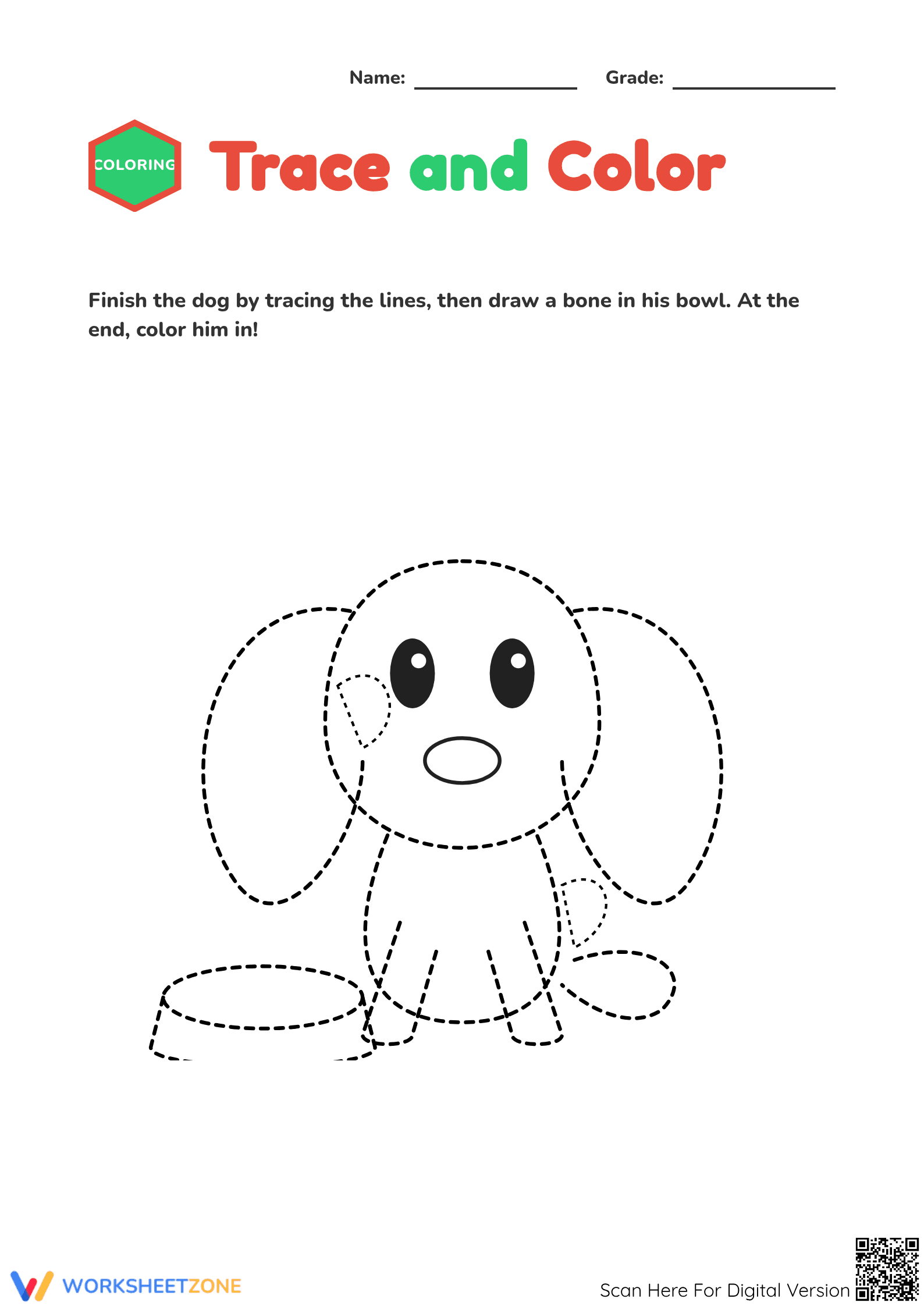

Printable Doggie Trace and Color Worksheet | Preschool ELA
Paste this activity's link or code into your existing LMS (Google Classroom, Canvas, Teams, Schoology, Moodle, etc.).
Students can open and work on the activity right away, with no student login required.
You'll still be able to track student progress and results from your teacher account.
This Preschool Doggie Trace and Color worksheet provides an engaging way for early learners to develop essential pre-writing skills. By following the dashed lines to complete the puppy illustration, students strengthen the small muscles in their hands required for future handwriting success. This activity transforms foundational motor practice into a creative and enjoyable artistic experience.
At a Glance
- Grade: Preschool · Subject: Early Literacy
- Standard:
CCSS.ELA-LITERACY.L.PK.1— Use fine motor skills to control writing tools and follow lines- Skill Focus: Fine motor control and tracing
- Format: 1 page · 3 tasks · No answer key needed · PDF
- Best For: Independent morning work or literacy centers
- Time: 10–15 minutes
This single-page PDF features a large, clear illustration of a puppy composed of dashed lines. The worksheet includes three distinct instructional prompts: tracing the dog's outline, drawing a bone in the provided bowl, and coloring the completed image. The minimalist design ensures that young children can focus entirely on their hand-eye coordination without visual distractions.
Zero-Prep Workflow
The zero-prep design allows for immediate classroom implementation. First, print the single-page PDF (30 seconds). Next, distribute the sheets along with crayons or markers to your students (1 minute). Finally, observe as students engage with the tracing task, providing verbal encouragement as they navigate the curves of the dog’s ears and tail. This is an ideal resource for emergency sub plans or quiet-time transitions.
Standards Alignment
This resource aligns with `CCSS.ELA-LITERACY.L.PK.1`, which focuses on the conventions of standard English, including the physical development necessary for writing. By practicing line following and grip control, students build the foundational strength required for letter formation. This standard code can be copied directly into lesson plans, IEP goals, or district curriculum mapping tools.
How to Use It
Use this worksheet during a "Pet" themed unit or as a warm-up activity before a formal writing lesson. It serves as an excellent formative assessment tool; teachers can observe a student's pencil grip and their ability to stay on the dashed lines to gauge motor development. Expect most preschoolers to spend 10 to 15 minutes completing all three tasks.
Who It's For
This activity is designed for preschoolers and early kindergarteners who are beginning to explore writing tools. It is particularly beneficial for students needing extra support with hand strength or those who enjoy kinesthetic learning. Pair this worksheet with a picture book about dogs or a tactile sand-tracing activity for a comprehensive literacy experience.
According to the Fisher & Frey (2014) framework for gradual release of responsibility, providing structured motor tasks like tracing allows young learners to build the "muscle memory" necessary for complex cognitive tasks later in their education. Research from the RAND AIRS 2024 report emphasizes that early childhood literacy is deeply intertwined with physical development; specifically, the ability to manipulate writing instruments is a significant predictor of later academic achievement. This worksheet addresses CCSS.ELA-LITERACY.L.PK.1 by offering a low-stakes, high-engagement environment for students to practice line following and spatial awareness. By integrating drawing and coloring with tracing, the resource ensures that fine motor practice remains developmentally appropriate and motivating. Educators can utilize this tool to bridge the gap between free-form drawing and formal letter construction, ensuring that every child develops the hand control required for the rigors of the primary grade curriculum.


