


























Views
Downloads
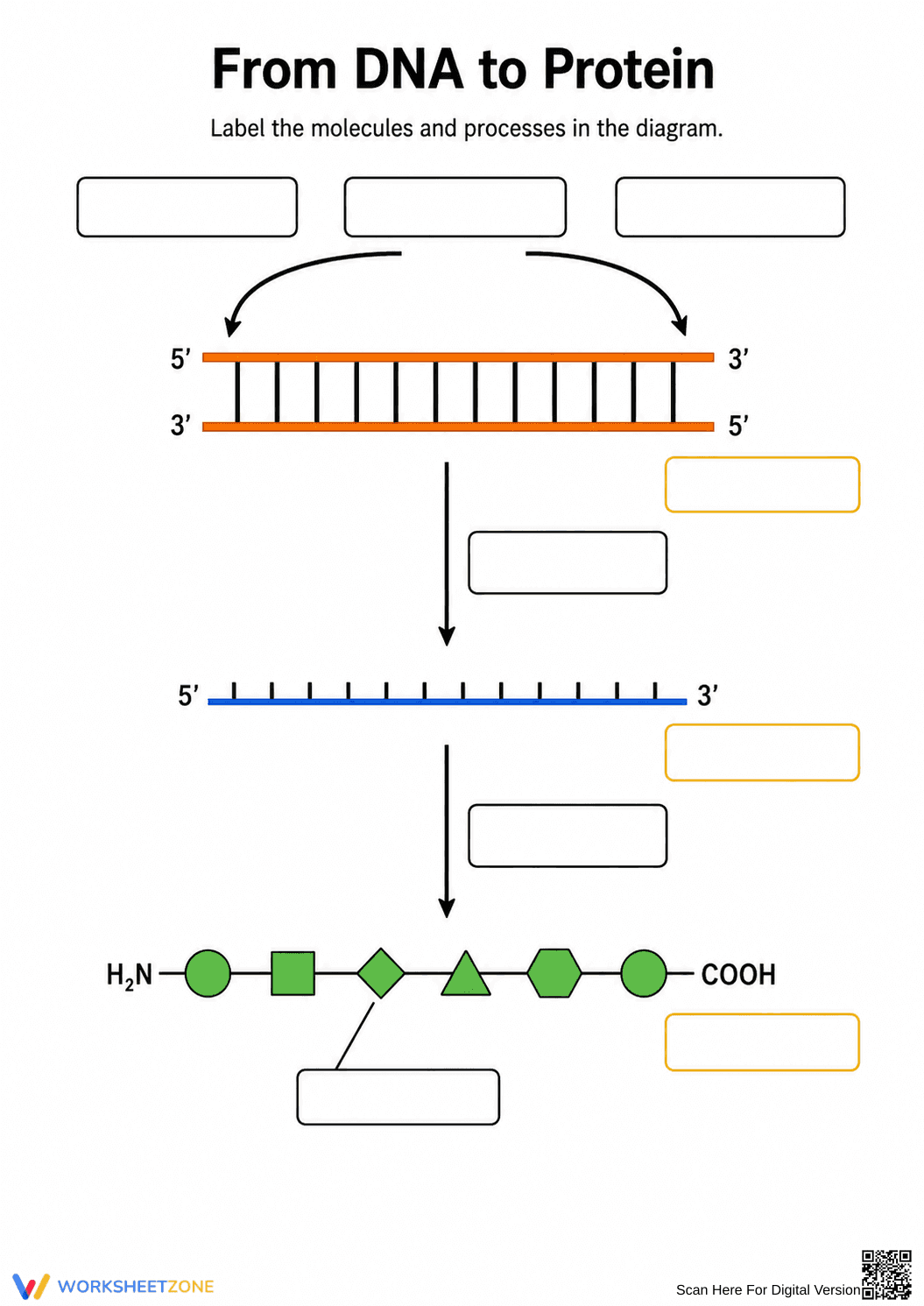

Grade 9 DNA to Protein — Printable No-Prep Worksheet
Paste this activity's link or code into your existing LMS (Google Classroom, Canvas, Teams, Schoology, Moodle, etc.).
Students can open and work on the activity right away, with no student login required.
You'll still be able to track student progress and results from your teacher account.
This high school biology worksheet provides students with a clear visual framework to map the central dogma of molecular biology. By labeling the molecules and processes involved in converting genetic information from DNA to RNA to protein, learners solidify their understanding of transcription and translation mechanisms.
At a Glance
- Grade: 9 · Subject: Biology
- Standard:
HS-LS1-1— Explain how DNA structure determines protein structure- Skill Focus: Labeling transcription and translation
- Format: 1 page · 8 problems · Answer key included · PDF
- Best For: Independent practice or review
- Time: 10–15 minutes
Inside this resource, educators will find a single-page diagram featuring eight targeted labeling tasks. Students must identify key molecules, including the double-stranded DNA, single-stranded RNA, and the resulting polypeptide chain. The visual layout also requires learners to pinpoint where replication, transcription, and translation occur, complete with 5' to 3' directional cues and structural endpoints like the amino and carboxyl groups. A comprehensive answer key is provided for immediate grading.
- Print (1 minute): Generate enough copies of the single-page diagram for your entire roster.
- Distribute (1 minute): Hand out the assignment as a bell-ringer or immediate follow-up to your genetics lecture.
- Review (3 minutes): Display the answer key on your smartboard to allow students to self-correct their molecular labels.
Total teacher preparation requires under two minutes, making this an ideal, self-explanatory activity for emergency substitute plans or quick formative checks.
Aligned to HS-LS1-1, this activity supports the directive to "construct an explanation based on evidence for how the structure of DNA determines the structure of proteins which carry out the essential functions of life through systems of specialized cells." It reinforces the foundational vocabulary needed to master complex genetic expression concepts. Both standard codes can be copied directly into lesson plans, IEP goals, or district curriculum mapping tools.
Deploy this diagram during direct instruction as a guided note-taking tool, allowing students to fill in the blanks as you explain the central dogma. Alternatively, assign it as a brief formative assessment after completing the transcription and translation unit. While students work, observe whether they correctly distinguish between the processes of transcription (DNA to RNA) and translation (RNA to protein), which is a common misconception. Expect completion within 10 to 15 minutes.
This resource is designed for high school biology students encountering molecular genetics for the first time. The clear, uncluttered visual format provides built-in scaffolding for visual learners and English Language Learners who might struggle with dense textbook descriptions. Pair this diagram with a 3D molecular modeling activity or an interactive digital simulation of protein synthesis to reinforce the concepts.
Mastering the central dogma requires students to accurately explain how DNA structure determines protein structure, a core competency outlined in HS-LS1-1. Research indicates that using explicit visual models significantly improves comprehension of unobservable cellular processes. According to a ScienceDirect TpT Analysis, students who engage with structured diagram-labeling activities demonstrate higher retention rates when transitioning from abstract genetic concepts to concrete molecular mechanisms. By requiring learners to actively map the directional flow of genetic information—from replication through transcription and translation—this exercise bridges the gap between rote memorization and conceptual understanding. The visual spatial arrangement of the 5' and 3' ends alongside the amino acid chain provides critical context cues that reduce cognitive load, allowing students to focus on the sequential logic of protein synthesis.


