


























Views
Downloads
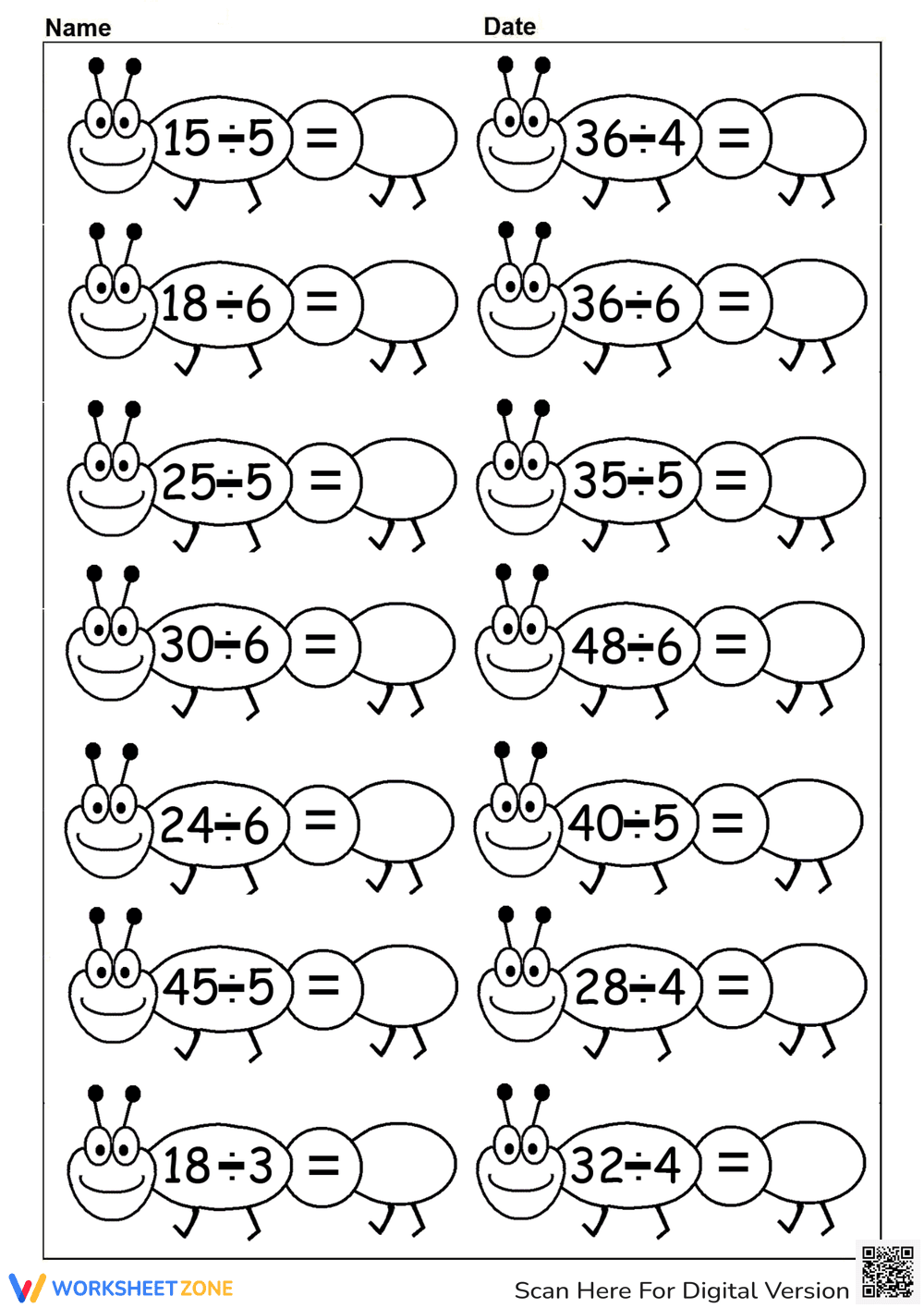

Division Facts Worksheet | Grade 3-5 Essential
Paste this activity's link or code into your existing LMS (Google Classroom, Canvas, Teams, Schoology, Moodle, etc.).
Students can open and work on the activity right away, with no student login required.
You'll still be able to track student progress and results from your teacher account.
This Grade 3-5 division facts worksheet helps students master basic quotient recall through 14 engaging, ant-themed problems. By focusing on mental math strategies and fluency, students build the foundational speed necessary for long division and multi-step word problems. It provides a clear, distraction-free layout for independent practice or quick assessment.
At a Glance
- Grade: 3-5 · Subject: Math
- Standard:
CCSS.MATH.CONTENT.3.OA.C.7— Fluently divide within 100 using strategies such as the relationship between multiplication and division- Skill Focus: Basic division facts fluency
- Format: 1 page · 14 problems · Answer key included · PDF
- Best For: Morning work or quick math warm-ups
- Time: 10–15 minutes
Inside this resource, you will find a single-page PDF featuring 14 division problems presented within a friendly ant graphic. The problems focus on divisors 3 through 6, targeting the "sweet spot" of mid-range fact fluency. The worksheet includes a dedicated space for name and date, along with a comprehensive answer key for rapid grading and immediate student feedback.
The zero-prep workflow for this resource is designed for maximum efficiency. First, print the single-page PDF (30 seconds). Next, distribute the sheets to your students as they enter the room or transition between subjects (1 minute). Finally, use the included answer key to review results or facilitate peer-grading (2 minutes). This makes it an ideal choice for unexpected sub plans or emergency math fillers.
This worksheet is specifically aligned to `CCSS.MATH.CONTENT.3.OA.C.7`, which requires students to fluently multiply and divide within 100. It also supports 4th and 5th-grade remediation for students who need to strengthen their mental math foundations before tackling fractions or decimals. This standard code can be copied directly into lesson plans, IEP goals, or district curriculum mapping tools.
Use this worksheet as a "Mad Minute" style timed challenge to build automaticity during your math block. Alternatively, assign it as a formative assessment after a lesson on the relationship between multiplication and division. Observe if students are counting on their fingers or using known multiplication facts to find the quotients in under 15 minutes to gauge their current mastery level.
This resource is designed for general education students in Grade 3, as well as Grade 4 and 5 students requiring Tier 2 intervention for math fluency. It pairs naturally with division flashcards or a multiplication chart anchor chart for students who are still developing their recall speed. The visual ant theme provides a non-threatening entry point for learners who struggle with math anxiety.
According to the RAND AIRS 2024 report, consistent practice with basic arithmetic facts is a significant predictor of success in higher-level algebraic reasoning. This worksheet targets CCSS.MATH.CONTENT.3.OA.C.7 by providing 14 focused opportunities for students to practice division within 100. By isolating the operation of division, students can focus on the inverse relationship with multiplication without the cognitive load of complex word problems. Research from Fisher & Frey (2014) emphasizes that "distributed practice"—short, frequent sessions of skill reinforcement—is more effective for long-term retention than massed practice. This printable resource facilitates that instructional model by offering a high-utility, low-stakes environment for mastery. Educators can use the results to identify specific fact families that require additional direct instruction, ensuring that every student reaches the fluency benchmarks required for upper elementary mathematics and beyond.


