


























Views
Downloads

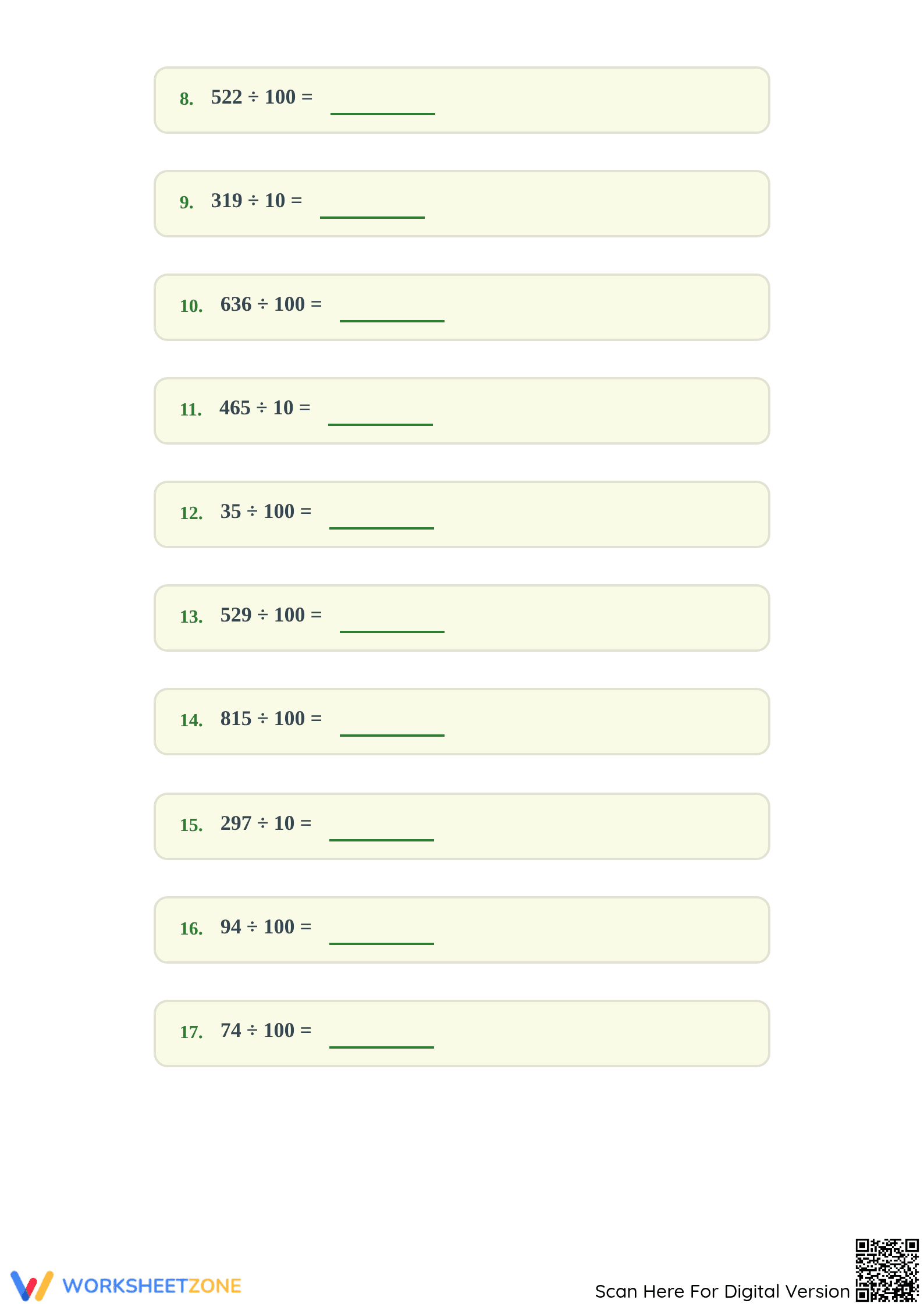


Printable Dividing by 10 and 100 Worksheet | Grade 4 Math
Paste this activity's link or code into your existing LMS (Google Classroom, Canvas, Teams, Schoology, Moodle, etc.).
Students can open and work on the activity right away, with no student login required.
You'll still be able to track student progress and results from your teacher account.
This Grade 4 math worksheet helps students master the essential skill of dividing by powers of ten. By shifting decimal points to the left, learners develop the fluency required for advanced mental math and scientific notation. Students will solve equations, compare values, and complete sequences to solidify their understanding of place value relationships and base-ten patterns.
At a Glance
- Grade: 4 · Subject: Math
- Standard:
CCSS.MATH.CONTENT.5.NBT.A.2— Explain decimal point placement when dividing a number by a power of 10- Skill Focus: Decimal placement fluency
- Format: 4 pages · 38 problems · Answer key included · PDF
- Best For: Independent practice and decimal placement drills
- Time: 20–30 minutes
This comprehensive four-page practice pack contains 38 unique tasks designed to build confidence in decimal division. It features 20 "Quick Calculations" for rapid-fire practice, a comparison section to challenge number sense, and two "Decimal Sequences" that require multi-step processing. The final page includes a structured division table to help students organize their work and visualize the patterns in place value shifts across different magnitudes.
Zero-Prep Workflow
This resource is designed for immediate classroom implementation with a total teacher prep time of less than 2 minutes. Follow these three simple steps to integrate it into your lesson:
- Print: Select the pages you need and print enough copies for your group in seconds.
- Distribute: Hand out the worksheets as a warm-up, sub plan, or independent station activity.
- Review: Use the included answer key for quick self-correction or whole-group verification of decimal placement.
The primary focus of this worksheet is CCSS.MATH.CONTENT.5.NBT.A.2, which requires students to explain patterns in the placement of the decimal point when a decimal is multiplied or divided by a power of 10. While often used for Grade 4, it serves as an excellent bridge to middle school math standards. This standard code can be copied directly into lesson plans, IEP goals, or district curriculum mapping tools.
Use this worksheet during the independent practice phase of a gradual release model to monitor student mastery of decimal shifts. It is particularly effective as a formative assessment after teaching the "left-shift" rule for division. Set a timer for the first 20 problems to encourage automaticity, and observe students during the comparison challenge to identify common misconceptions regarding decimal magnitudes. Expected completion typically takes 25 minutes.
This resource is ideal for Grade 4 and Grade 5 students who are developing their base-ten fluency. It provides necessary scaffolds for learners who struggle with place value and extension opportunities for younger students who are ready for advanced concepts. Pair this worksheet with a place value slider or decimal anchor chart to support visual learners during the sequence and table sections of the activity.
Mathematical fluency with powers of ten serves as a critical gateway to algebraic reasoning and scientific literacy. According to the ScienceDirect TpT Analysis, students who demonstrate proficiency in shifting decimal points by powers of ten show significantly higher success rates in 6th-grade ratio and proportion units. This worksheet aligns with CCSS.MATH.CONTENT.5.NBT.A.2 by providing the repetitive, structured practice required to move decimal placement from a conscious procedure to an automatic skill. By engaging with 38 varied tasks—including tables and comparison logic—students internalize the relationship between division and place value reduction. Research indicates that frequent, short-burst drills on these foundational base-ten patterns reduce cognitive load during more complex multi-step operations in upper elementary grades. This resource ensures that learners have the procedural consistency needed to accurately predict and verify quotients without over-reliance on calculators.


