


























0
Views
0
Downloads

Save
0 Likes
Share
Direct and Indirect Characterization: Analyzing Characters
0 Views
0 Downloads
Paste this activity's link or code into your existing LMS (Google Classroom, Canvas, Teams, Schoology, Moodle, etc.).
Students can open and work on the activity right away, with no student login required.
You'll still be able to track student progress and results from your teacher account.
Information
Description
What It Is:
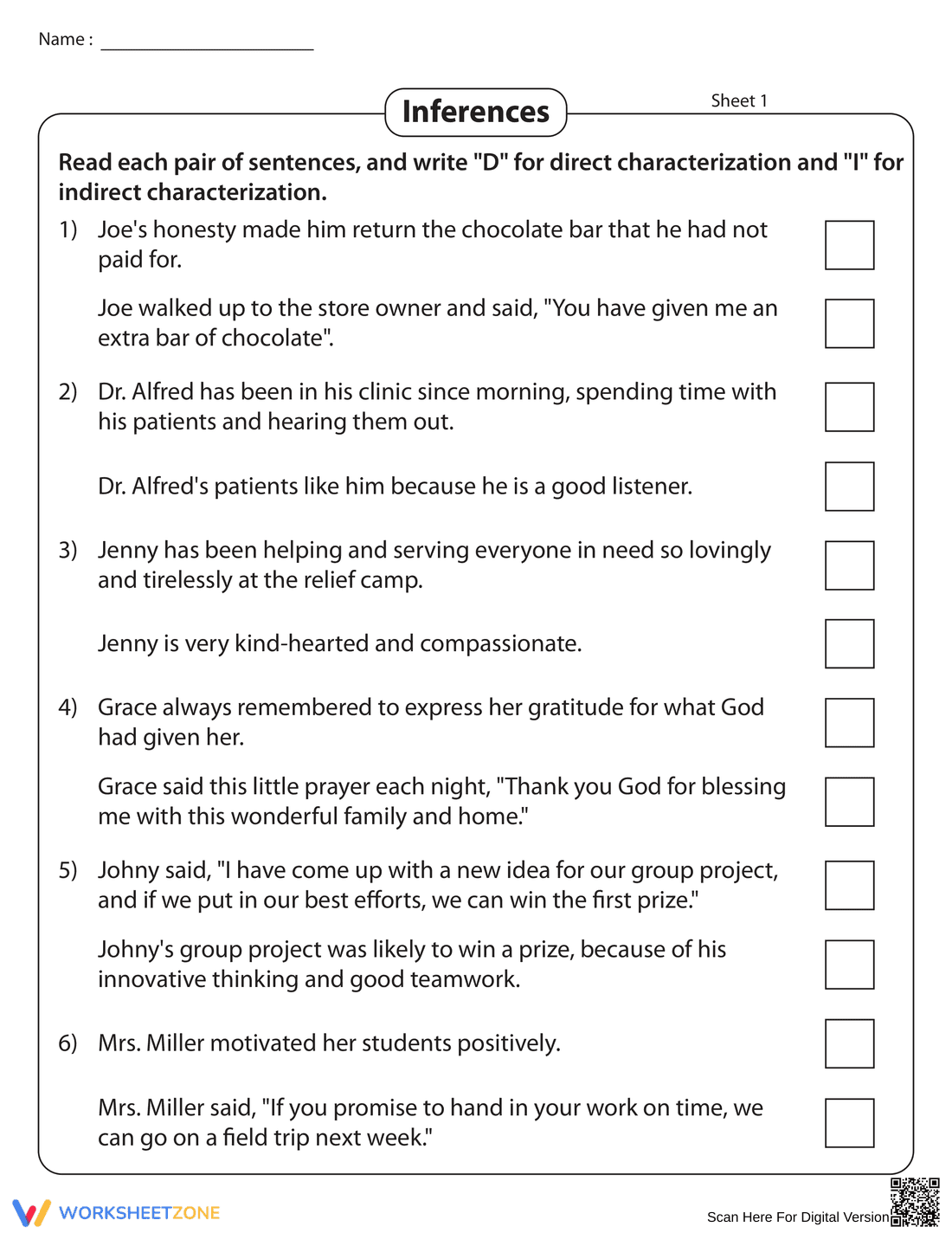
This is an educational worksheet focusing on direct versus indirect characterization. The worksheet presents six pairs of sentences. For each pair, students must determine which sentence uses direct characterization and which uses indirect characterization, marking 'D' for direct and 'I' for indirect in the provided boxes. Examples include scenarios involving honesty, helpfulness, gratitude, and motivation.
Grade Level Suitability:
This worksheet is suitable for grades 6-8. The content requires understanding of literary devices and the ability to analyze sentence structure and meaning, which are skills typically developed in middle school.
Why Use It:
This worksheet helps students develop critical reading skills and improve their understanding of character development in literature. It reinforces the difference between explicitly stating a character's traits (direct characterization) and revealing them through actions, dialogue, and thoughts (indirect characterization). This improves reading comprehension and analytical abilities.
How to Use It:
Students should read each pair of sentences carefully. They must decide which sentence directly describes a character trait and which implies the trait through actions or dialogue. They then write 'D' in the box next to the sentence using direct characterization and 'I' next to the sentence using indirect characterization.
Target Users:
This worksheet is ideal for middle school students, English language arts teachers, and homeschooling parents who want to reinforce literary concepts and improve reading comprehension skills. It can be used for classroom activities, homework assignments, or independent practice.
This is an educational worksheet focusing on direct versus indirect characterization. The worksheet presents six pairs of sentences. For each pair, students must determine which sentence uses direct characterization and which uses indirect characterization, marking 'D' for direct and 'I' for indirect in the provided boxes. Examples include scenarios involving honesty, helpfulness, gratitude, and motivation.
Grade Level Suitability:
This worksheet is suitable for grades 6-8. The content requires understanding of literary devices and the ability to analyze sentence structure and meaning, which are skills typically developed in middle school.
Why Use It:
This worksheet helps students develop critical reading skills and improve their understanding of character development in literature. It reinforces the difference between explicitly stating a character's traits (direct characterization) and revealing them through actions, dialogue, and thoughts (indirect characterization). This improves reading comprehension and analytical abilities.
How to Use It:
Students should read each pair of sentences carefully. They must decide which sentence directly describes a character trait and which implies the trait through actions or dialogue. They then write 'D' in the box next to the sentence using direct characterization and 'I' next to the sentence using indirect characterization.
Target Users:
This worksheet is ideal for middle school students, English language arts teachers, and homeschooling parents who want to reinforce literary concepts and improve reading comprehension skills. It can be used for classroom activities, homework assignments, or independent practice.


