


























Views
Downloads
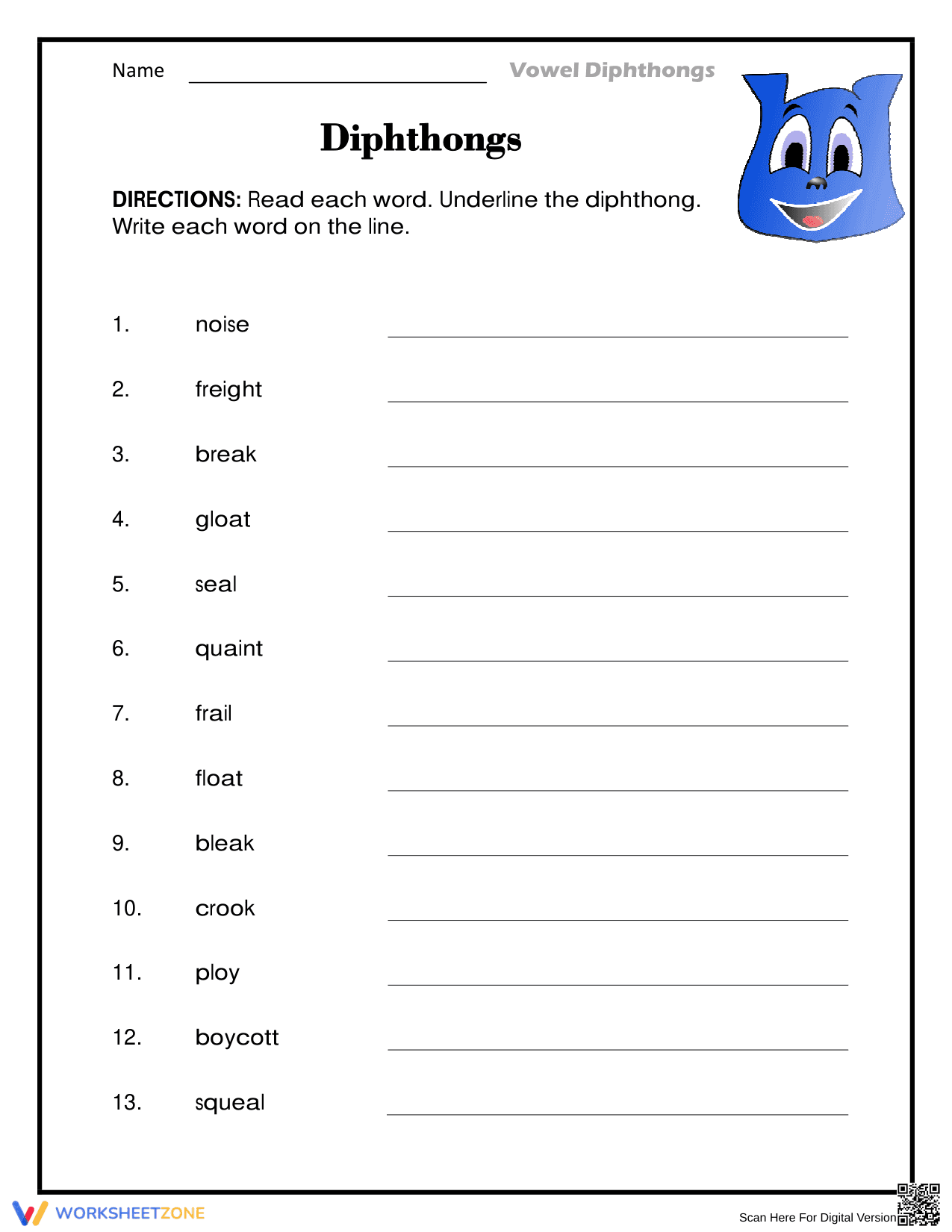

Essential Diphthongs Worksheet | Grade 2 Phonics Practice
Paste this activity's link or code into your existing LMS (Google Classroom, Canvas, Teams, Schoology, Moodle, etc.).
Students can open and work on the activity right away, with no student login required.
You'll still be able to track student progress and results from your teacher account.
Vowel diphthongs are a challenging phonetic concept for young readers, but this focused worksheet makes identification and spelling intuitive. Students practice recognizing complex vowel sounds within 13 targeted words, reinforcing the connection between visual patterns and auditory output. Learners solidify their phonemic awareness and improve orthographic mapping for consistent spelling success.
At a Glance
- Grade: 2 · Subject: English Language Arts
- Standard:
CCSS.ELA-LITERACY.RF.2.3.B— Know spelling-sound correspondences for additional common vowel teams and diphthongs- Skill Focus: Vowel Diphthong Identification
- Format: 1 page · 13 problems · Answer key included · PDF
- Best For: Independent phonics practice and spelling reinforcement
- Time: 10–15 minutes
This resource contains a single page of intensive phonics practice focusing on common vowel diphthongs. The layout includes 13 distinct vocabulary words such as "noise," "freight," and "quaint." Students interact with the text twice: first by locating and underlining the vowel team, and then by handwriting the word to reinforce memory.
Skill Progression
- Guided practice: The initial section allows teachers to model the first two examples ("noise" and "freight") together with the class to establish the underlining and rewriting pattern.
- Supported practice: The middle set of words offers familiar vocabulary where students can apply their understanding with minimal teacher intervention.
- Independent practice: The final items, including complex words like "boycott," require students to independently synthesize their phonetic knowledge.
This worksheet follows a gradual-release model, moving from teacher-led modeling to independent mastery of vowel team recognition.
Standards Alignment
The primary focus is CCSS.ELA-LITERACY.RF.2.3.B, requiring students to know spelling-sound correspondences for vowel teams. By targeting diphthongs—vowels that slide from one sound to another—the activity ensures students decode complex words accurately. This standard code can be copied directly into lesson plans, IEP goals, or district curriculum mapping tools to track student progress toward foundational literacy benchmarks.
How to Use It
Use this worksheet as a formative assessment during a phonics unit. It serves as an excellent Exit Ticket to gauge which students struggle to distinguish between vowels and diphthongs. Teachers should observe whether students identify the vowel team without vocalizing, indicating high orthographic awareness. Expected completion time is 10 to 15 minutes for most Grade 2 learners in a standard classroom.
Who It's For
This resource is designed for Grade 2 students transitioning from basic CVC words to complex vowel patterns. It is also suitable for Grade 3 students requiring remedial spelling support or English Language Learners focusing on American English pronunciation. Pair this worksheet with a diphthong anchor chart or a reading passage that features these specific words to provide meaningful instructional context.
Phonological awareness is a primary predictor of reading success in early childhood. According to Fisher & Frey (2014), the gradual release of responsibility—moving from teacher modeling to independent practice—is essential for students to internalize complex phonetic rules like those governing vowel diphthongs. This worksheet aligns with CCSS.ELA-LITERACY.RF.2.3.B by requiring students to actively identify and reproduce vowel teams in 13 unique contexts. Research in NAEP reports highlights that students who master orthographic mapping early in second grade demonstrate higher reading fluency scores by mid-elementary school. By combining visual identification with kinesthetic reinforcement, this resource targets multiple learning modalities to ensure that vowel sound correspondences move to long-term phonetic storage. This allows for more efficient decoding during the reading of complex informational texts and literature, providing a stable foundation for students as they encounter increasingly difficult academic vocabulary in higher grades.


