


























Views
Downloads

Grade 1-2 Dinosaur Names — Printable No-Prep Worksheet
Paste this activity's link or code into your existing LMS (Google Classroom, Canvas, Teams, Schoology, Moodle, etc.).
Students can open and work on the activity right away, with no student login required.
You'll still be able to track student progress and results from your teacher account.
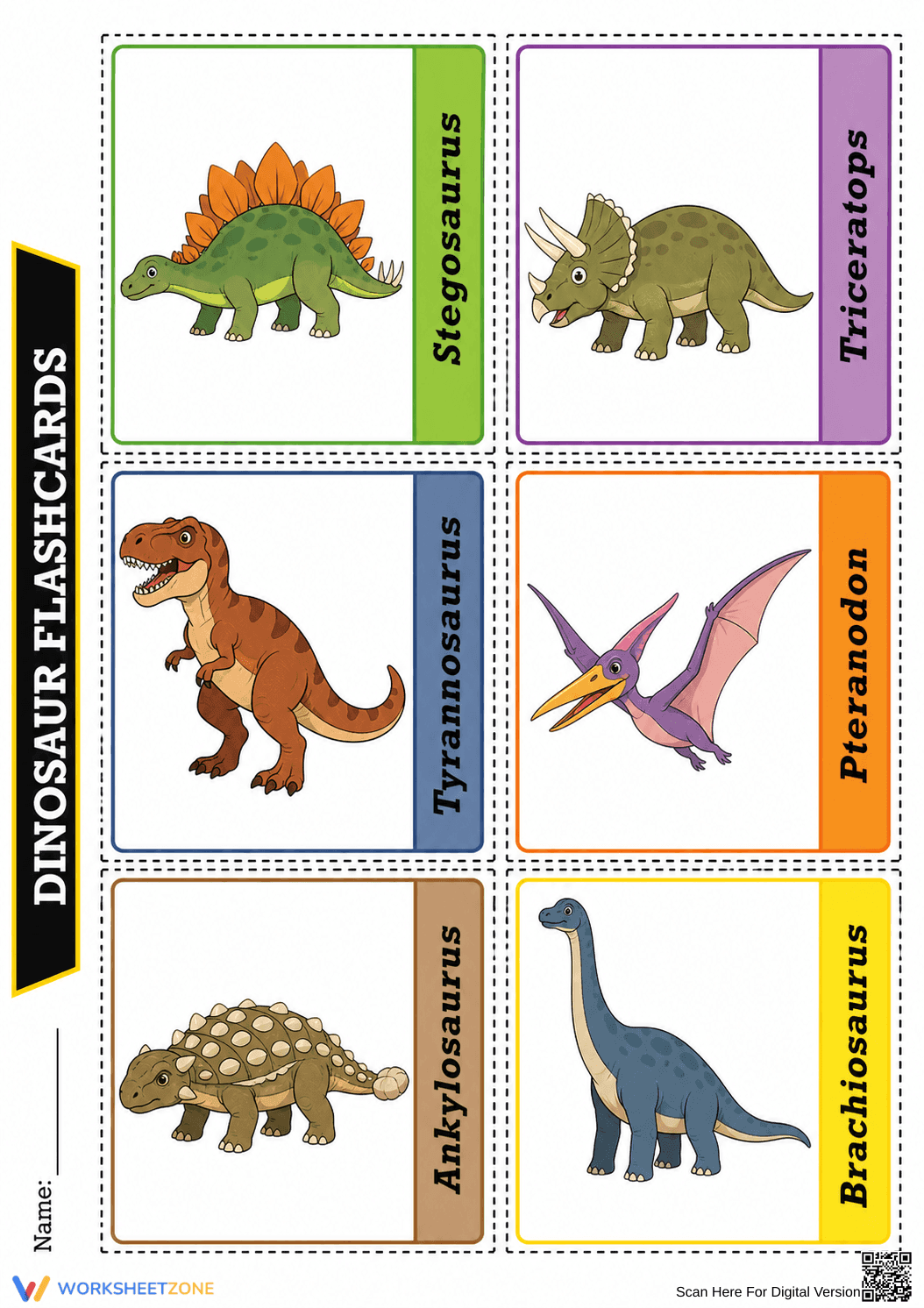
These printable dinosaur flashcards provide an immediate, visual way for young learners to master the scientific names of prehistoric creatures. By pairing vibrant illustrations with clear text, students develop vocabulary and classification skills essential for early science. This resource simplifies the introduction of paleontology, ensuring students can confidently identify diverse species.
At a Glance
- Grade: 1–2 · Subject: Science
- Standard:
2-LS4-1— Make observations of plants and animals to compare the diversity of life- Skill Focus: Dinosaur identification and vocabulary
- Format: 1 page · 6 cards · No answer key · PDF
- Best For: Science centers and vocabulary building
- Time: 10–15 minutes
What's Inside
This single-page PDF features six distinct, color-coded dinosaur flashcards. Each card includes a high-quality illustration of a dinosaur, such as the Brachiosaurus, Triceratops, and Pteranodon, alongside its scientific name in a legible font. The layout is optimized for quick printing and cutting, with dashed lines provided for uniform card sizes. No extra materials are required to begin using these visual aids in the classroom.
Zero-Prep Workflow
The zero-prep design allows teachers to implement this activity in under two minutes. Step one: Print the sheet on standard paper or cardstock for durability (30 seconds). Step two: Distribute the page to students or an assistant for quick cutting along the marked borders (1 minute). Step three: Review the pronunciations of the six scientific names during a transition (30 seconds). This process makes it an ideal choice for sudden sub plans or quick science center rotations.
Standards Alignment
This resource aligns primarily with 2-LS4-1, which requires students to make observations of plants and animals to compare the diversity of life in different habitats. By identifying the unique physical characteristics of different dinosaurs, students engage with core concepts of biological diversity. Both standard codes can be copied directly into lesson plans, IEP goals, or district curriculum mapping tools.
How to Use It
Use these cards during the engage phase of a science lesson to spark curiosity about prehistoric life before direct instruction. They also function as a formative assessment tool: ask students to group cards by physical traits, such as long necks or horns, and observe their reasoning. Most students will complete the identification and sorting activity within 15 minutes, making it a perfect supplement to a broader unit on fossils or habitats.
Who It's For
This resource is designed for Grade 1 and Grade 2 students exploring life science and animal classification. It is particularly effective for visual learners and English Language Learners who benefit from pairing images with technical vocabulary. It naturally pairs with a dinosaur-themed reading passage or an anchor chart describing prehistoric periods. This resource supports inclusive classrooms by providing clear, visual-first educational content.
Visual aids such as flashcards are essential for scaffolding scientific vocabulary in the early elementary grades. According to Fisher & Frey (2014), the use of intentional visual supports during instruction significantly improves a student's ability to retain and retrieve technical terms. These dinosaur flashcards specifically address standard 2-LS4-1 by providing the concrete visual evidence needed to make observations of plants and animals to compare the diversity of life. Research highlights that students who engage with high-interest topics demonstrate higher levels of informational text engagement and scientific literacy. By providing six distinct species with scientific names, this worksheet offers a structured entry point into biological classification. This approach ensures that young learners build a foundational schema for diversity before moving on to more complex evolutionary concepts in later grades.


