


























Views
Downloads



Counting Coins Worksheet | Grade 3-6 Essential Practice
Paste this activity's link or code into your existing LMS (Google Classroom, Canvas, Teams, Schoology, Moodle, etc.).
Students can open and work on the activity right away, with no student login required.
You'll still be able to track student progress and results from your teacher account.
This comprehensive math worksheet helps students master the practical skill of counting mixed US coins and solving real-world currency problems. By identifying dimes, nickels, pennies, and quarters, learners develop the financial literacy needed for everyday transactions. The structured layout ensures students move from visual identification to abstract word problem solving with confidence.
At a Glance
- Grade: 3-6 · Subject: Math / Currency
- Standard:
CCSS.MATH.CONTENT.2.MD.C.8— Solve word problems involving quarters, dimes, nickels, and pennies- Skill Focus: Mixed coin counting and change calculation
- Format: 3 pages · 12 problems · Answer key included · PDF
- Best For: Independent practice or life skills review
- Time: 15–25 minutes
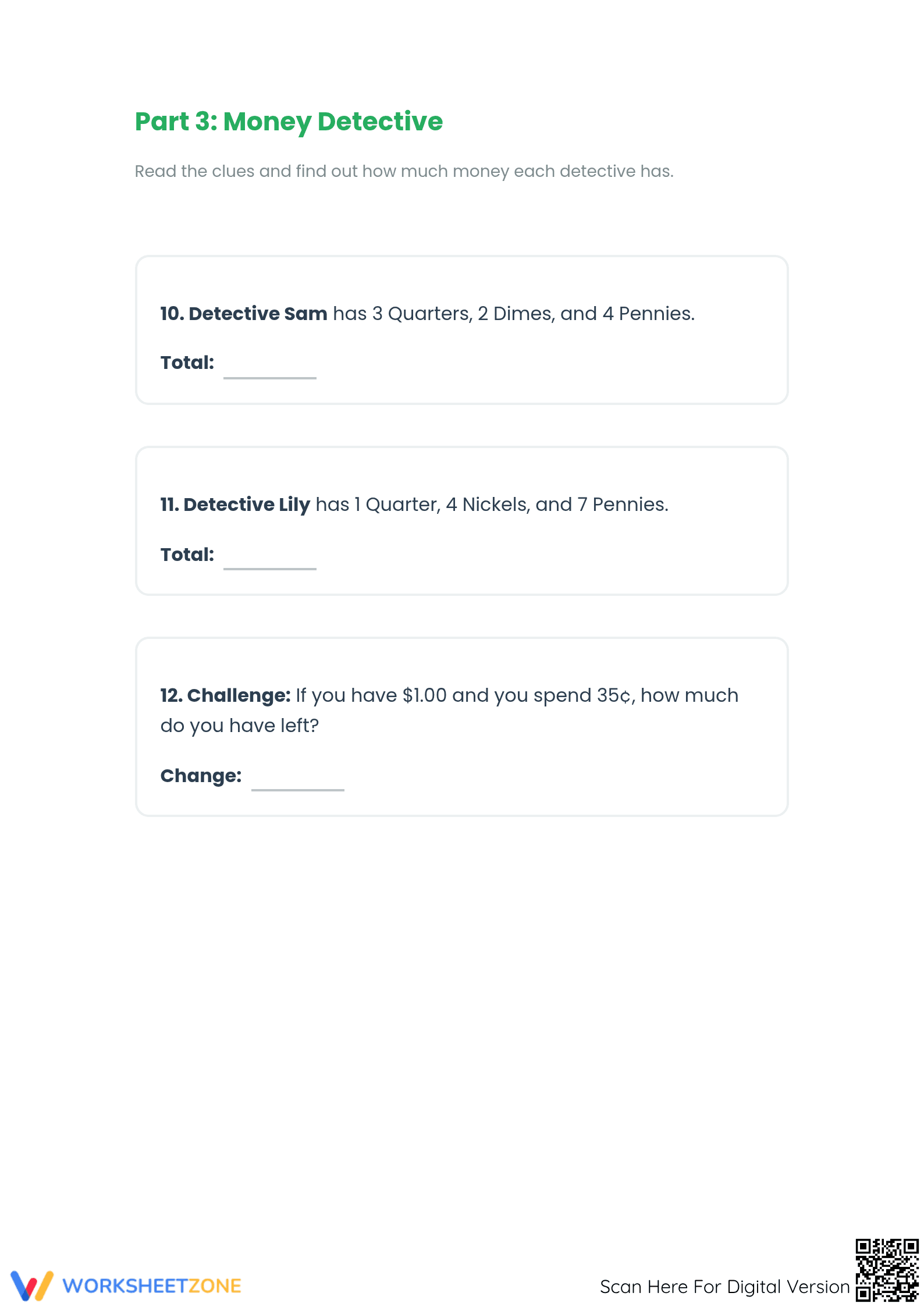
The resource spans three distinct pages, featuring 12 high-quality tasks. Page one focuses on basic combinations of dimes, nickels, and pennies. Page two introduces the "Quarters Challenge," requiring students to integrate 25-cent values into their totals. The final page presents "Money Detective" word problems, including a challenge task focused on calculating change from a dollar. A full answer key is provided for rapid grading.
Skill Progression
- Guided Practice: The first 5 problems provide clear visual representations of coins with labeled values (e.g., 10¢, 5¢), allowing students to practice skip-counting in a supported environment.
- Supported Practice: Problems 6 through 9 introduce quarters into the mix, increasing the complexity of mental addition while maintaining the visual scaffolding of coin icons.
- Independent Practice: The final section transitions to text-based "Money Detective" scenarios, where students must visualize the coins themselves and perform multi-step addition and subtraction.
This gradual-release model ensures students build a solid foundation before tackling abstract financial concepts through an I Do, We Do, You Do approach.
Standards Alignment
This worksheet is primarily aligned with CCSS.MATH.CONTENT.2.MD.C.8: "Solve word problems involving dollar bills, quarters, dimes, nickels, and pennies, using $ and ¢ symbols appropriately." While introduced in earlier grades, this standard remains a critical foundational skill for upper elementary students working toward decimal fluency and financial literacy.
How to Use It
Use this worksheet as a formative assessment after a lesson on US currency. It works well as a station rotation activity where students can check their work against the provided key. Teachers should observe students during Part 2 to see if they are successfully transitioning from skip-counting by fives and tens to incorporating the 25-cent quarter. Expected completion time ranges from 15 to 25 minutes depending on student fluency.
Who It's For
This resource is designed for Grade 3-6 students who require additional practice with physical money concepts. It is particularly effective for Special Education (SPED) or Life Skills classrooms where functional math is a priority. Pair this worksheet with physical plastic coins or a digital interactive whiteboard display to provide a multi-sensory learning experience for students struggling with abstract addition.
Instructional materials that bridge the gap between concrete visual representations and abstract word problems improve long-term retention of mathematical concepts. This worksheet utilizes this methodology by transitioning students from labeled coin icons to complex "Money Detective" scenarios. By requiring students to calculate totals and determine change, the resource addresses the cognitive demands of the CCSS.MATH.CONTENT.2.MD.C.8 standard while providing necessary scaffolding. Research emphasizes that the gradual release of responsibility—moving from visual identification to independent word problems—is essential for mastery in functional math skills. This 3-page set provides 12 targeted opportunities for students to demonstrate proficiency in currency management, making it an essential tool for any elementary or middle school math curriculum focused on real-world application.


