




























Views
Downloads

Essential Digestive System Word Search | Grade 7-12

Paste this activity's link or code into your existing LMS (Google Classroom, Canvas, Teams, Schoology, Moodle, etc.).
Students can open and work on the activity right away, with no student login required.
You'll still be able to track student progress and results from your teacher account.
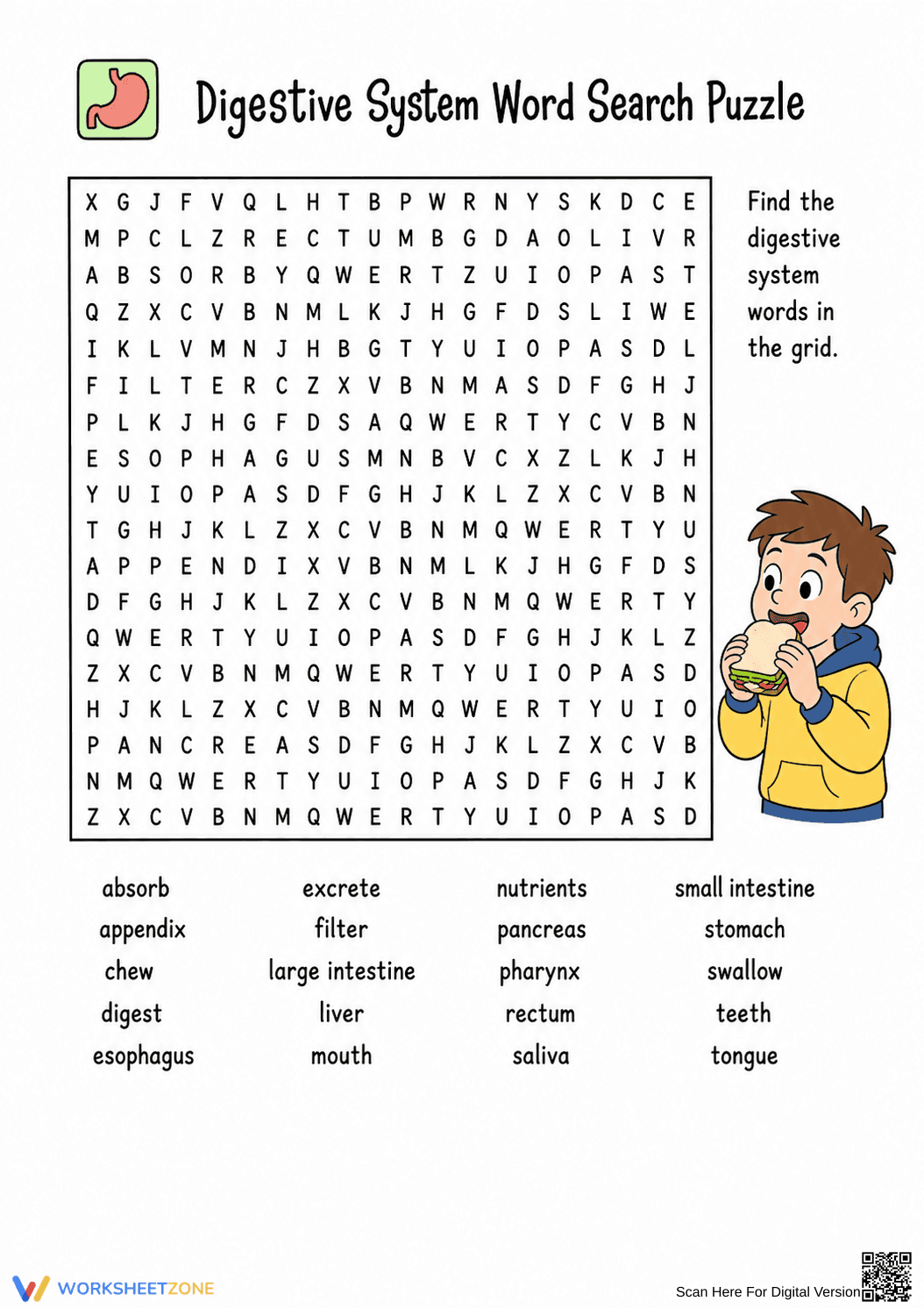
This printable digestive system word search provides a focused way for students to internalize complex biological terminology. By identifying 20 key terms related to human anatomy and physiological processes, learners build the foundational literacy required for advanced life science units. It transforms rote memorization into an active scanning task that improves term recognition.
At a Glance
- Grade: 7-12 · Subject: Science
- Standard:
MS-LS1-3— Describe how the body is a system of interacting subsystems and organs- Skill Focus: Digestive system vocabulary
- Format: 1 page · 20 problems · Answer key included · PDF
- Best For: Vocabulary reinforcement and early finishers
- Time: 15–20 minutes
This single-page PDF features a dense letter grid containing 20 hidden terms ranging from major organs like the pancreas and liver to physiological actions such as absorb and excrete. The layout includes a clear word bank at the bottom and a thematic illustration to maintain engagement. The word list is comprehensive, covering the entire alimentary canal from the mouth to the rectum.
Zero-Prep Workflow
This resource is designed for immediate classroom implementation with three simple steps:
- Print (30 seconds): Select the single-page PDF and print copies for your entire class.
- Distribute (30 seconds): Hand out the sheets as a bell-ringer or transition activity; the task is self-explanatory.
- Review (1 minute): Use the included answer key to verify student findings or have students peer-grade to reinforce spelling.
Total teacher preparation time is under two minutes, making this an ideal solution for unexpected schedule changes or sub plans.
Standards Alignment
This resource aligns with MS-LS1-3: "Use argument supported by evidence for how the body is a system of interacting subsystems composed of groups of cells." By mastering the names and spelling of these specific organs, students are better prepared to explain the mechanical and chemical interactions within the digestive tract. This standard code can be copied directly into lesson plans or IEP goals.
How to Use It
Use this worksheet as a formative assessment after an introductory lecture on the human body. It serves as an excellent bridge activity between direct instruction and more complex diagram labeling. Alternatively, assign it as a quiet-time activity for students who complete their primary lab work early. Expected completion time is approximately 15 to 20 minutes.
Who It's For
This activity is designed for middle and high school students in general science or biology courses. It is particularly helpful for English Language Learners who need visual and repetitive exposure to scientific nomenclature. Pair this with a digestive system anchor chart or a 3D torso model for a multi-sensory learning experience.
According to the RAND AIRS 2024 analysis of instructional materials, vocabulary-focused activities like word searches significantly reduce cognitive load when students transition to complex system modeling. By isolating the terminology of the digestive system—such as the esophagus, pharynx, and small intestine—students develop the lexical fluency necessary to engage in higher-order scientific discourse. Research from Fisher & Frey (2014) supports the use of word-recognition tasks as a scaffold for disciplinary literacy, ensuring that students are not hindered by spelling or identification errors during summative assessments. This worksheet provides 20 distinct opportunities for students to interact with the MS-LS1-3 standard, reinforcing the names of the interacting subsystems that comprise the human body. Integrating such no-prep tools into a broader science curriculum allows educators to maximize instructional time while ensuring all students meet foundational literacy benchmarks in the life sciences. This resource is a reliable tool for biology classrooms.


