




























Views
Downloads

Digestive System Cloze Worksheet | Grade 7 Essential

Paste this activity's link or code into your existing LMS (Google Classroom, Canvas, Teams, Schoology, Moodle, etc.).
Students can open and work on the activity right away, with no student login required.
You'll still be able to track student progress and results from your teacher account.
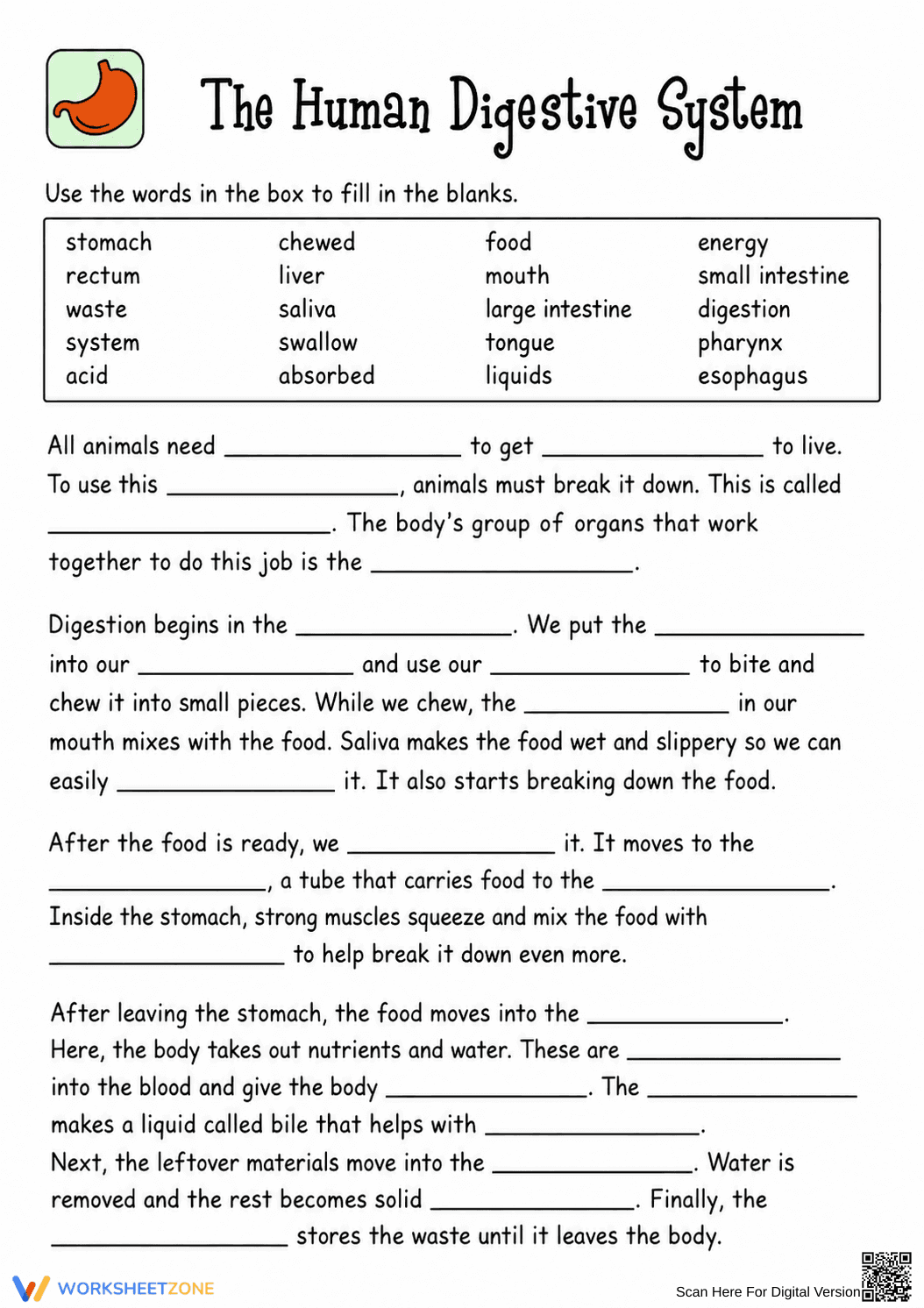
This digestive system cloze worksheet provides a comprehensive overview of the human digestion process. Students use a 20-word bank to identify key organs and physiological functions, from mechanical breakdown in the mouth to nutrient absorption. It serves as an effective tool for reinforcing biological vocabulary and understanding how body systems work together to maintain homeostasis.
At a Glance
- Grade: 7 · Subject: Science
- Standard:
MS-LS1-3— Describe how the body is a system of interacting subsystems and organs- Skill Focus: Digestive process sequencing
- Format: 1 page · 20 problems · Answer key included · PDF
- Best For: Formative assessment or vocabulary review
- Time: 15–20 minutes
The resource features a single-page layout containing a structured narrative of the digestive journey. It includes a clear word bank with 20 terms such as esophagus, small intestine, and absorbed. The text is broken into logical paragraphs that follow the path of food, making it easy for students to track the sequence of events and the specific role of each organ.
This worksheet is designed for immediate classroom implementation. Teachers can print the PDF in under 2 minutes, distribute it to students for a 15-minute independent activity, and review the answers as a whole group in 5 minutes. It requires zero setup and serves as an ideal bell-ringer or emergency sub plan material for life science units.
This activity aligns with `MS-LS1-3`, which requires students to provide evidence that the body is a system of multiple interacting subsystems. By identifying how the stomach, liver, and intestines work in tandem, students demonstrate an understanding of organ-level interactions. Both standard codes can be copied directly into lesson plans, IEP goals, or district curriculum mapping tools.
Use this as a post-instruction check after a lecture on the human body. It works well as a formative assessment to identify which students struggle with specific organ functions. Expected completion time is 15 to 20 minutes. For a challenge, have students color-code the organs mentioned in the text on a separate diagram to visualize the system.
This is designed for middle school science students, particularly those in Grade 7, but is also suitable for ESL/ELL learners due to the heavy vocabulary support provided by the word bank. It pairs naturally with a digestive system anchor chart or a 3D torso model demonstration to provide a multi-modal learning experience.
According to the RAND AIRS 2024 report on science literacy, cloze activities significantly improve the retention of domain-specific vocabulary in middle school learners. This worksheet targets the MS-LS1-3 standard by requiring students to synthesize their knowledge of the digestive system into a coherent narrative. By filling in 20 specific terms, students move beyond rote memorization toward understanding the functional relationships between organs like the pharynx and esophagus. Research from Fisher & Frey (2014) suggests that scaffolded vocabulary tasks like this one provide the necessary support for students to transition into more complex physiological modeling. This resource ensures that the foundational terminology of human biology is mastered before students engage in higher-order systems analysis. It is a reliable, evidence-based tool for any life science curriculum focusing on human body systems and internal homeostasis.


