


























Views
Downloads

Essential Sight Word "Did" Worksheet | Grade 1 Printable
Paste this activity's link or code into your existing LMS (Google Classroom, Canvas, Teams, Schoology, Moodle, etc.).
Students can open and work on the activity right away, with no student login required.
You'll still be able to track student progress and results from your teacher account.
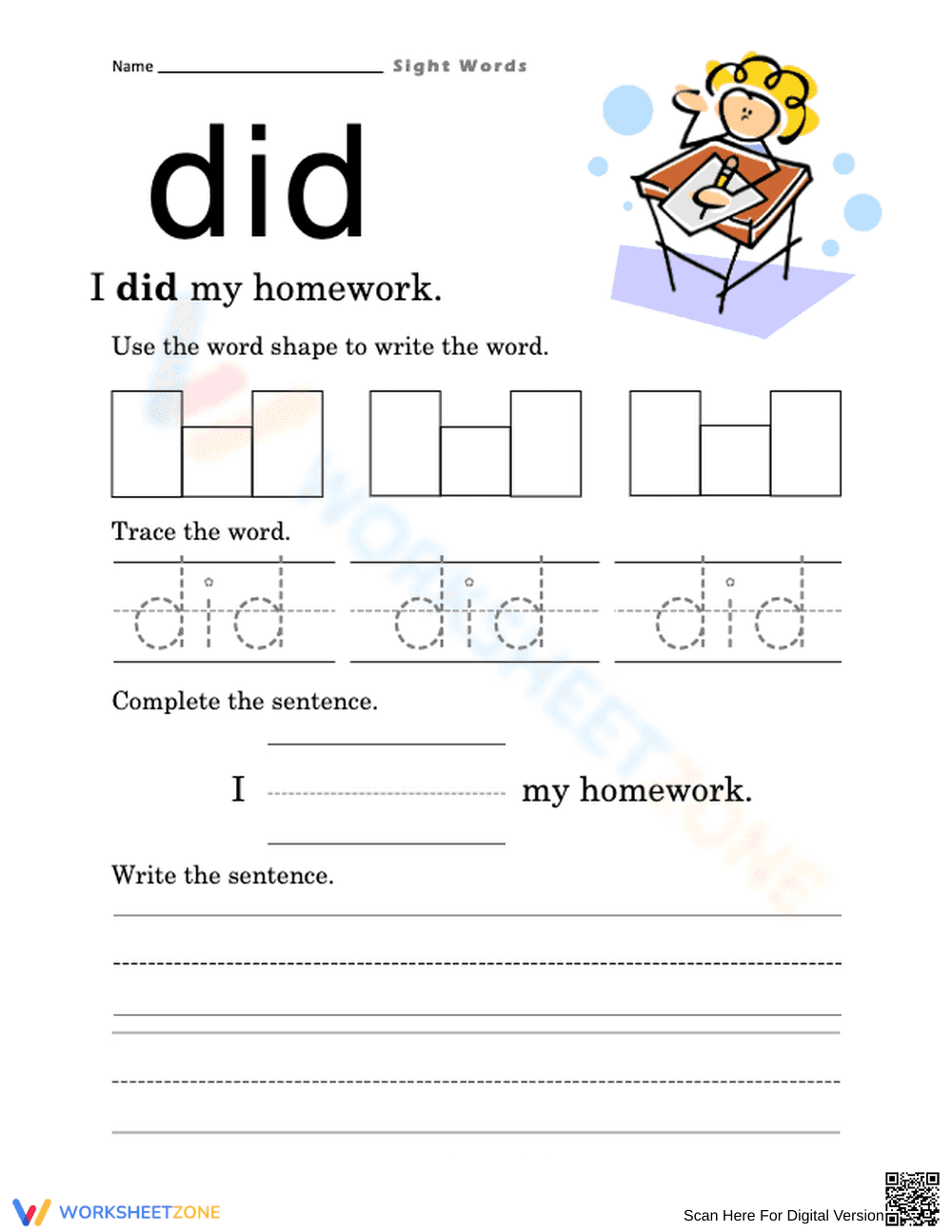
This Grade 1 worksheet provides practice for the sight word "did." Students engage in word shape recognition, tracing, and sentence-level application. By completing these activities, learners build the fluency required to recognize irregularly spelled words in reading and writing contexts across the primary curriculum.
At a Glance
- Grade: 1 · Subject: English
- Standard:
CCSS.ELA-LITERACY.RF.1.3.G— Recognize and read grade-appropriate irregularly spelled words in text and writing- Skill Focus: Sight word "did" recognition
- Format: 1 page · 8 problems · Answer key included · PDF
- Best For: Literacy centers and morning work
- Time: 10–15 minutes
What's Inside
This single-page resource is designed for immediate classroom use. It includes three word-shape puzzles to help students visualize the letter heights of the word "did," followed by three tracing exercises to reinforce muscle memory. The worksheet then moves to application with a sentence-completion task and a dedicated space for students to write the full sentence independently on primary-ruled lines.
Zero-Prep Workflow
- Print (1 minute): Print enough copies for your literacy block or small group session.
- Distribute (30 seconds): Hand out the worksheets with pencils; no teacher setup is required.
- Review (30 seconds): Use the answer key to check for accuracy or for student self-correction.
Total prep time is under two minutes, making this ideal for emergency sub plans.
Standards Alignment
The primary focus of this activity is CCSS.ELA-LITERACY.RF.1.3.G, which requires students to recognize and read grade-appropriate irregularly spelled words. Additionally, it supports CCSS.ELA-LITERACY.L.1.1 by reinforcing conventions of standard English grammar and usage when writing. Both standard codes can be copied directly into lesson plans, IEP goals, or district curriculum mapping tools.
How to Use It
Use this worksheet as a formative assessment after introducing the word "did" during a direct instruction lesson. Observe students as they complete the "Write the sentence" section to identify those who may need additional scaffolding with letter formation or spacing. It also functions effectively as a "do now" activity to settle the class during morning transitions.
Who It's For
This resource is tailored for first-grade students but is also appropriate for kindergarteners ready for extension or second graders requiring Tier 2 literacy intervention. The visual cues from word shapes make it particularly beneficial for English Language Learners and students with dyslexia. It pairs naturally with a sight word anchor chart or a reading passage.
Mastering the sight word "did" is a fundamental component of early literacy development, as high-frequency words account for approximately 50% of the text encountered by primary students. Research from Fisher & Frey (2014) emphasizes that the gradual release of responsibility—moving from tracing to independent writing—is critical for consolidating word recognition skills in young learners. This worksheet utilizes multisensory techniques, such as word-shape analysis, to support orthographic mapping, which is the process the brain uses to store words for immediate retrieval. According to the NAEP, students who develop automaticity with high-frequency words in Grade 1 demonstrate significantly higher reading comprehension levels in later elementary years. By integrating tracing, filling in blanks, and full sentence production, this resource ensures that the word "did" is not just memorized but internalized for practical application. This structured approach aligns with evidence-based practices for foundational reading skills.


