


























Views
Downloads

Anatomy of the Leg Worksheet | Grade 6-8 Essential
Paste this activity's link or code into your existing LMS (Google Classroom, Canvas, Teams, Schoology, Moodle, etc.).
Students can open and work on the activity right away, with no student login required.
You'll still be able to track student progress and results from your teacher account.
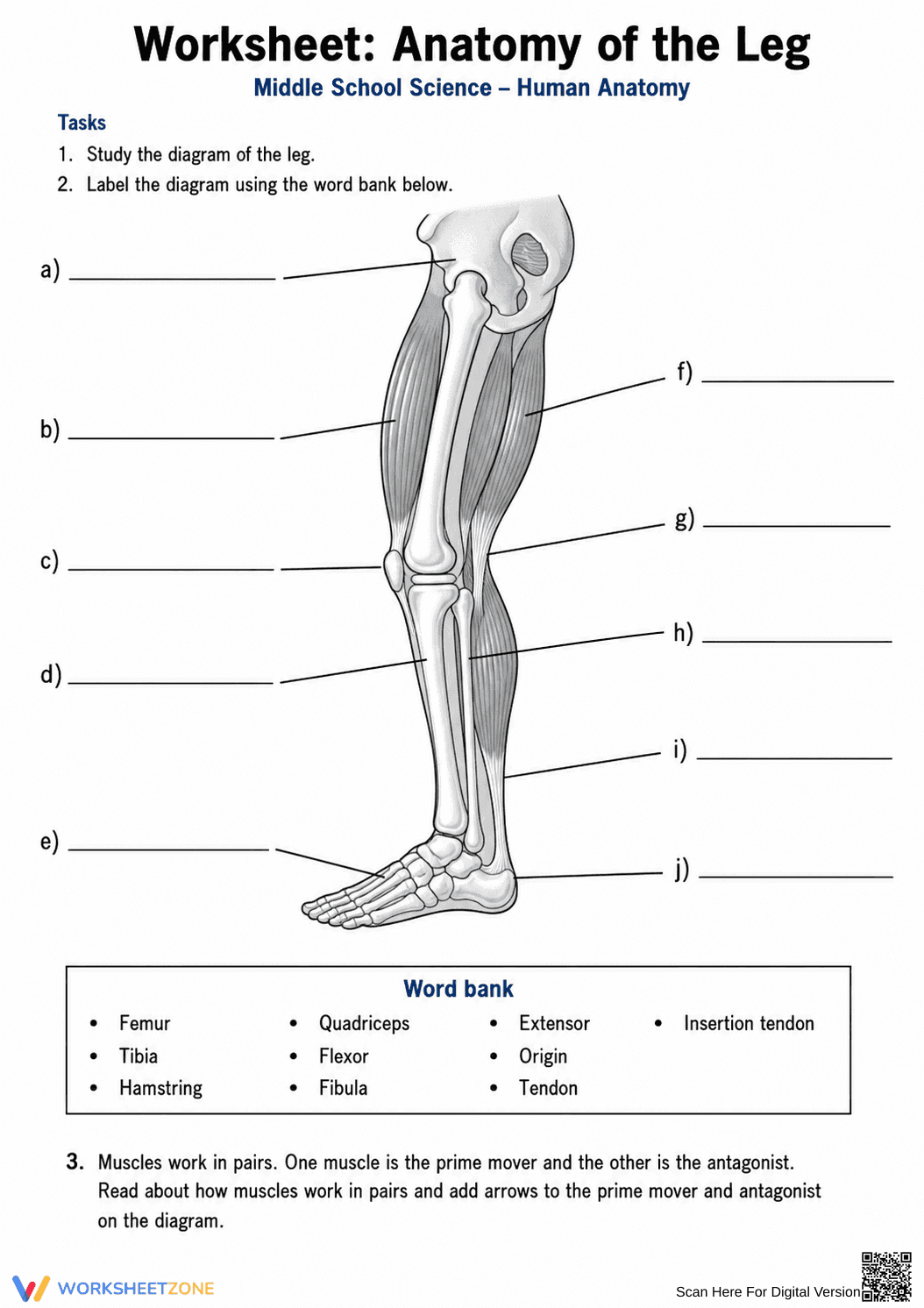
This middle school science worksheet provides a comprehensive overview of human leg anatomy, focusing on the intersection of the skeletal and muscular systems. Students identify major bones and muscle groups, demonstrating how these structures work in coordinated pairs to facilitate movement. This resource ensures mastery of complex biological terminology through structured visual practice.
At a Glance
- Grade: 6-8 · Subject: Science
- Standard:
MS-LS1-3— Explain how the body is a system of interacting subsystems for life- Skill Focus: Musculoskeletal labeling
- Format: 1 page · 12 tasks · Answer key included · PDF
- Best For: Middle school biology or health units
- Time: 15–20 minutes
The worksheet features a detailed anatomical diagram of the human leg, including hip, knee, and foot structures. It provides a 10-term word bank with essential vocabulary like the femur, tibia, fibula, quadriceps, and hamstrings. Beyond simple labeling, a specialized task requires students to apply knowledge of muscle mechanics by identifying prime movers and antagonists. The single-page layout is designed for clarity with ample space for responses.
This zero-prep resource is designed for maximum classroom efficiency. Teachers can print the single-page PDF and distribute it immediately. With a built-in word bank and clear instructions, student orientation takes less than one minute. The structured labeling format allows for a rapid five-minute group review or self-correction session using the provided answer key, making it ideal for emergency sub plans or quick formative checks.
Aligned to MS-LS1-3, this resource helps students provide evidence that the body is a system of interacting subsystems. By labeling bones and muscles, students visualize the connection between the skeletal and muscular systems. Supporting standards include CCSS.ELA-LITERACY.RST.6-8.4, focusing on domain-specific terms. Both codes can be copied directly into lesson plans or curriculum mapping tools.
Use this worksheet as a mid-unit formative assessment after introducing the skeletal system. During the activity, circulate to observe if students can correctly distinguish between the tibia and fibula, a common point of confusion. The 15 to 20-minute completion time makes it a perfect bell-ringer or exit ticket to gauge comprehension of leg structures.
Designed for grades 6-8, this worksheet is also appropriate for high school biology foundational review. The word bank provides necessary scaffolding for English Language Learners and students with IEPs who may struggle spelling anatomical terms. It pairs naturally with a 3D leg model or textbook chapter to provide a multi-modal learning experience.
This worksheet meets the rigorous requirements of MS-LS1-3 by providing a concrete visual representation of how the skeletal and muscular systems interact. Identifying the femur, tibia, and fibula alongside muscle groups like the quadriceps and hamstrings facilitates a deeper understanding of structural hierarchy. Scaffolded labeling tasks utilizing the word bank are essential for developing domain-specific vocabulary. Furthermore, prime mover and antagonist identification tasks move students beyond rote memorization toward functional analysis. This ensures the worksheet serves as a valid tool for formative assessment and direct instruction, bridging the gap between anatomical terminology and physiological function.


