




























Views
Downloads

Essential Cell Cycle Diagram Worksheet | Grade 9-10

Paste this activity's link or code into your existing LMS (Google Classroom, Canvas, Teams, Schoology, Moodle, etc.).
Students can open and work on the activity right away, with no student login required.
You'll still be able to track student progress and results from your teacher account.
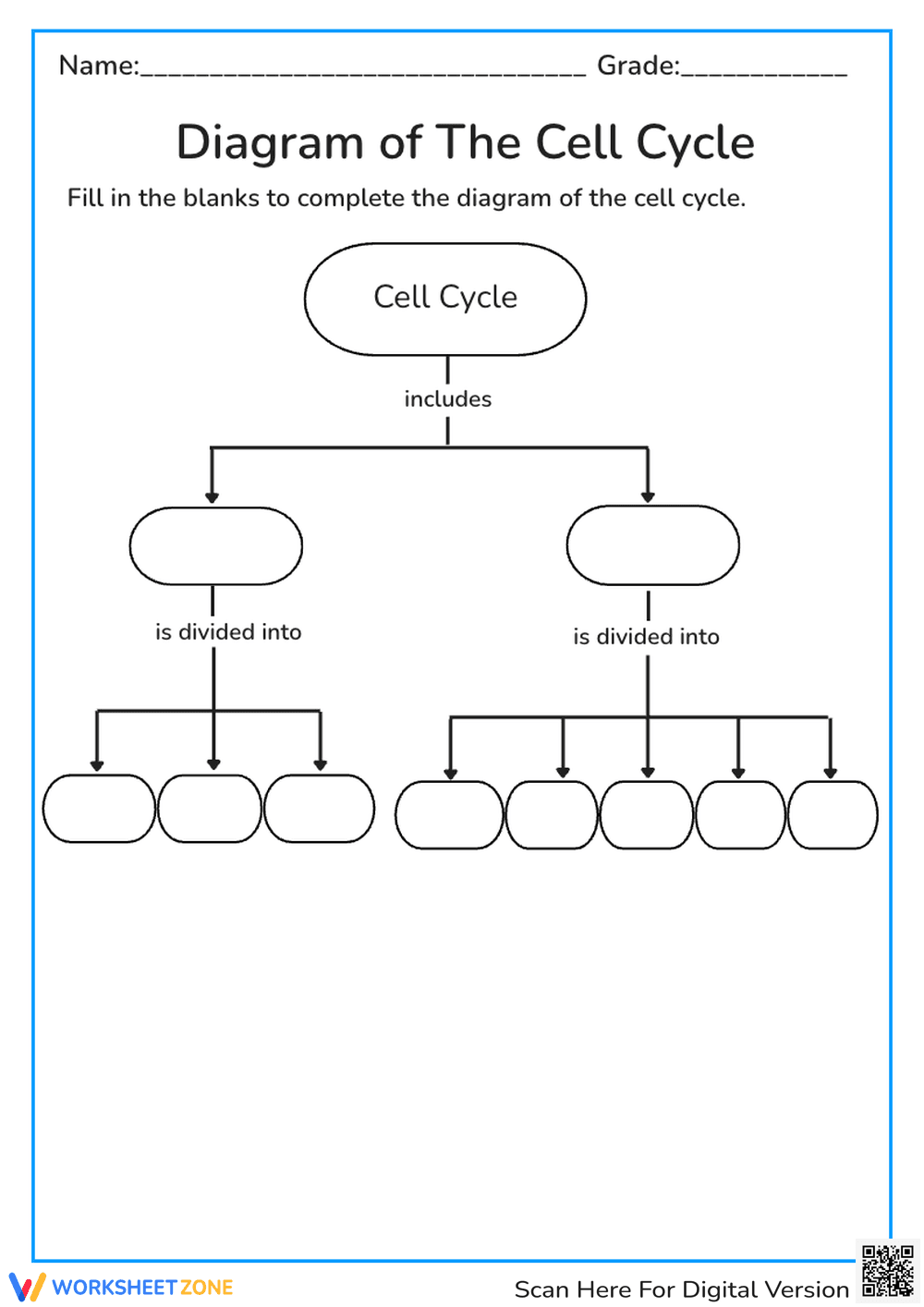
This Grade 9-10 cell cycle worksheet provides a clear, structured framework for students to identify and sequence the various stages of cellular division. By completing the diagram, learners demonstrate their understanding of how cells progress from interphase through the mitotic phases. This resource ensures students can visualize the relationship between different parts of the cycle effectively.
At a Glance
- Grade: 9-10 · Subject: Biology
- Standard:
HS-LS1-4— Use a model to illustrate the role of cellular division and mitosis- Skill Focus: Cell Cycle Phase Identification
- Format: 1 page · 9 problems · Answer key included · PDF
- Best For: Quick formative assessment or review
- Time: 10–15 minutes
The worksheet features a clean, hierarchical flow chart that breaks the cell cycle into its primary components. Students are presented with 9 empty bubbles arranged to show the logical progression of division. The layout is designed to be intuitive, starting from the broad concept of the "Cell Cycle" and branching down into specific sub-phases.
This resource is designed for a zero-prep classroom workflow that saves valuable instructional time. First, print the single-page PDF (30 seconds). Second, distribute the worksheet as a bell-ringer or exit ticket to gauge student readiness (1 minute). Finally, use the included answer key to review the correct sequence with the whole class (5 minutes). Prep time is under 2 minutes.
This activity is directly aligned with HS-LS1-4: "Use a model to illustrate the role of cellular division (mitosis) and differentiation in producing and maintaining complex organisms." It specifically addresses the modeling component by requiring students to complete a conceptual map of the process. This standard code can be copied directly into lesson plans, IEP goals, or district curriculum mapping tools.
Use this worksheet as a formative assessment immediately following a lecture on mitosis to identify common misconceptions about phase order. It also serves as an excellent review tool before a unit test. Teachers should observe whether students can correctly distinguish between the broader categories of interphase and the specific stages of the mitotic phase. Completion typically takes 10 to 15 minutes.
This resource is tailored for Grade 9 and 10 Biology students, including those requiring visual scaffolding to organize complex information. It pairs naturally with a cell cycle anchor chart or a microscopic slide lab where students observe actual onion root tip cells. The diagram provides the theoretical foundation needed before students engage in hands-on biological observation.
According to Fisher & Frey (2014), graphic organizers like this cell cycle diagram are critical for helping secondary students internalize complex biological sequences. By requiring students to actively retrieve and place the names of phases—such as interphase, prophase, metaphase, anaphase, and telophase—within a hierarchical structure, the worksheet reinforces the spatial and temporal relationships of cellular division. This alignment with HS-LS1-4 ensures that students are not merely memorizing terms but are constructing a mental model of how organisms maintain themselves through mitosis. Research indicates that structured visual aids reduce cognitive load during the initial stages of learning high-school level science concepts. This 1-page resource provides the necessary scaffolding for Grade 9 and 10 learners to achieve mastery before moving toward more complex laboratory observations or data analysis. The inclusion of 9 specific tasks allows for a comprehensive check of the entire cycle in under 15 minutes.


