


























Views
Downloads


Diagonal Lines: School Supplies Printable Worksheet | Ready
Paste this activity's link or code into your existing LMS (Google Classroom, Canvas, Teams, Schoology, Moodle, etc.).
Students can open and work on the activity right away, with no student login required.
You'll still be able to track student progress and results from your teacher account.
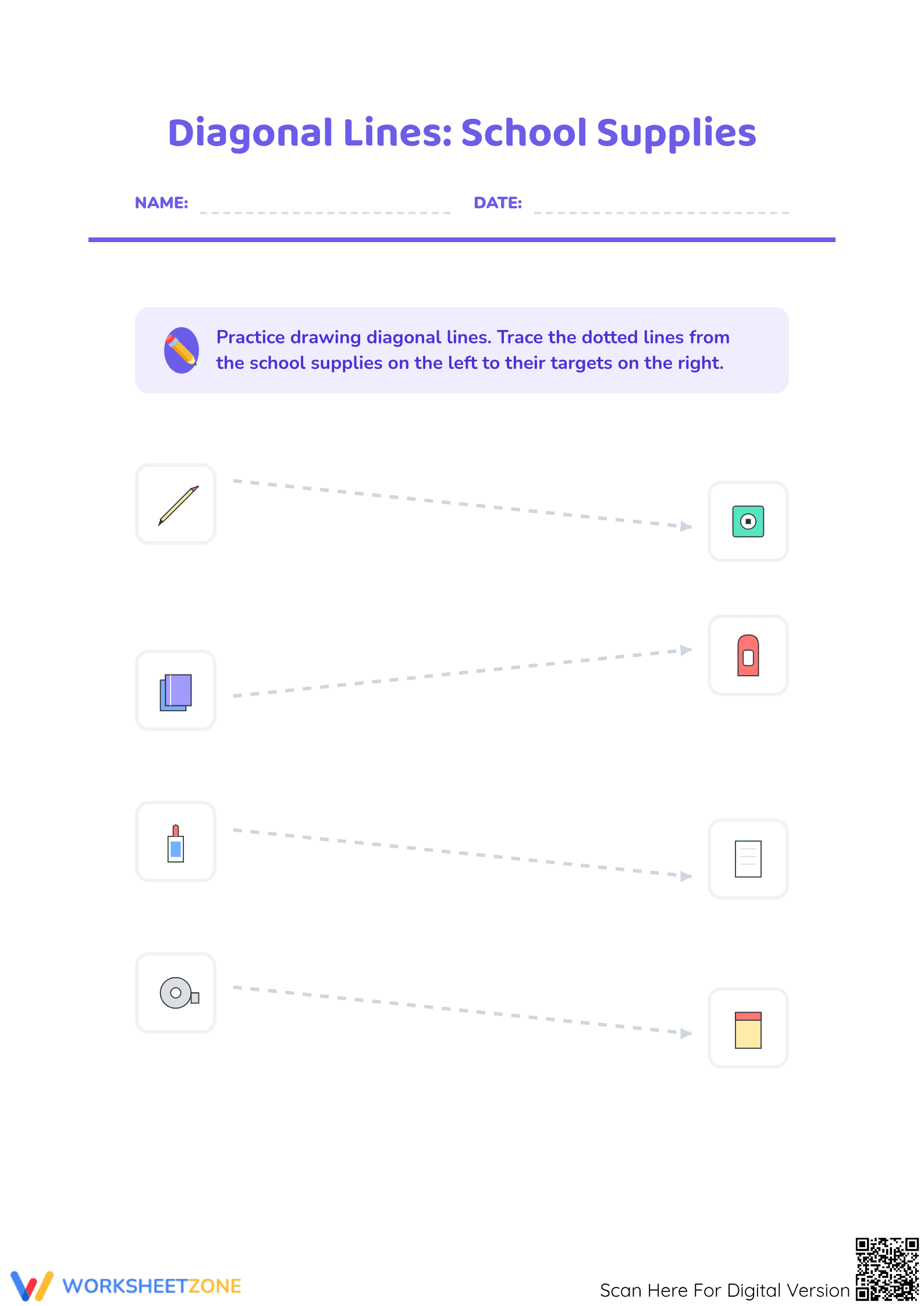
This printable preschool worksheet provides focused practice for early learners to develop fine motor control through diagonal line tracing. By connecting familiar school supplies, students build the hand-eye coordination necessary for future letter formation and handwriting success. It is a perfect addition to any back-to-school literacy center.
At a Glance
- Grade: Preschool · Subject: Early Literacy
- Standard:
L.K.1.A— Print many upper- and lowercase letters through developing fine motor control- Skill Focus: Diagonal and Zig-Zag Tracing
- Format: 2 pages · 9 problems · Answer key included · PDF
- Best For: Pre-writing practice and fine motor development
- Time: 10–15 minutes
This two-page resource features a variety of engaging tracing activities designed for young hands. Page one includes four clear diagonal paths connecting vibrant school supply icons to their matching targets. Page two extends the challenge with more complex zig-zag patterns and a matching section where students use diagonal lines to pair shapes. A complete answer key is provided to assist with modeling and checking.
The "Diagonal Lines: School Supplies" worksheet is designed for immediate classroom implementation with zero preparation.
- Print (30 seconds): Download the PDF and print copies on standard paper.
- Distribute (30 seconds): Pass out worksheets along with crayons to provide a high-contrast experience.
- Review (1 minute): Model the "start and stop" points on the first item to ensure students understand the flow.
This activity aligns with CCSS.ELA-LITERACY.L.K.1.A, focusing on the ability to print letters. While Preschoolers are developing foundational movements, tracing diagonal lines is a critical prerequisite for forming letters like 'A', 'M', and 'X'. This standard code can be copied directly into lesson plans, IEP goals, or district curriculum mapping tools.
Use this worksheet during small-group rotations to observe individual student grip and pressure. As a formative assessment tip, watch for students lifting their pencil mid-line; encouraging continuous motion builds fluid muscle memory. Alternatively, use it as a quiet morning work activity during the first week of school to settle students while reinforcing school-related vocabulary.
This resource is ideal for preschool and early kindergarten students who are beginning their writing journey. It serves as a gentle introduction for students with occupational therapy goals or those requiring extra scaffolding before moving to formal letter tracing. It pairs naturally with a "Back to School" themed read-aloud or a "show and tell" session about school supplies.
The development of fine motor control through repetitive tracing is a fundamental component of early literacy instruction. According to Fisher & Frey (2014), the gradual release of responsibility begins with providing clear, scaffolded opportunities for students to mimic professional strokes. This worksheet specifically targets standard L.K.1.A by focusing on diagonal line proficiency, a motor skill that directly correlates with the ability to form complex alphabetic characters. By engaging in 9 distinct tasks, students reinforce the hand-eye coordination necessary for legible handwriting. This printable resource ensures that young learners are practicing high-value pre-writing motions in a contextually relevant theme. Such targeted practice is essential for bridging the gap between scribbling and formal print production in early childhood settings.


