


























Views
Downloads
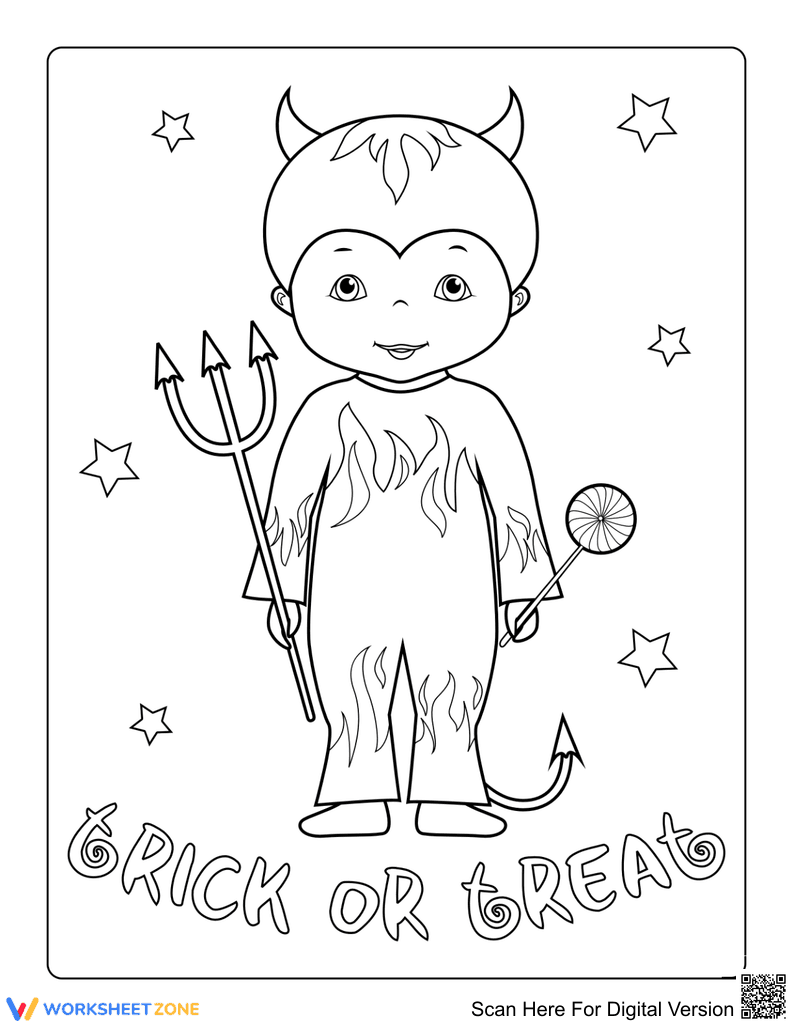

Devil Costume Coloring Page | Essential Halloween Printable
Paste this activity's link or code into your existing LMS (Google Classroom, Canvas, Teams, Schoology, Moodle, etc.).
Students can open and work on the activity right away, with no student login required.
You'll still be able to track student progress and results from your teacher account.
This printable devil costume coloring page provides Kindergarten students with a creative outlet to develop fine motor control while engaging with seasonal Halloween themes. By focusing on the "Trick or Treat" text and the detailed character illustration, learners practice hand-eye coordination and color selection in a festive, low-stakes environment.
At a Glance
- Grade: Kindergarten · Subject: English
- Standard:
CCSS.ELA-LITERACY.L.K.6— Use words and phrases acquired through conversations and responding to texts- Skill Focus: Fine motor control
- Format: 1 page · 1 task · Answer key not applicable · PDF
- Best For: Morning work or holiday centers
- Time: 15–20 minutes
What's Inside
Inside this resource, you will find a single-page PDF featuring a high-quality line art illustration of a child in a friendly devil costume. The page includes the thematic phrase "Trick or Treat" in bubble letters, allowing for additional coloring practice. The clear borders and distinct sections of the costume make it ideal for young learners practicing staying within the lines.
Zero-Prep Workflow
The zero-prep workflow for this activity is designed for maximum efficiency. First, print the single-page PDF (30 seconds). Second, distribute the sheets along with crayons or markers to your students (1 minute). Third, review the holiday vocabulary words like "costume" and "treat" as students work (1 minute). Total teacher preparation time is under 3 minutes, making it a perfect sub plan addition.
Standards Alignment
This worksheet aligns with `CCSS.ELA-LITERACY.L.K.6`, which focuses on using words and phrases acquired through conversations and responding to texts. By discussing the Halloween theme and the specific elements of the costume, students reinforce their seasonal vocabulary. This standard code can be copied directly into lesson plans, IEP goals, or district curriculum mapping tools.
How to Use It
Use this coloring page during a Halloween-themed literacy center or as a quiet morning work activity during the last week of October. It serves as an excellent formative assessment for observing pencil grip and fine motor endurance. Expect students to spend approximately 15 to 20 minutes completing the page, depending on their level of detail.
Who It's For
This resource is designed for Kindergarten students but is suitable for Pre-K or Grade 1 learners needing fine motor practice. It pairs naturally with a read-aloud about Halloween traditions or an anchor chart listing different types of costumes. It is particularly helpful for students who benefit from calming, repetitive tasks.
According to the RAND AIRS 2024 report on early childhood education, integrating thematic art activities into the curriculum supports the development of fine motor skills necessary for later writing proficiency. This devil costume coloring page addresses CCSS.ELA-LITERACY.L.K.6 by providing a visual context for holiday-specific vocabulary, allowing students to connect spoken words with representative imagery. Research from Fisher & Frey (2014) emphasizes that low-stress creative tasks can lower the affective filter, making students more receptive to language acquisition. By engaging with the "Trick or Treat" text and the character illustration, learners build the foundational hand strength and coordination required for standard manuscript formation. This 1-page printable is a practical tool for educators seeking to balance seasonal engagement with developmental milestones in a classroom setting. The simplicity of the task ensures that all students can achieve success independently.


