


























Views
Plays
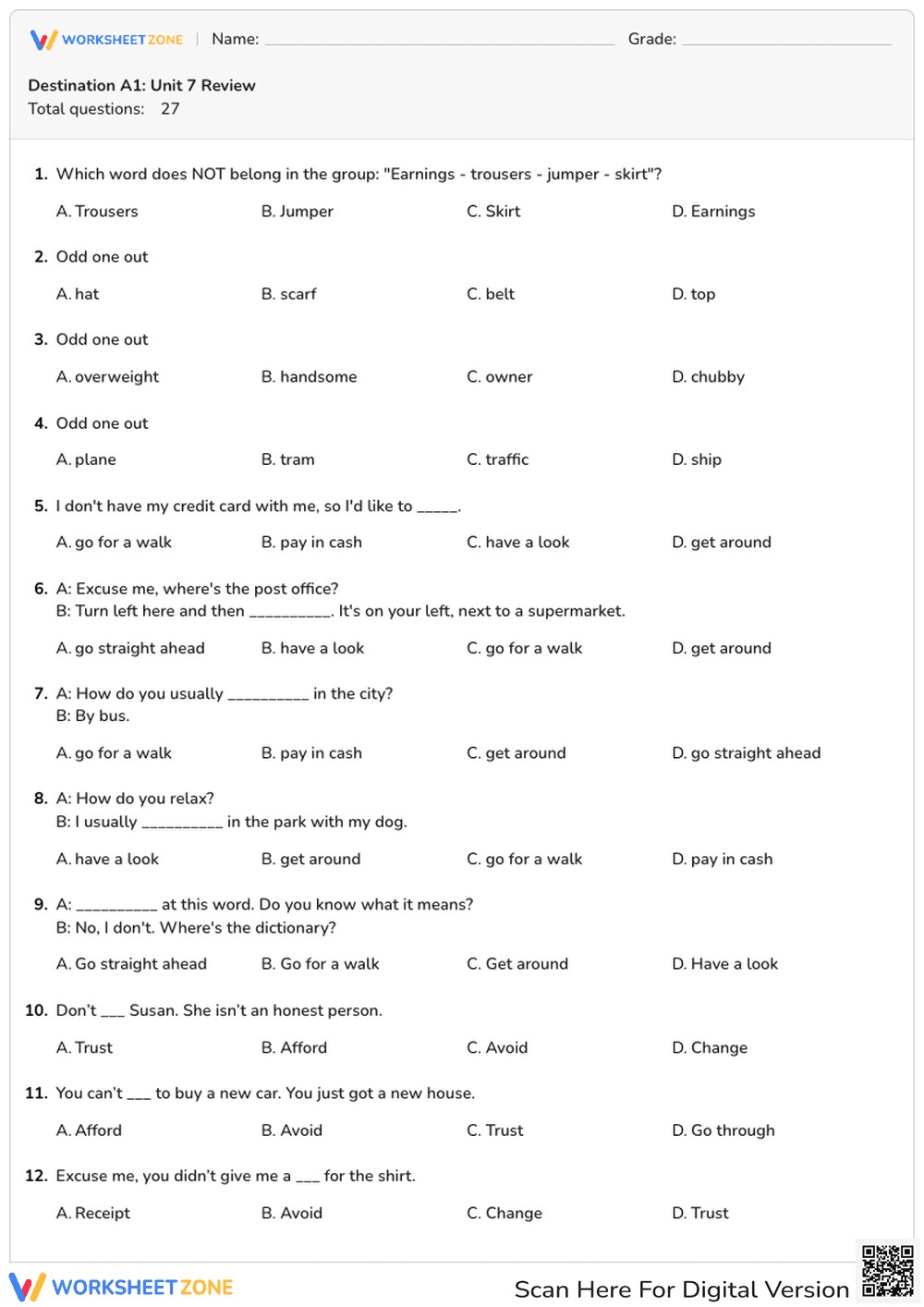
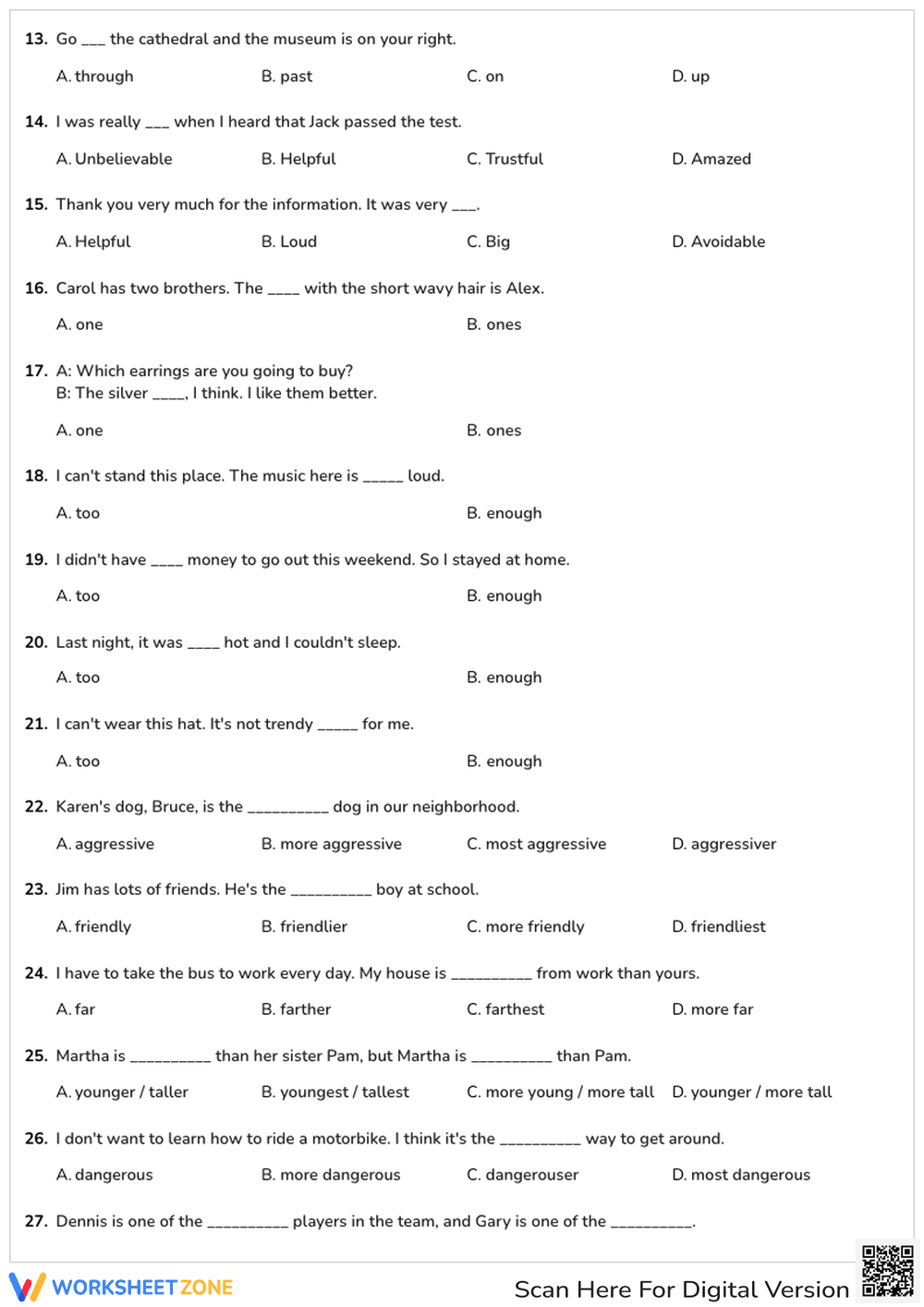


Destination A1 Unit 7 Review | Essential ELA Worksheet
Paste this activity's link or code into your existing LMS (Google Classroom, Canvas, Teams, Schoology, Moodle, etc.).
Students can open and work on the activity right away, with no student login required.
You'll still be able to track student progress and results from your teacher account.
This Grade 4-6 ELA review worksheet provides a comprehensive assessment of Unit 7 language skills. Students demonstrate mastery of thematic vocabulary and essential grammar structures through 27 targeted multiple-choice questions. It is designed to bridge the gap between vocabulary acquisition and functional sentence application in real-world contexts.
At a Glance
- Grade: 4-6 · Subject: ELA Grammar
- Standard:
CCSS.ELA-LITERACY.L.4.1— Demonstrate command of the conventions of standard English grammar and usage- Skill Focus: Vocabulary & Grammar Review
- Format: 2 pages · 27 problems · Answer key included · PDF
- Best For: End-of-unit assessment or test prep
- Time: 20–30 minutes
The worksheet contains 27 multiple-choice questions spread across two pages. It begins with "Odd One Out" categorization tasks for clothing and transport, moves into context-based vocabulary selection, and concludes with grammar mechanics. Key focus areas include the use of "one/ones," "too/enough," and comparative/superlative adjective forms. A clear layout ensures students can focus on the linguistic challenges without visual distraction.
This resource is designed for immediate classroom implementation with a total teacher prep time of under 2 minutes. Simply print the two-page PDF (1 minute), distribute to students for independent work (30 seconds), and use the included answer key for rapid grading or peer-review (30 seconds). Its self-contained nature makes it an ideal candidate for emergency sub plans or Friday review sessions.
The primary focus is `CCSS.ELA-LITERACY.L.4.1`, which requires students to demonstrate command of the conventions of standard English grammar and usage when writing or speaking. Additionally, it supports `CCSS.ELA-LITERACY.L.4.5.C` by challenging students to demonstrate understanding of words by relating them to their opposites or to similar words in categories. Both standard codes can be copied directly into lesson plans, IEP goals, or district curriculum mapping tools.
Use this worksheet as a summative assessment after completing a unit on adjectives and daily life vocabulary. It works best during the "independent practice" phase of a lesson. For a formative check, observe students during questions 16-21 to see if they correctly distinguish between singular and plural determiners. Expect completion within 20 to 30 minutes depending on student reading speed.
This resource is tailored for Grade 4, 5, and 6 students, particularly those in ESL/ELL programs working toward A1 proficiency. It provides excellent support for students needing structured grammar practice. Pair this with a visual anchor chart for "too vs. enough" or a clothing-themed word wall to provide additional scaffolding for struggling learners.
This Grade 4-6 review worksheet aligns with CCSS.ELA-LITERACY.L.4.1 by assessing 27 distinct points of English grammar and vocabulary, including determiners and intensifiers. By utilizing a multiple-choice format, the resource allows for high-frequency retrieval practice, a method proven to enhance long-term retention of linguistic structures. According to the RAND AIRS 2024 report on instructional materials, structured review cycles that combine vocabulary categorization with grammatical application are essential for developing syntactic fluency in middle-grade learners. The inclusion of "odd one out" tasks specifically targets semantic mapping skills, helping students organize mental lexicons more effectively. This worksheet serves as a reliable tool for measuring student progress toward standard mastery in both general education and English Language Development (ELD) settings, providing clear data points for instructional adjustment.


