


























Views
Downloads


Printable Density Formula Worksheet | Grade 8 Science
Paste this activity's link or code into your existing LMS (Google Classroom, Canvas, Teams, Schoology, Moodle, etc.).
Students can open and work on the activity right away, with no student login required.
You'll still be able to track student progress and results from your teacher account.
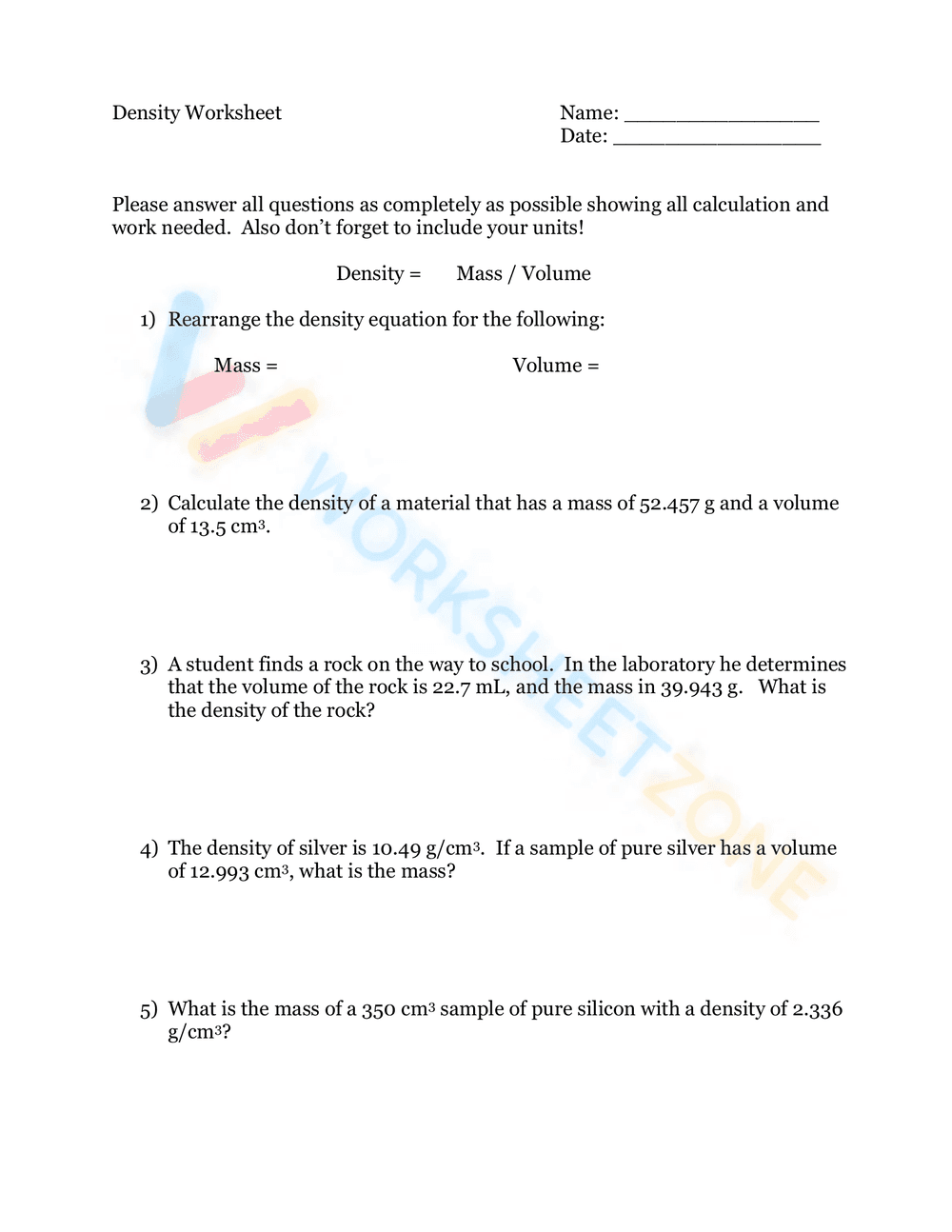
This printable Grade 8 and 9 science worksheet provides focused practice on the density formula. Students will learn to rearrange the equation to solve for mass, volume, and density using real-world examples. This resource builds essential physical science math skills and reinforces the relationship between these core properties.
At a Glance
- Grade: 8 · Subject: Science
- Standard:
MS-PS1-2— Calculate and analyze characteristic physical properties- Skill Focus: Calculating density, mass, and volume
- Format: 2 pages · 10 problems · Answer key included · PDF
- Best For: Independent practice or homework
- Time: 20–30 minutes
This two-page resource features 10 calculation problems. It begins with an exercise on rearranging the standard density equation to solve for mass and volume. The remaining questions are word problems requiring students to identify the given variables, select the correct formula variation, and calculate the missing value with proper units. A complete answer key is included for easy grading.
- Guided practice: The first section prompts students to explicitly rearrange the formula for mass and volume, setting a foundation for the word problems.
- Supported practice: Early word problems provide straightforward values for mass and volume, allowing students to practice basic division and unit labeling.
- Independent practice: Later questions require students to apply the rearranged formulas to find missing mass or volume, increasing the cognitive demand.
This gradual-release approach ensures students build confidence before tackling more complex algebraic manipulations.
Aligned to MS-PS1-2, this worksheet supports the analysis of characteristic physical properties like density to identify substances. It also reinforces essential crosscutting concepts in mathematical modeling. Both standard codes can be copied directly into lesson plans, IEP goals, or district curriculum mapping tools.
Assign this worksheet after your initial direct instruction on the density formula to solidify student understanding. It works perfectly as an in-class independent practice activity or a homework assignment. As a formative assessment tip, check students' work on question one before they proceed; ensuring they have correctly rearranged the formulas will prevent cascading errors in the subsequent word problems. Expect students to complete this in 20 to 30 minutes.
This resource is designed for 8th and 9th-grade physical science students. For learners needing extra support, consider providing a magic triangle graphic organizer to help them visualize the formula manipulation. It pairs excellently with hands-on density labs where students measure irregular objects.
Integrating mathematical computations into science instruction is absolutely critical for developing robust analytical skills in middle school learners. By practicing how to calculate and analyze characteristic physical properties, students effectively bridge the gap between abstract algebraic concepts and concrete physical phenomena observed in the natural world. According to a ScienceDirect TpT Analysis, providing students with structured practice in formula manipulation significantly improves their ability to solve complex scientific word problems independently. Furthermore, this targeted repetition reduces cognitive overload during high-stakes assessments, allowing students to focus on scientific reasoning rather than basic arithmetic struggles. Mastery of the MS-PS1-2 standard ensures learners can confidently evaluate material properties and understand how substances interact. Building this mathematical fluency now lays the essential groundwork for success in advanced high school chemistry and physics coursework, where these foundational equations are used daily.


