


























Views
Downloads



Grade 5-7 Decimal Mastery — Essential Printable Worksheet
Paste this activity's link or code into your existing LMS (Google Classroom, Canvas, Teams, Schoology, Moodle, etc.).
Students can open and work on the activity right away, with no student login required.
You'll still be able to track student progress and results from your teacher account.
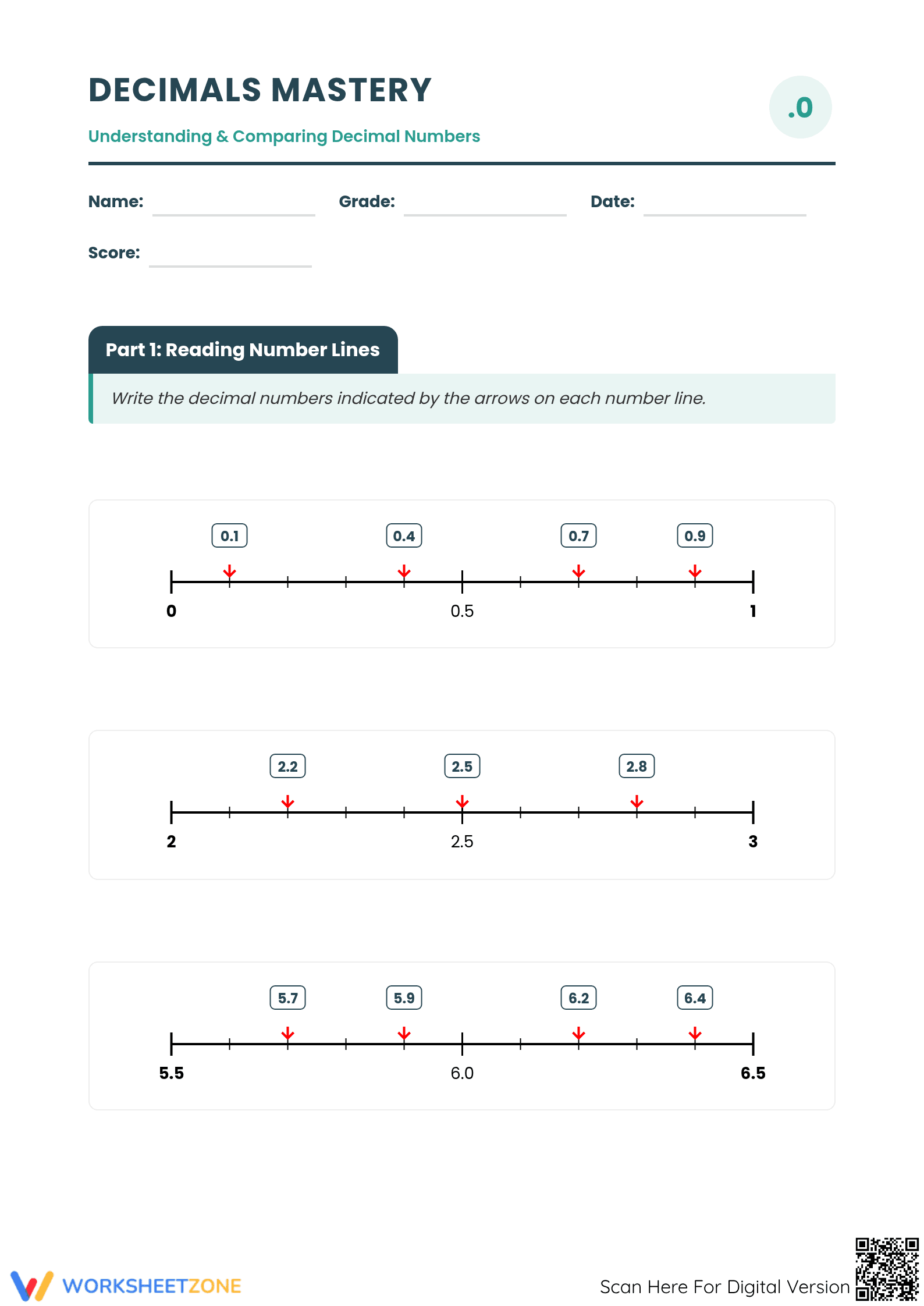
Master decimal operations and conceptual understanding with this comprehensive four-page practice packet. Students develop fluency in reading number lines, comparing values, and identifying place value positions. By connecting visual models to abstract calculations, this resource ensures learners build a durable foundation for middle-school mathematics and complex real-world data analysis.
At a Glance
- Grade: 5-7 · Subject: Math
- Standard:
CCSS.MATH.CONTENT.5.NBT.A.3— Read, write, and compare decimals to thousandths using base-ten numerals and names- Skill Focus: Decimal place value and comparison
- Format: 4 pages · 45 problems · Answer key included · PDF
- Best For: Comprehensive decimal unit review or assessment
- Time: 30–45 minutes
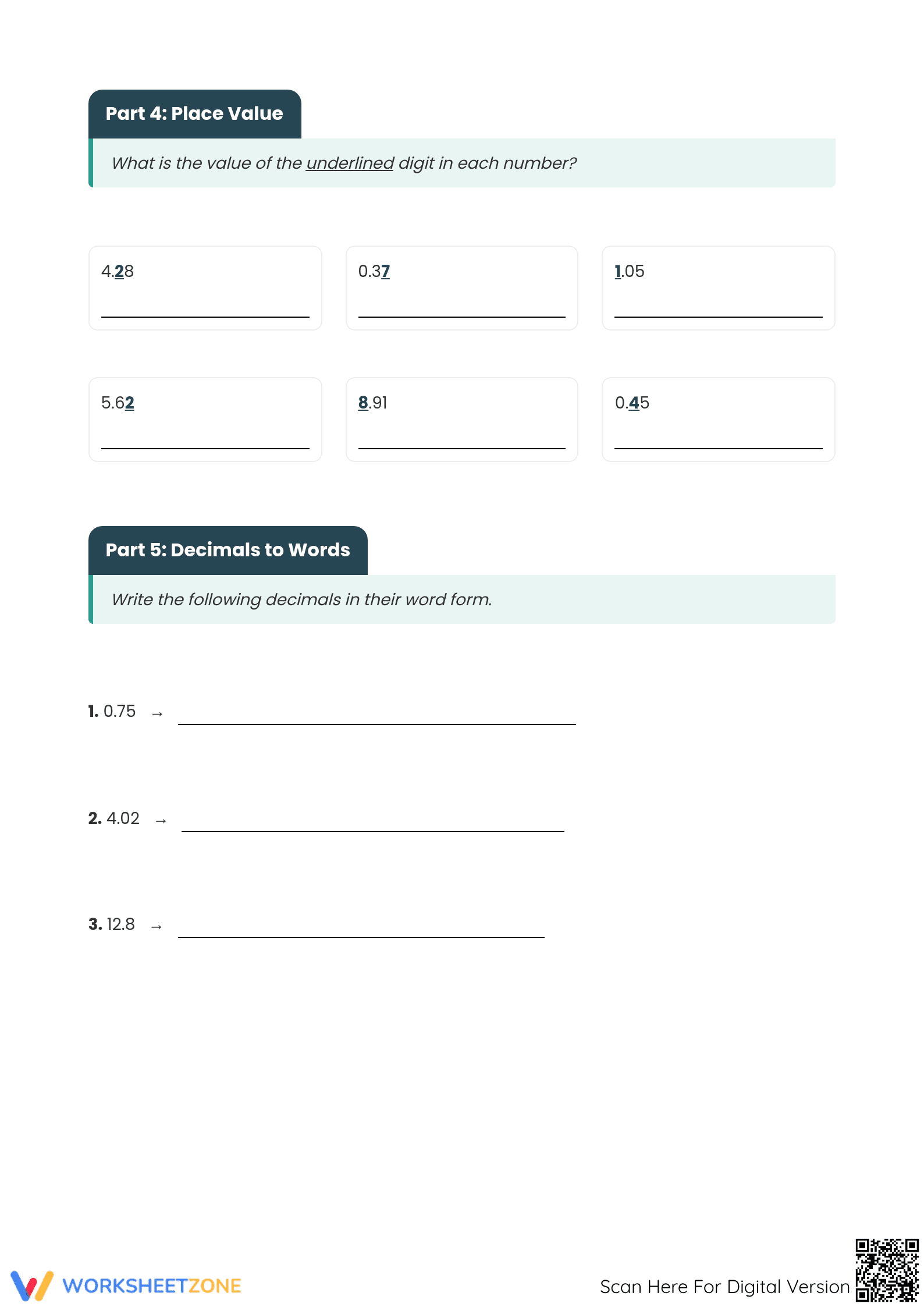
This resource contains six distinct sections designed for total decimal mastery. Across four printable pages, students engage with number lines, inequality statements, ordering sets from smallest to largest, and place value identification. The packet also includes a word-form conversion task and a mental math dash to reinforce computational speed and accuracy.
Designed for immediate implementation, this worksheet requires minimal teacher intervention. Teachers can Print (30 seconds) the four-page set directly from the PDF. Students Distribute (1 minute) and begin working through the scaffolded sections. Finally, Review (5 minutes) the results using the provided answer key, making this an ideal choice for substitute lesson plans.
The primary focus is CCSS.MATH.CONTENT.5.NBT.A.3, which requires students to read, write, and compare decimals to thousandths. Supporting standard CCSS.MATH.CONTENT.6.NS.B.3 is also addressed through the mental math section involving multi-digit decimal operations. Both standard codes can be copied directly into lesson plans, IEP goals, or district curriculum mapping tools to ensure instructional compliance.
Use this packet as a cumulative review after direct instruction on decimal place value and comparison. During the "Mental Math Dash," observe students to identify those struggling with rapid recall or basic subtraction facts. The multi-page format allows for flexible assignment; give the number line and comparison pages as an in-class activity and save the ordering and operations pages for independent homework. Expect completion in 35 minutes.
This resource is optimized for Grade 5-7 students requiring reinforced practice with decimal concepts. It serves as an excellent bridge for struggling learners or a solid refresher for upper-middle schoolers. Pair this worksheet with a visual decimal grid or anchor chart to support students who need concrete representations.
Research from RAND AIRS 2024 emphasizes that math worksheets integrating multiple representations—such as the number lines and word forms used here—significantly improve the retention of abstract numerical concepts. This resource directly targets the requirements of CCSS.MATH.CONTENT.5.NBT.A.3 by requiring students to transition between visual, symbolic, and linguistic models of decimals. By practicing the plain-English skill of reading, writing, and comparing decimal numbers to the hundredths and thousandths place, students develop the mental agility necessary for higher-level algebraic reasoning. Consistent exposure to these scaffolded task types allows educators to identify specific misconceptions in place value understanding before they compound into errors in complex operations. As noted in the RAND AIRS analysis, the inclusion of mental math components alongside conceptual tasks fosters both procedural fluency and conceptual depth, ensuring that Grade 5-7 learners are prepared for the rigorous demands of middle-school mathematical frameworks.


