


























Views
Downloads


Essential Significant Figures & Decimals | Grades 9-12
Paste this activity's link or code into your existing LMS (Google Classroom, Canvas, Teams, Schoology, Moodle, etc.).
Students can open and work on the activity right away, with no student login required.
You'll still be able to track student progress and results from your teacher account.
Master the precision required for high school science and math with this comprehensive significant figures and decimals worksheet. This resource helps students identify, round, and perform calculations with significant digits, ensuring they report measurements with the correct level of accuracy. It bridges the gap between raw data and professional scientific communication.
At a Glance
- Grade: 9–12 · Subject: Math
- Standard:
HSN.Q.A.3— Choose a level of accuracy appropriate to measurement limitations when reporting quantities- Skill Focus: Significant Figures & Rounding
- Format: 4 pages · 50+ problems · Answer key included · PDF
- Best For: High school chemistry and physics prep
- Time: 30–45 minutes
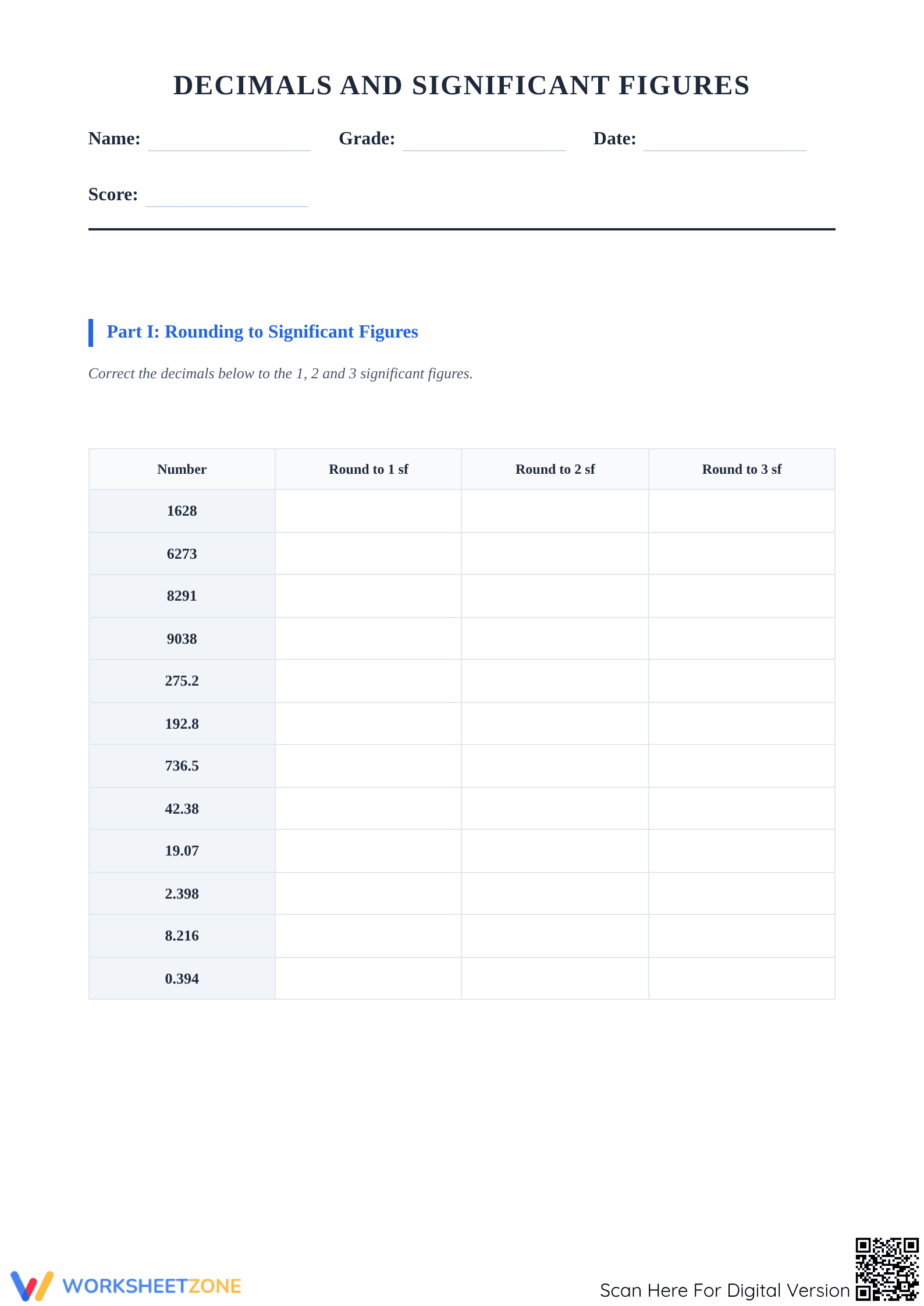
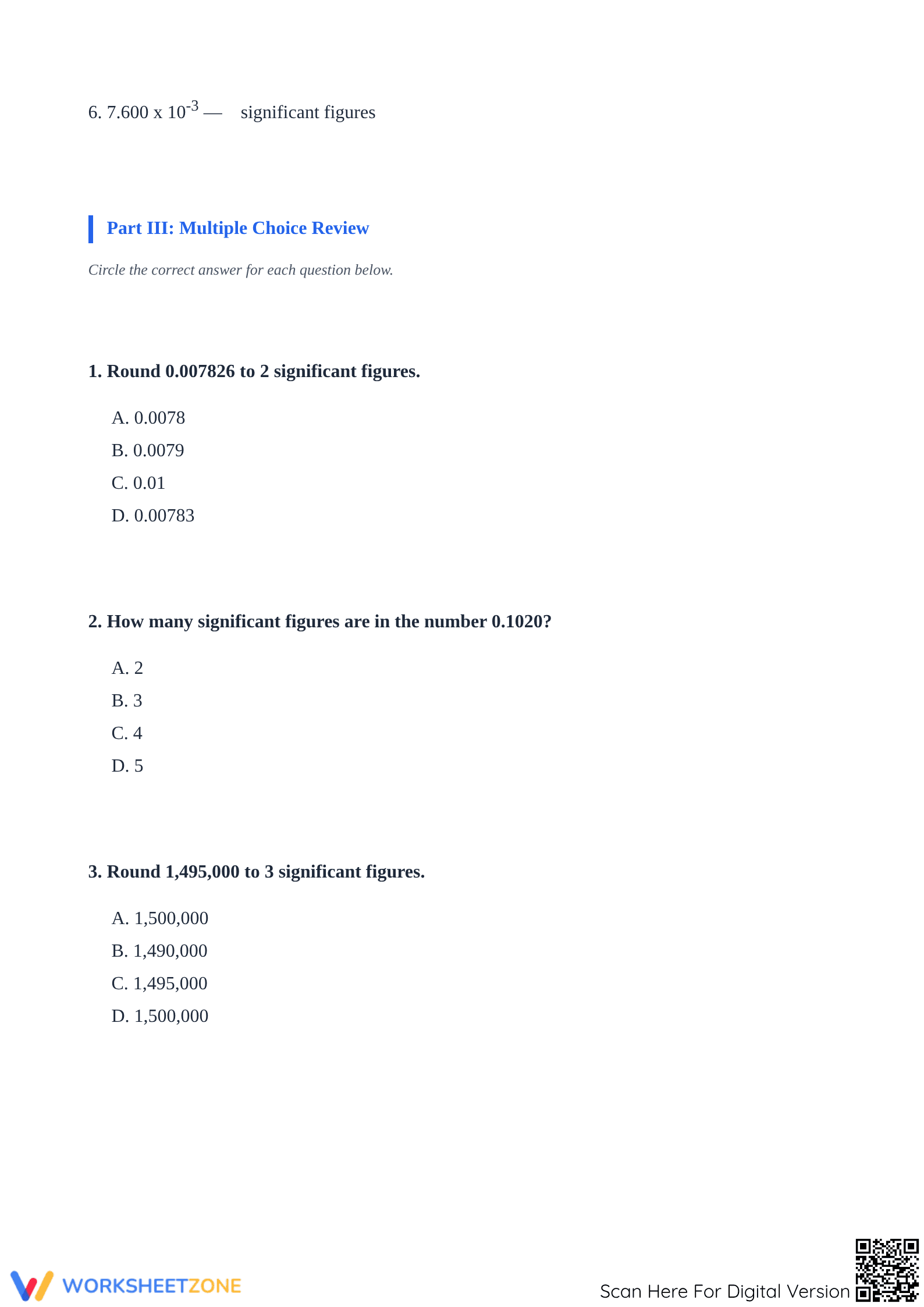
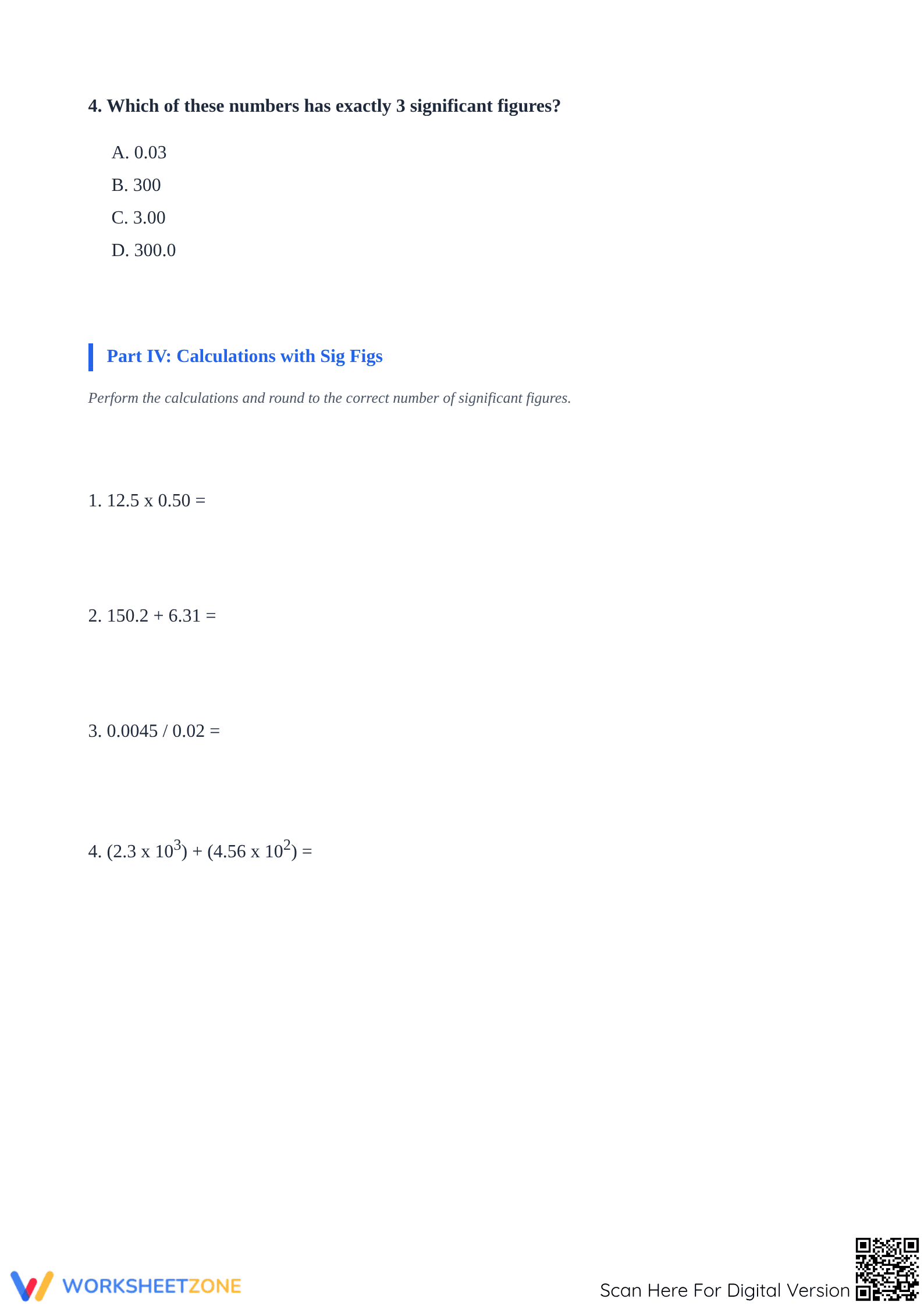
This four-page PDF resource provides a structured investigation into the rules of precision. It begins with a comprehensive rounding table where students practice converting 13 different numerical values into one, two, and three significant figures. Following this, students identify sig figs in varied contexts, including scientific notation. The worksheet concludes with multi-step calculations and a full answer key.
Skill Progression
- Guided Practice: Students use the initial rounding table to build a foundational understanding of which digits count, moving from simple whole numbers to complex decimals.
- Supported Practice: The identification section provides specific units to ground rules in real-world scenarios, reinforced by multiple-choice conceptual checks.
- Independent Practice: The final calculation section requires students to independently apply operations while maintaining the correct number of significant digits in their results.
The worksheet follows a gradual-release model for mastery.
Standards Alignment
This worksheet is primarily aligned with HSN.Q.A.3, which requires students to choose a level of accuracy appropriate to limitations on measurement when reporting quantities. By mastering significant figures, students fulfill the core requirement of reporting data that accurately reflects precision. Both standard codes can be copied directly into lesson plans, IEP goals, or district curriculum mapping tools.
How to Use It
- Science Lab Prep: Assign this worksheet at the start of a Chemistry or Physics unit to ensure students can accurately report lab data.
- Math Intervention: Use this as a post-instruction practice for students struggling with measurement precision. Expected completion time is 30 to 45 minutes. Observe student calculations to verify correct rule application.
Who It's For
This resource is designed for high school students in Grades 9 through 12, particularly those enrolled in Algebra, Chemistry, or Physics. It is ideal for students who need to move beyond basic rounding to understand scientific precision. It serves as a rigorous refresher before tackling complex laboratory reports or standardized testing.
Research from ScienceDirect TpT Analysis emphasizes that mastering significant figures is a critical threshold skill for success in secondary STEM education. Aligned to the HSN.Q.A.3 standard, this worksheet focuses on the plain-English skill of reporting measurements with appropriate accuracy. Without a firm grasp of precision rules, students often struggle with the higher-order reasoning required in chemistry labs. This resource addresses that gap by providing a high-volume, low-stakes environment for practice. This gradual transition from identification to calculation ensures that students don't just memorize rules but understand how they apply to mathematical operations. Students who complete these 50+ problems build the muscle memory needed for automaticity in measurement reporting, a prerequisite for advanced quantitative analysis. By isolating the mechanics of sig figs from complex scientific concepts, it allows for targeted skill acquisition and improved confidence in data reporting.


