


























Views
Downloads

Printable CCSS.MATH.CONTENT.5.NBT.A.3 Decimal Evaluation
Paste this activity's link or code into your existing LMS (Google Classroom, Canvas, Teams, Schoology, Moodle, etc.).
Students can open and work on the activity right away, with no student login required.
You'll still be able to track student progress and results from your teacher account.
Grade 5/6 Decimal Mastery Assessment
Ensuring students possess a deep understanding of decimal concepts is vital for their success in higher-level mathematics. This Grade 5 and 6 decimal evaluation provides a comprehensive assessment of essential skills, ranging from basic place value identification to complex multi-digit subtraction within real-world word problems. By working through these tasks, students demonstrate their ability to manipulate decimal values with accuracy.
At a Glance
- Grade: 5 · Subject: Math
- Standard:
CCSS.MATH.CONTENT.5.NBT.A.3— Read, write, and compare decimals to the thousandths place.- Skill Focus: Place value, ordering, and operations
- Format: 3 pages · 12 problems · Answer key included · PDF
- Best For: Summative assessment of term decimal skills
- Time: 30–45 minutes
What's Inside
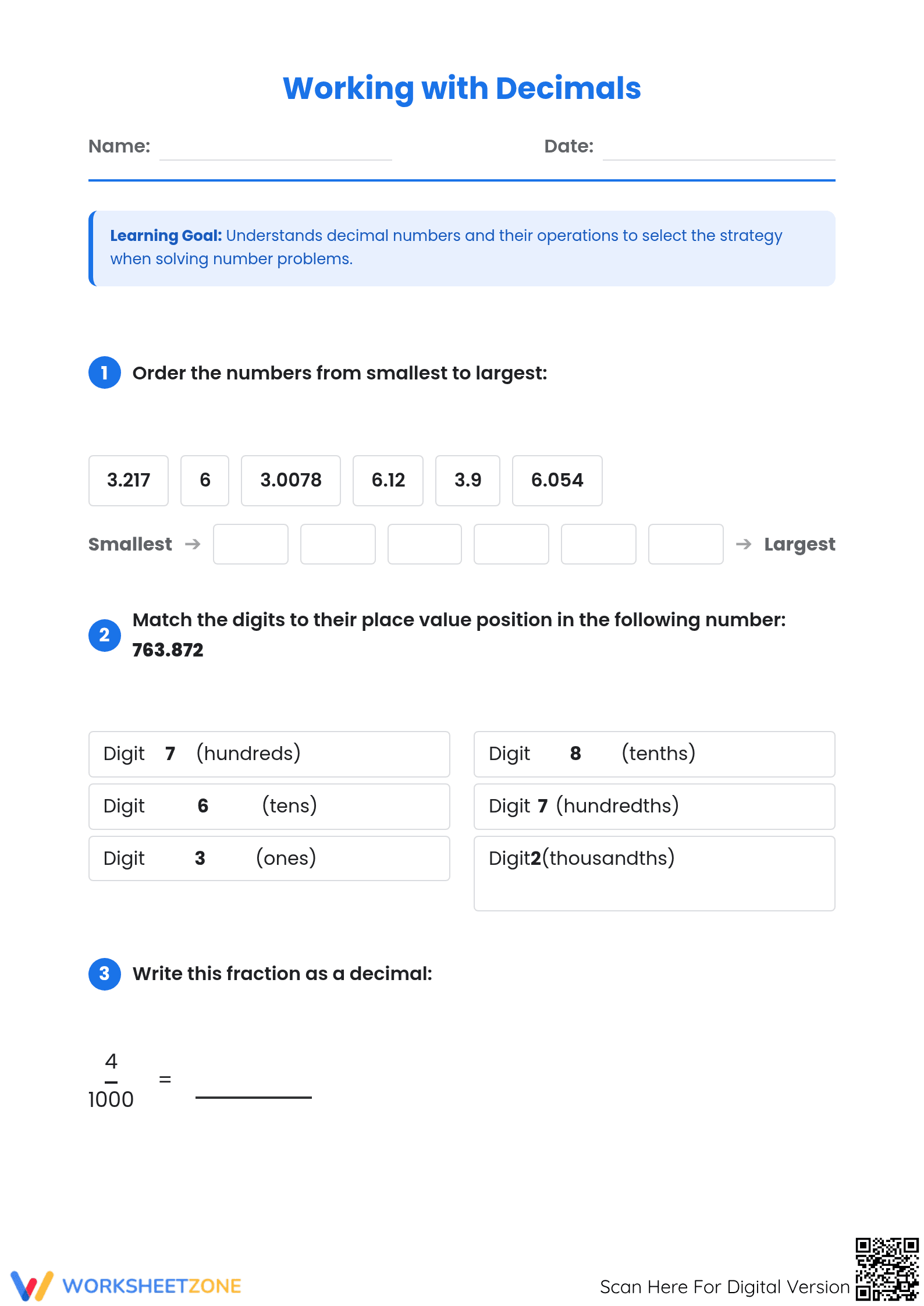
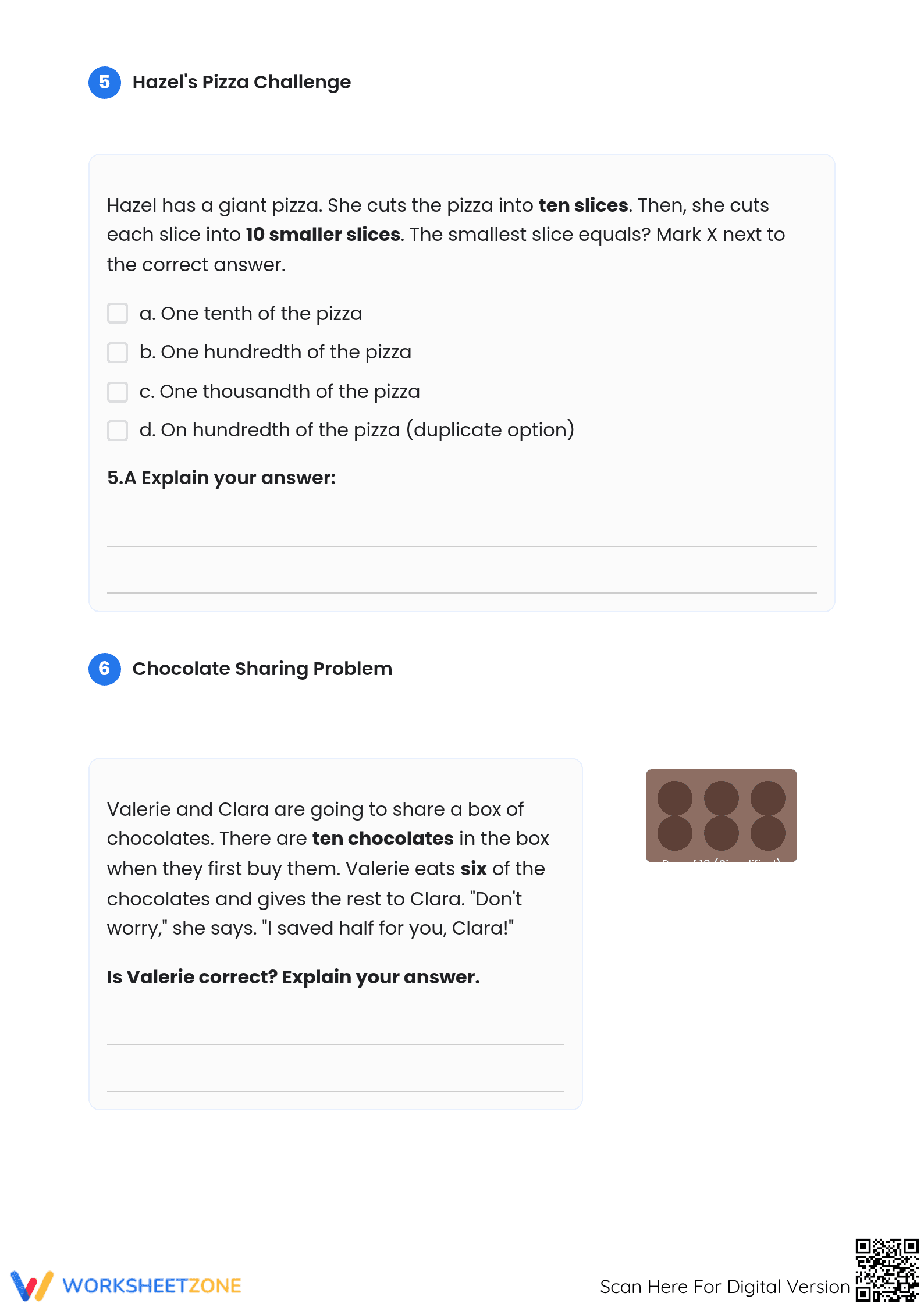
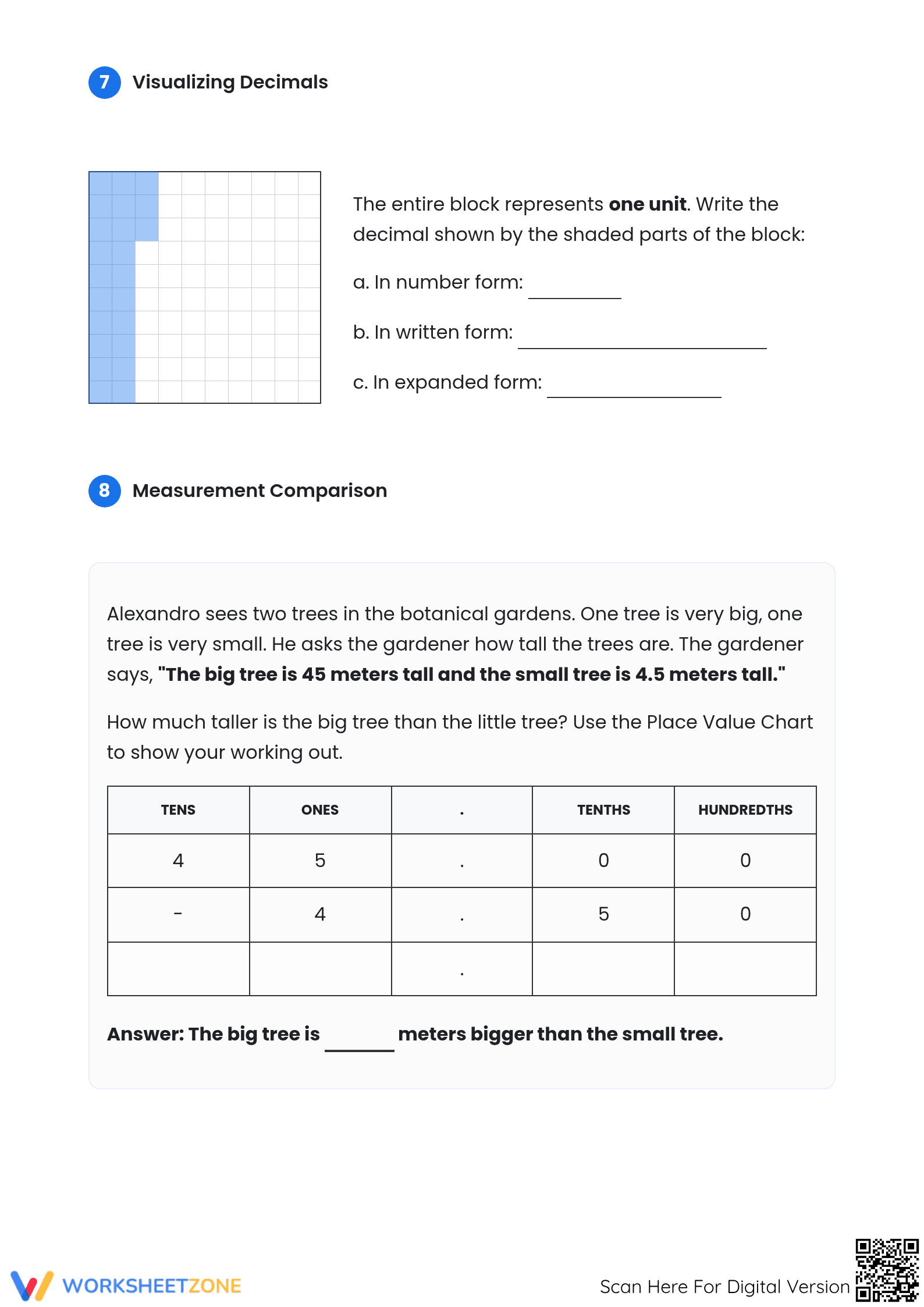
This three-page worksheet features 12 distinct tasks designed to probe various facets of decimal fluency. Students will encounter ordering exercises that require comparing values like 3.217 and 3.0078, place value matching for multi-digit numbers, and fraction-to-decimal conversions. The resource also includes visual hundredths grids to support conceptual understanding and structured place value charts to guide students through decimal subtraction operations.
Mastery Evidence
The evaluation is structured to provide clear evidence of student mastery across the decimal strand. Specific tasks are mapped to CCSS benchmarks: ordering tasks verify comparison skills, while the measurement comparison task provides data on operational accuracy. Teachers can use the layout to identify whether a student is approaching, meeting, or exceeding grade-level expectations, and scores can be entered directly into gradebooks or IEP progress notes.
Standards Alignment
The primary focus is CCSS.MATH.CONTENT.5.NBT.A.3, which requires students to read, write, and compare decimals to thousandths. Additionally, the worksheet supports CCSS.MATH.CONTENT.5.NBT.B.7 by challenging students to subtract decimals using concrete models or drawings. Both standard codes can be copied directly into lesson plans, IEP goals, or district curriculum mapping tools to ensure instructional alignment with state and national requirements.
How to Use It
This resource is best as a summative assessment at the end of a unit or as a benchmark to gauge readiness. It can also serve as a rigorous homework or review session. One formative assessment tip: during the visual grid task, observe if students correctly identify shaded hundredths, as this reveals their underlying grasp of part-to-whole relationships and identifies specific misconceptions regarding decimal magnitude.
Who It's For
Designed for Grade 5 and 6 learners, this worksheet offers scaffolds for a wide range of abilities. Visual models make it accessible for English Language Learners, while multi-step word problems provide rigor for advanced students. It pairs naturally with decimal place value anchor charts or digital manipulatives for a well-rounded instructional experience that addresses diverse student needs.
The development of decimal fluency is a critical milestone in upper elementary mathematics, serving as a bridge to more complex algebraic thinking and real-world data interpretation. This worksheet is purposefully designed to align with CCSS.MATH.CONTENT.5.NBT.A.3, focusing on the essential skill of reading, writing, and comparing decimals to the thousandths place. By integrating visual models like hundredths grids and structured supports such as place value charts, the resource mirrors the gradual release of responsibility model advocated by Fisher & Frey (2014). Research indicates that students who master these foundational place value relationships are better equipped for secondary-level ratios and proportions. The inclusion of multi-step word problems ensures that learners apply their understanding of decimal operations in practical scenarios, from measurement comparisons to fractional sharing. Educators can utilize this assessment to gather robust evidence of student mastery, ensuring that every learner can accurately navigate the transition between fractional and decimal representations with confidence and precision.


