


























Views
Downloads
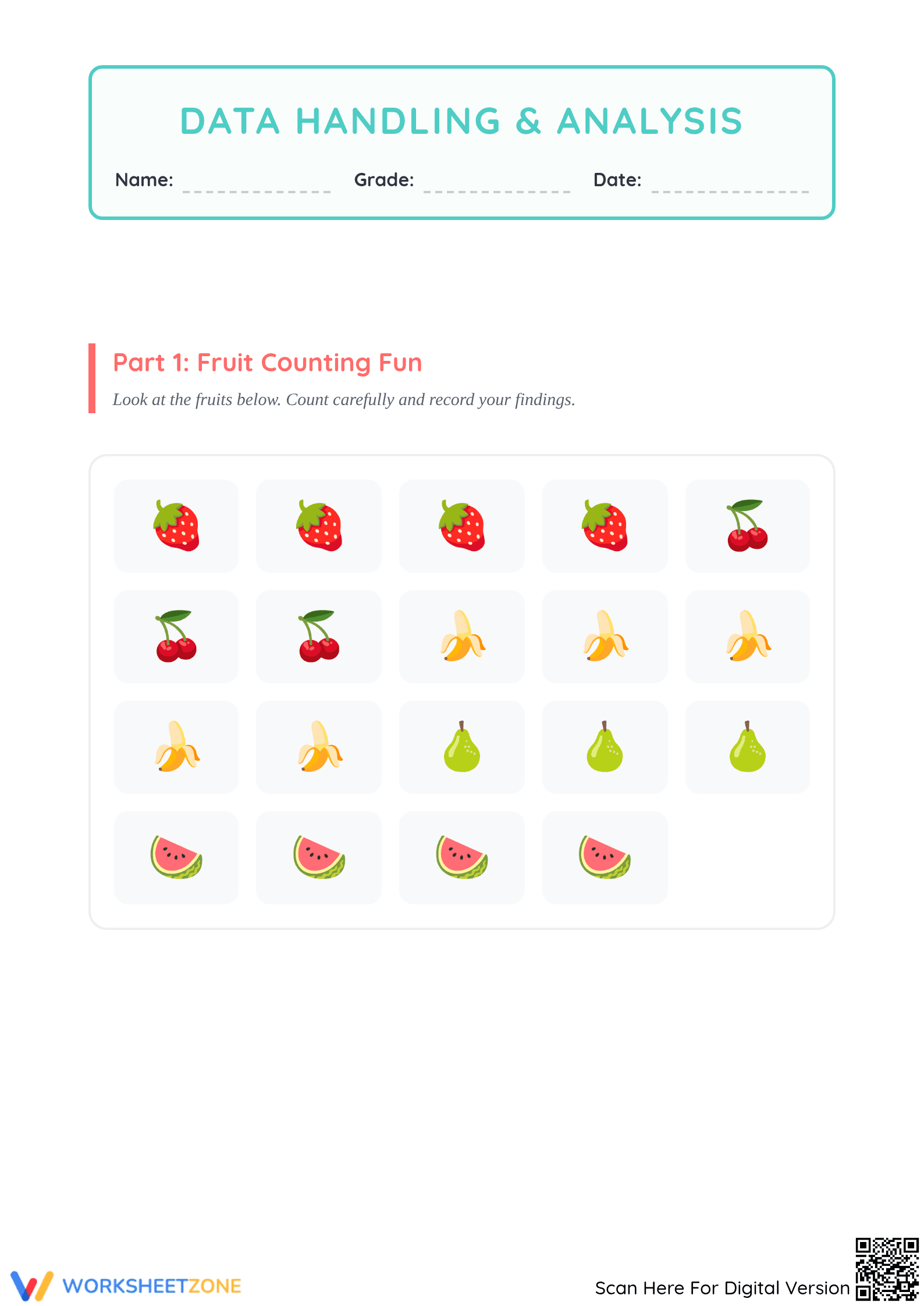



Printable Data & Graphing Worksheet | Grade 3 Math
Paste this activity's link or code into your existing LMS (Google Classroom, Canvas, Teams, Schoology, Moodle, etc.).
Students can open and work on the activity right away, with no student login required.
You'll still be able to track student progress and results from your teacher account.
This worksheet provides targeted practice for third-graders on interpreting data from pictographs and bar graphs. Through 14 questions across four pages, learners build confidence in reading and analyzing graphical data. It's a straightforward resource for reinforcing instruction and developing foundational mathematical reasoning.
At a Glance
- Grade: 3 · Subject: Math
- Standard:
CCSS.MATH.CONTENT.3.MD.B.3— Represent and interpret data using scaled bar graphs.- Skill Focus: Interpreting Bar Graphs and Pictographs
- Format: 4 pages · 14 problems · Answer key included · PDF
- Best For: Independent practice, station work, or formative assessment.
- Time: 20–30 minutes
What's Inside
This 5-page PDF includes four student activity sheets and a one-page answer key. The first two pages focus on analyzing a bar graph, while the next two challenge students with a pictograph. The clear, numbered questions make it easy for students to follow and teachers to grade.
Skill Progression
This worksheet set uses a gradual-release model to build student independence.
- Guided practice: The first page introduces the bar graph with four direct-retrieval questions, serving as the "I Do" or "We Do" part of the lesson.
- Supported practice: The second page offers more complex, two-step problems requiring simple calculations based on the same graph.
- Independent practice: The final two pages transition to a pictograph, where students apply their skills independently to a fresh data set.
This progression moves students from basic reading to analysis.
Standards Alignment
This worksheet directly aligns with CCSS.MATH.CONTENT.3.MD.B.3, which requires students to interpret scaled picture and bar graphs. It provides essential practice for the interpretive component of this standard and builds on the foundational skills from CCSS.MATH.CONTENT.2.MD.D.10. Both standard codes can be copied directly into lesson plans, IEP goals, or curriculum maps.
How to Use It
This resource is flexible. Use it as independent practice after a graphing lesson or as a math station activity. For formative assessment, observe where students struggle to identify common misconceptions. The clear format also makes it an excellent resource for a substitute teacher's plan. The entire packet should take most students 20–30 minutes to complete.
Who It's For
Designed for third-grade students, this worksheet can also serve as review for fourth graders or an extension for advanced second graders. Its visual nature supports English Language Learners and students who benefit from concrete data representation. This resource pairs well with an introductory lesson using a classroom anchor chart that defines the parts of a graph.
Effective data literacy begins with structured practice in early grades. This worksheet aligns with standard CCSS.MATH.CONTENT.3.MD.B.3, focusing on the critical skill of interpreting graphical data. Research consistently shows that proficiency with data representation is a key predictor of later success in STEM fields. According to the NAEP, students who can interpret data from charts and graphs perform significantly better on overall mathematics assessments. This resource provides the focused, repetitive practice necessary for students to internalize the process of extracting and analyzing information from bar graphs and pictographs. The clear progression from simple to complex questions mirrors the scaffolding techniques recommended by Fisher & Frey (2014), ensuring that students build both competence and confidence. By mastering this foundational skill, students are better prepared for more advanced statistical concepts.


