


























Views
Downloads



Printable Data Collection Worksheet | Grades K-2 Math
Paste this activity's link or code into your existing LMS (Google Classroom, Canvas, Teams, Schoology, Moodle, etc.).
Students can open and work on the activity right away, with no student login required.
You'll still be able to track student progress and results from your teacher account.
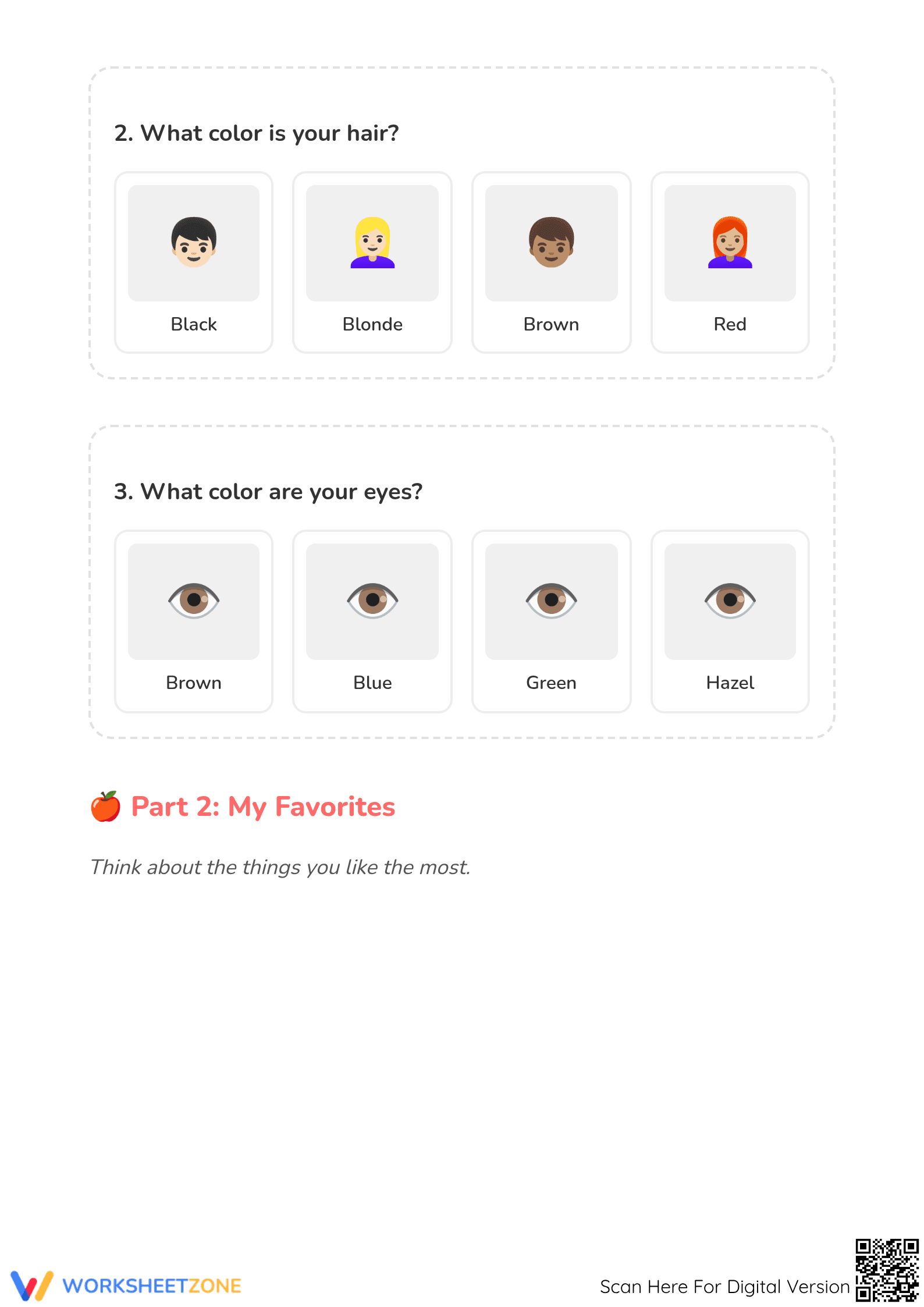
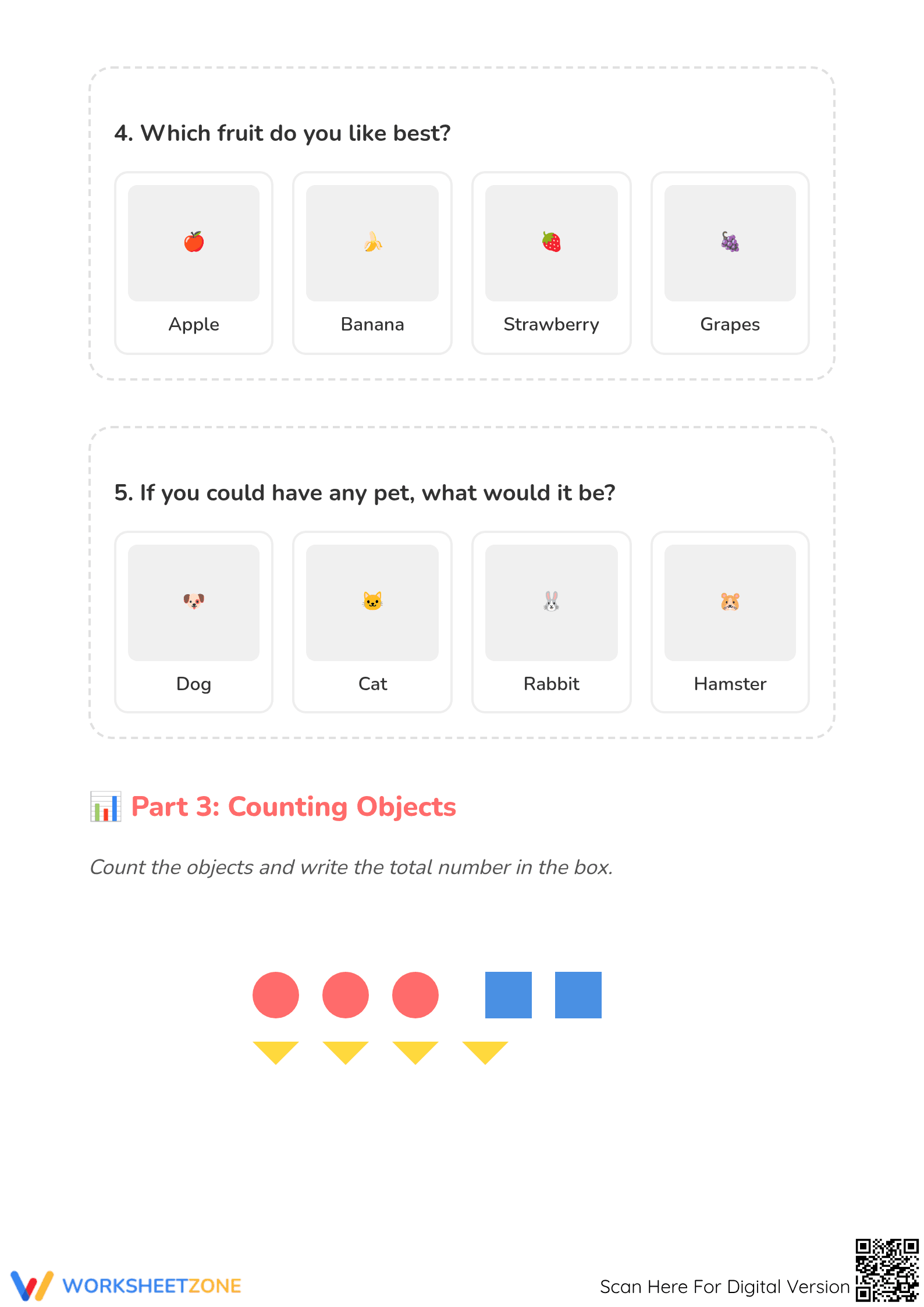
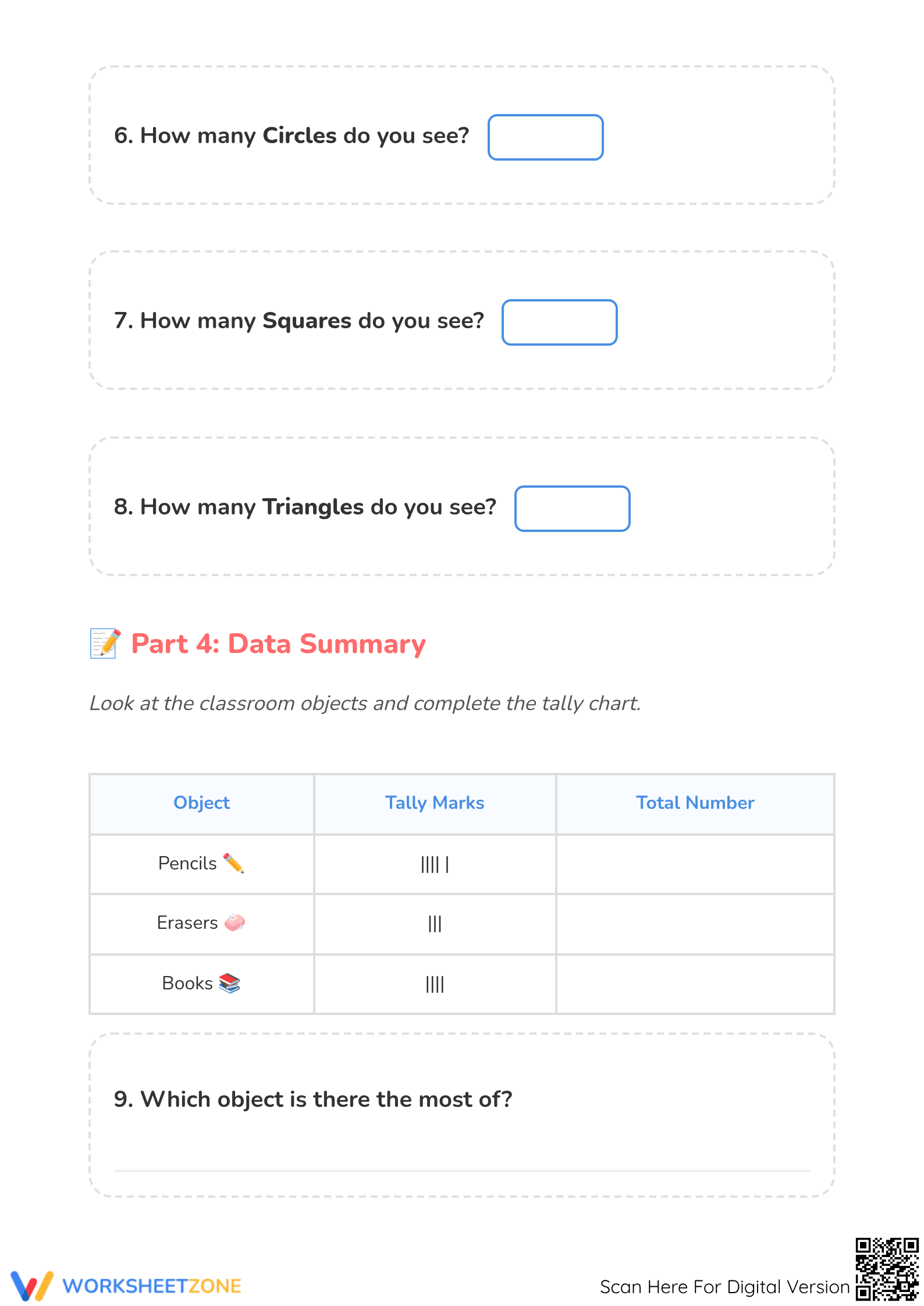
This comprehensive 5-page worksheet set helps early learners master data collection and interpretation through engaging visual sets. Students observe varied groups of objects, count specific categories, and answer analytical questions to build foundational statistics skills. By moving from simple identification to comparative analysis, children develop the mathematical reasoning necessary for Grade 1 and Grade 2 success.
At a Glance
- Grade: K–2 · Subject: Math (Data)
- Standard:
CCSS.MATH.CONTENT.1.MD.C.4— Organize, represent, and interpret data with up to three categories.- Skill Focus: Data collection and analysis
- Format: 5 pages · 24 problems · Answer key included · PDF
- Best For: Early elementary math centers and homework
- Time: 20–30 minutes
The packet contains five distinct pages of practice, each featuring unique visual data sets ranging from fruits and school supplies to animals. Each page presents a collection of items followed by a series of four to six structured questions. These questions require students to count individual groups, determine totals, and perform basic comparisons using terms like "most" and "least." A full five-page answer key is included for rapid grading.
This resource is designed for a seamless, zero-prep classroom experience. Teachers can print the five-page packet in less than 30 seconds, distribute it immediately to students, and utilize the provided answer key for review in under two minutes. The self-explanatory layout makes it an ideal option for emergency sub plans or independent math station rotations where teacher intervention is minimal.
Aligned primarily to `CCSS.MATH.CONTENT.1.MD.C.4`, the worksheet focuses on organizing and interpreting data with up to three categories. It also supports `CCSS.MATH.CONTENT.K.MD.B.3` by asking students to classify objects into given categories and count the numbers of objects in each. Both standard codes can be copied directly into lesson plans, IEP goals, or district curriculum mapping tools.
Use this worksheet during the practice phase of a gradual release model after introducing tally marks or pictographs. It serves as an excellent formative assessment tool; observe if students use a "cross-off" method when counting to gauge their organizational accuracy. Expected completion time is roughly 25 minutes for the full set, or five minutes per individual page.
Designed for Kindergarten, Grade 1, and Grade 2 students, this resource provides essential scaffolds for learners struggling with one-to-one correspondence. It pairs naturally with physical manipulatives or a classroom anchor chart detailing data vocabulary. The high-contrast images ensure accessibility for diverse learners needing visual clarity during independent practice.
Early exposure to data interpretation is critical for developing the logical-mathematical structures required for advanced STEM subjects. According to the RAND AIRS 2024 report, structured visual aids in early elementary math significantly improve the retention of categorization skills compared to abstract numerical sets alone. This worksheet utilizes high-signal imagery to reduce cognitive load while students focus on the primary task of organizing information into three distinct categories. By asking comparative questions such as which group has the "least" or "most" items, the material reinforces the standard CCSS.MATH.CONTENT.1.MD.C.4 through applied problem-solving. Educators can rely on this resource to provide the consistent, high-repetition practice necessary for students to move from simple counting to data-driven decision making. The inclusion of a comprehensive answer key further supports instructional efficiency and immediate feedback loops in diverse classroom settings.


