


























Views
Downloads
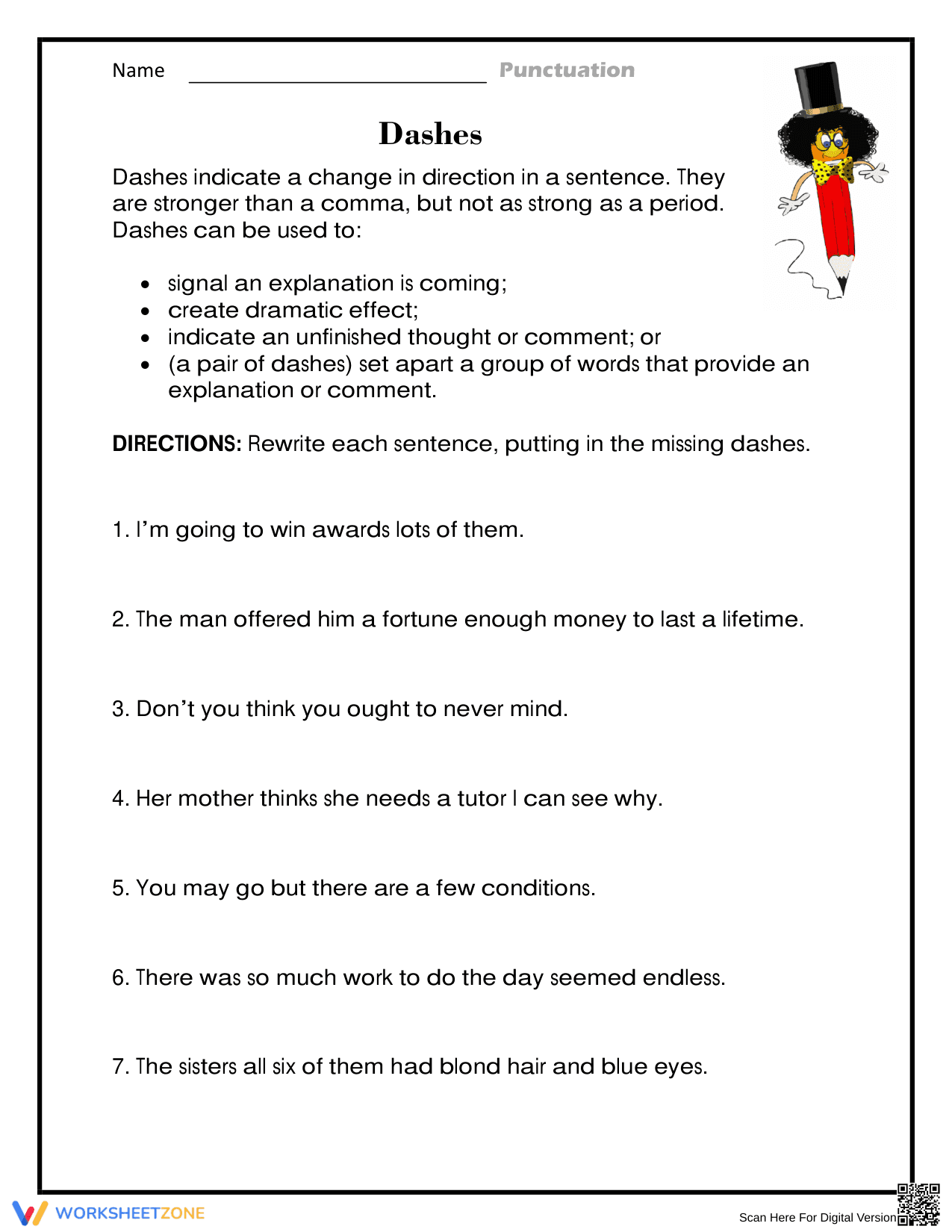

Grade 5 Dashes — Printable No-Prep Punctuation Worksheet
Paste this activity's link or code into your existing LMS (Google Classroom, Canvas, Teams, Schoology, Moodle, etc.).
Students can open and work on the activity right away, with no student login required.
You'll still be able to track student progress and results from your teacher account.
Dashes are a sophisticated punctuation tool that can transform student writing by adding emphasis or signaling sudden changes in thought. This worksheet provides clear rules and immediate practice to help Grade 5 students master dash usage in their compositions. Students will learn to use dashes for dramatic effect and clarity, improving overall sentence structure.
At a Glance
- Grade: 5 · Subject: ELA Grammar
- Standard:
CCSS.ELA-LITERACY.L.5.2— Use punctuation to separate items and clarify meaning in sentences- Skill Focus: Dash placement and function
- Format: 1 page · 7 problems · Answer key included · PDF
- Best For: Grammar warm-ups and independent practice
- Time: 10–15 minutes
What's Inside
This resource features a dedicated instruction block defining four primary use cases for dashes: signaling explanations, dramatic effect, unfinished thoughts, and parenthetical information. Students are presented with seven sentences that require rewriting. This single-page PDF provides ample space for revised sentences while internalizing the rhythmic flow that dashes provide to English prose.
Zero-Prep Workflow
The zero-prep design makes it ideal for busy educators reinforcing grammar without additional planning. In under two minutes, teachers can print copies for the class. Distribution takes seconds, and students can begin immediately thanks to the self-explanatory rules. The seven-task format allows for quick review, making it perfect for substitute folders or bell-ringers.
Standards Alignment
Mastery aligns with CCSS.ELA-LITERACY.L.5.2, which requires students to demonstrate command of the conventions of standard English punctuation. While the core focuses on overall proficiency, dashes specifically address clarity and sophisticated construction. This standard code can be copied directly into lesson plans, IEP goals, or district curriculum mapping tools to document student progress in punctuation mastery.
How to Use It
Use this as a targeted formative assessment after a mini-lesson on sentence variety. Observe students rewriting the fourth sentence; if they struggle with the break, discuss how dashes function as a 'stronger comma.' Assign this for independent practice where students read sentences aloud to hear the dramatic pause created by the dash.
Who It's For
This is tailored for Grades 4-5 students ready to expand their punctuation repertoire beyond basic commas. It is effective for creative writers wanting to represent dialogue or internal monologue accurately. The examples also support English Language Learners navigating the subtle differences between different types of structural pauses.
According to the RAND AIRS 2024 report on literacy instruction, the explicit teaching of sophisticated punctuation marks like dashes is a critical component of developing mature writing styles in the upper elementary grades. Research indicates that when students move beyond simple sentence structures, they require specialized tools to manage complex ideas and varied sentence rhythms. By providing structured practice with dashes, educators help bridge the gap between basic grammar and high-level composition. This Grade 5 worksheet focuses on the CCSS.ELA-LITERACY.L.5.2 standard, ensuring that students can use punctuation to clarify meaning and signal transitions effectively. The seven-task structure provides sufficient repetition for skill acquisition without causing cognitive overload. Mastering the plain-English skill of using dashes for dramatic effect or explanation prepares students for the rigorous writing demands of middle school and beyond.


