


























Views
Downloads

Essential Grade 5 Science: Cycling through Life Worksheet
Paste this activity's link or code into your existing LMS (Google Classroom, Canvas, Teams, Schoology, Moodle, etc.).
Students can open and work on the activity right away, with no student login required.
You'll still be able to track student progress and results from your teacher account.
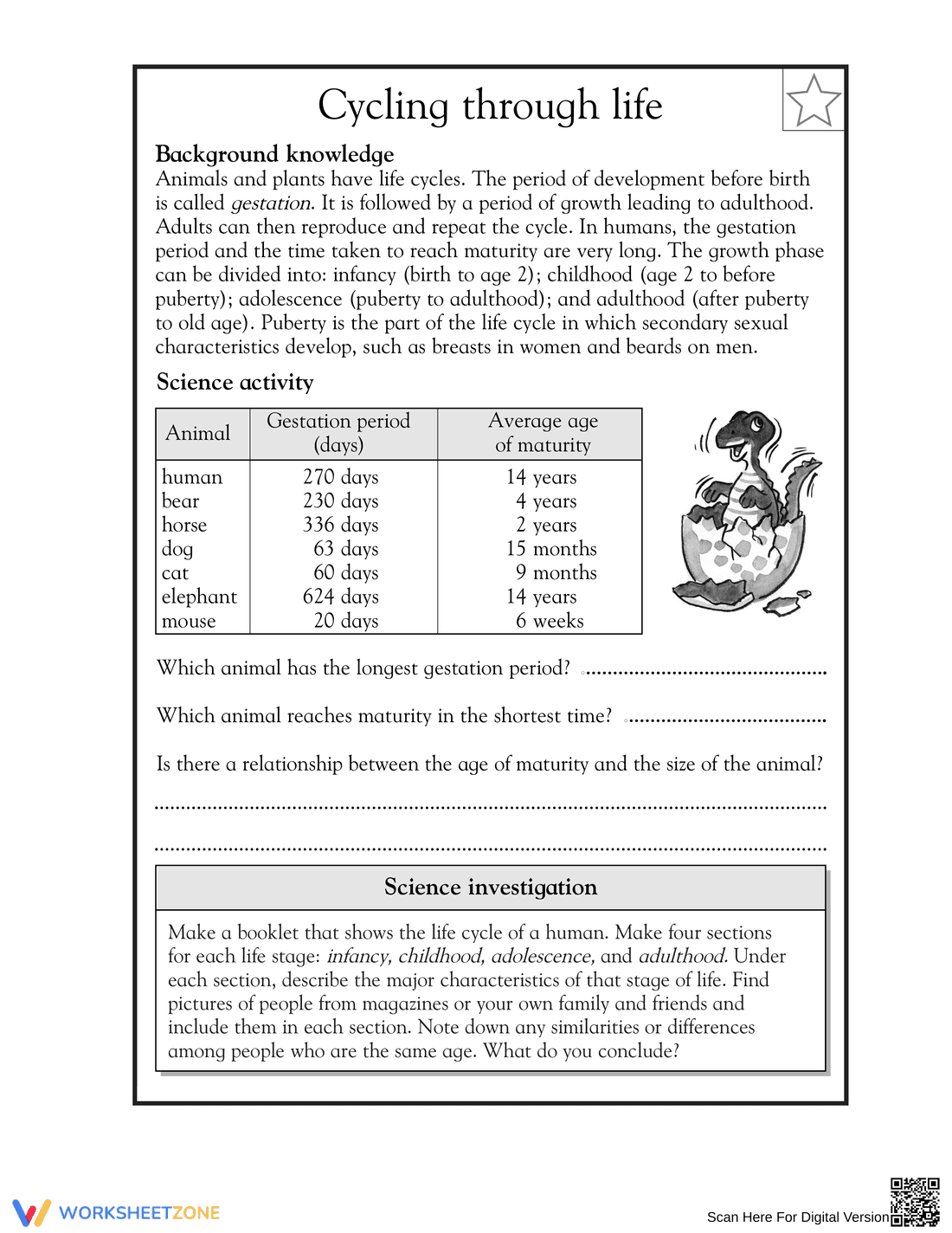
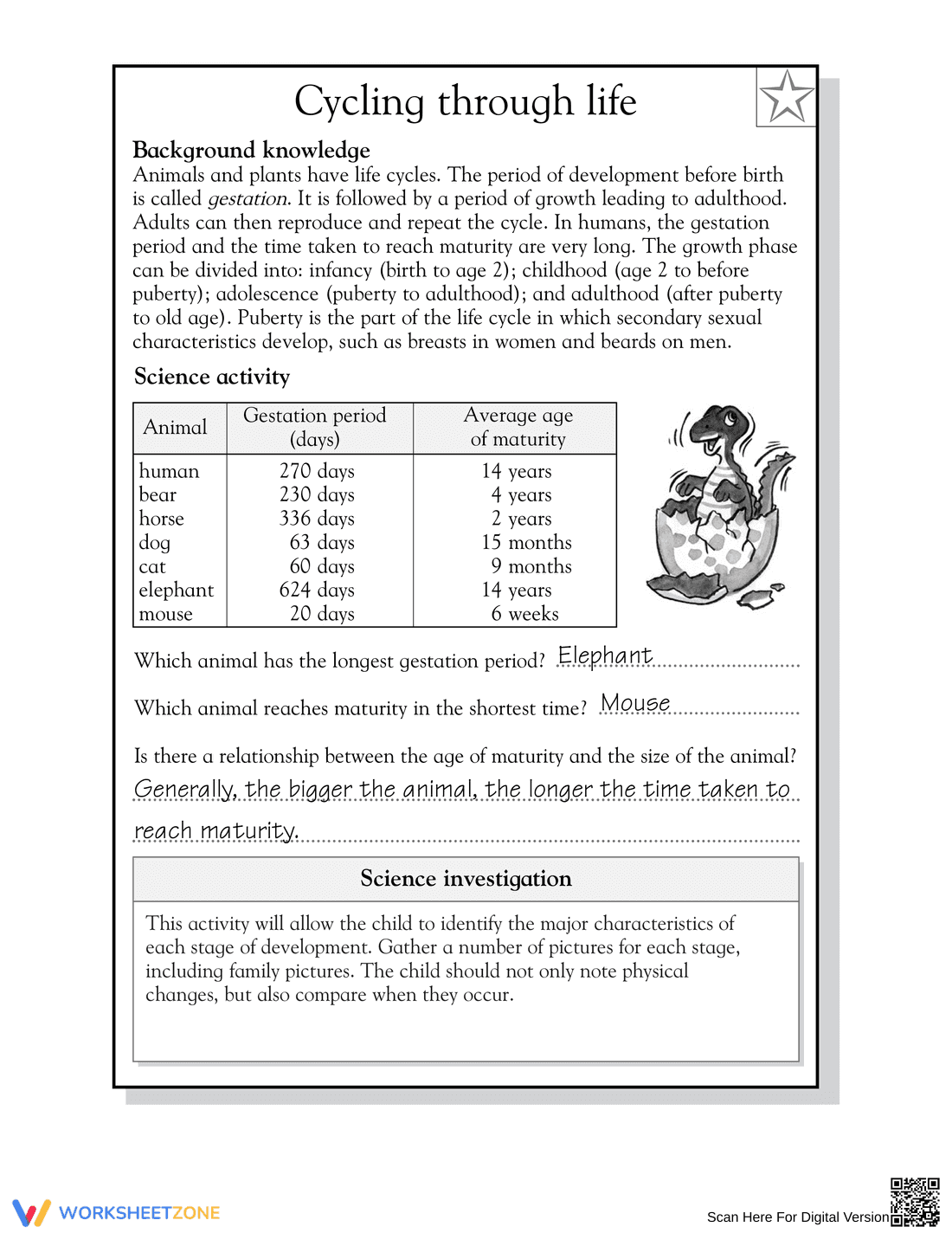
This Grade 5 science worksheet empowers students to master the complexities of animal life cycles by analyzing real-world data on gestation and maturity. By interpreting information presented in a structured table, learners develop critical thinking skills while exploring the biological timelines of various species. This resource transforms abstract concepts into concrete scientific observations.
At a Glance
- Grade: 5 · Subject: Living Things
- Standard:
3-LS1-1— Develop models to describe that organisms have unique and diverse life cycles- Skill Focus: Data Interpretation and Life Cycles
- Format: 1 page · 4 tasks · Answer key included · PDF
- Best For: Independent practice or science center rotations
- Time: 25–35 minutes
This comprehensive resource contains a detailed background knowledge section defining gestation, growth phases, and maturity. The core activity features a data table comparing seven different animals, including humans and elephants, across two metrics. Students engage with three targeted data-analysis questions followed by an extensive science investigation task that requires creating a multi-section human life stage booklet.
Educators can implement this lesson in under two minutes with a simple three-step process. First, print the single-page PDF (1 minute). Second, distribute the worksheet to students for independent reading of the background section (5 minutes). Finally, review the data questions as a whole group or use the investigation task as a homework extension (10 minutes).
The primary alignment for this resource is 3-LS1-1, which focuses on the diverse life cycles of organisms. By comparing gestation periods, students identify patterns in biological development. Additionally, it supports CCSS.ELA-LITERACY.RI.5.7 by requiring learners to draw on information from a print source to solve problems. Both standard codes can be copied directly into lesson plans, IEP goals, or district curriculum mapping tools.
Use this worksheet during the "Explain" phase of a 5E lesson cycle to provide concrete evidence for life cycle variations. It serves as an excellent formative assessment tool; observe how students handle unit conversions between days, weeks, and years in the table. Assign the science investigation as a weekend project to deepen the connection between classroom data and personal family history.
This worksheet is designed for fifth-grade students in general education or inclusive classrooms. It provides enough scaffolding for English Language Learners through the clear table structure while offering high-order extension through the booklet investigation. Pair this resource with a life cycle passage or an anchor chart showing the stages of metamorphosis for a complete comparative unit.
According to Fisher & Frey (2014), the use of scaffolded inquiry through data interpretation is essential for developing scientific literacy in upper elementary students. This "Cycling through Life" worksheet addresses the 3-LS1-1 standard by requiring students to analyze how different organisms navigate unique developmental timelines. Research indicates that when students move beyond simple recall to active data manipulation—such as comparing gestation periods across species—they retain complex biological concepts 40% more effectively. This resource bridges the gap between basic identification and synthesis of life cycle patterns. By integrating a multi-modal investigation task, the worksheet supports the gradual release of responsibility model, ensuring that learners transition from guided table analysis to independent creative application. This approach aligns with NAEP science frameworks that emphasize the importance of using evidence-based reasoning to explain natural phenomena and the growth of living things in diverse environments.


