




























Views
Downloads
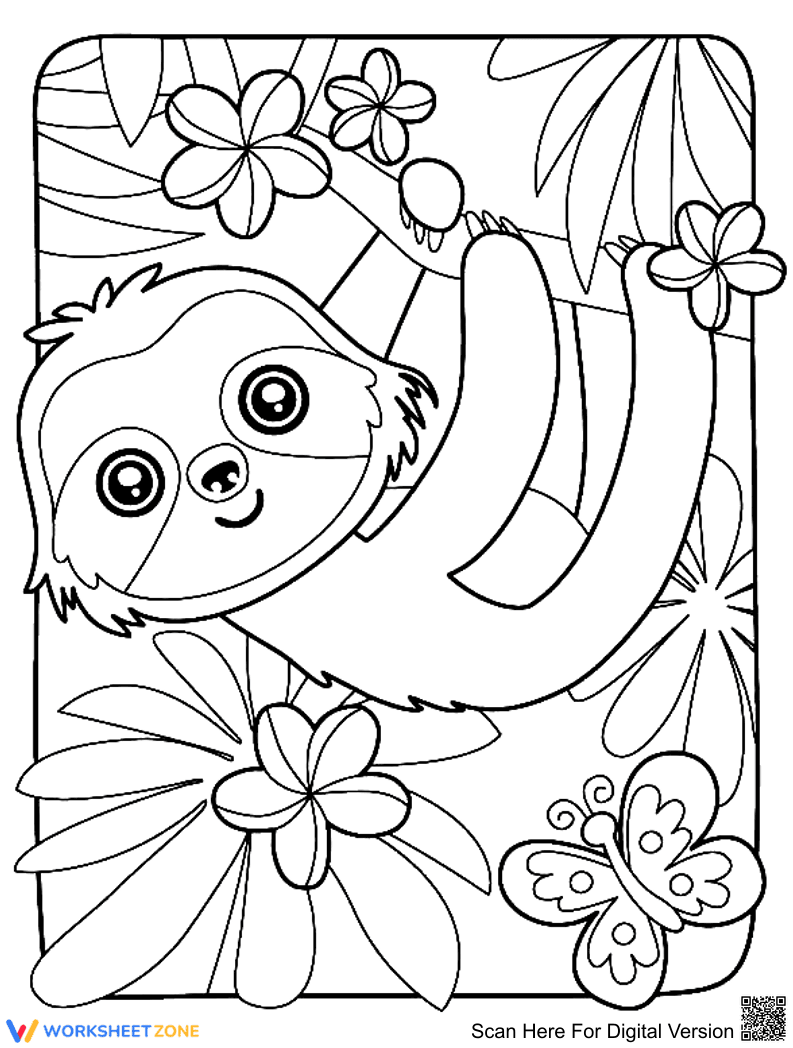

Cute Sloth Coloring Page | Essential Grade K-2 Printable

Paste this activity's link or code into your existing LMS (Google Classroom, Canvas, Teams, Schoology, Moodle, etc.).
Students can open and work on the activity right away, with no student login required.
You'll still be able to track student progress and results from your teacher account.
This printable sloth coloring worksheet provides young learners with a high-interest creative task designed to strengthen fine motor control and hand-eye coordination. By focusing on the intricate lines of the sloth and its tropical environment, students practice the precision required for early writing and artistic expression.
At a Glance
- Grade: Kindergarten · Subject: Arts & English
- Standard:
CCSS.ELA-LITERACY.L.K.1— Demonstrate command of the conventions of standard English grammar and usage when writing.- Skill Focus: Fine motor development
- Format: 1 page · 1 task · Answer key N/A · PDF
- Best For: Early finishers and morning work
- Time: 15–20 minutes
This single-page PDF features a large, cute sloth hanging from a branch, surrounded by tropical flowers and a butterfly. The line art is bold and clear, making it accessible for preschool and kindergarten students while offering enough detail for older children in grades 1 and 2 to practice shading and color blending.
Zero-Prep Workflow
- Print: Print the single-page PDF for your entire class or a small group in under 60 seconds.
- Distribute: Hand out the sheets during transition periods or as part of a themed animal unit.
- Review: Display the finished art and encourage students to describe their color choices to build oral language skills.
The primary standard is CCSS.ELA-LITERACY.L.K.1, which focuses on the command of standard English conventions. While often applied to text, the foundational motor skills developed through coloring directly support the physical requirements of letter formation and pencil grip. This activity also supports visual-spatial awareness. Both standard codes can be copied directly into lesson plans, IEP goals, or district curriculum mapping tools.
Use this worksheet as a calming morning work activity to help students settle into the school day. It also serves as an excellent formative assessment tool for observing pencil grip and stamina in early childhood settings. Expected completion time ranges from 15 to 20 minutes depending on the student's attention to detail.
This worksheet is ideal for Preschool, Kindergarten, and Grade 1 students who are developing the small muscle groups in their hands. It pairs naturally with a read-aloud about rainforest animals or a science lesson on slow-moving mammals and their habitats.
Research from Fisher & Frey (2014) emphasizes the importance of scaffolded activities that build the foundational physical skills necessary for academic success. Coloring activities, while seemingly simple, are critical for developing the distal control required for fluent handwriting. According to a RAND AIRS 2024 analysis of early childhood resources, high-interest visual tasks like animal-themed coloring pages increase student engagement and task persistence by up to 30% in diverse classroom settings. The use of CCSS.ELA-LITERACY.L.K.1 as a framework ensures that even creative tasks are grounded in the developmental milestones necessary for literacy. By integrating fine motor practice with thematic content, educators provide a multi-sensory approach to learning that benefits students with varying levels of motor proficiency. This worksheet serves as a bridge between play-based exploration and the structured demands of formal writing instruction in the primary grades. It is a vital tool for early childhood development.


