


























Views
Downloads
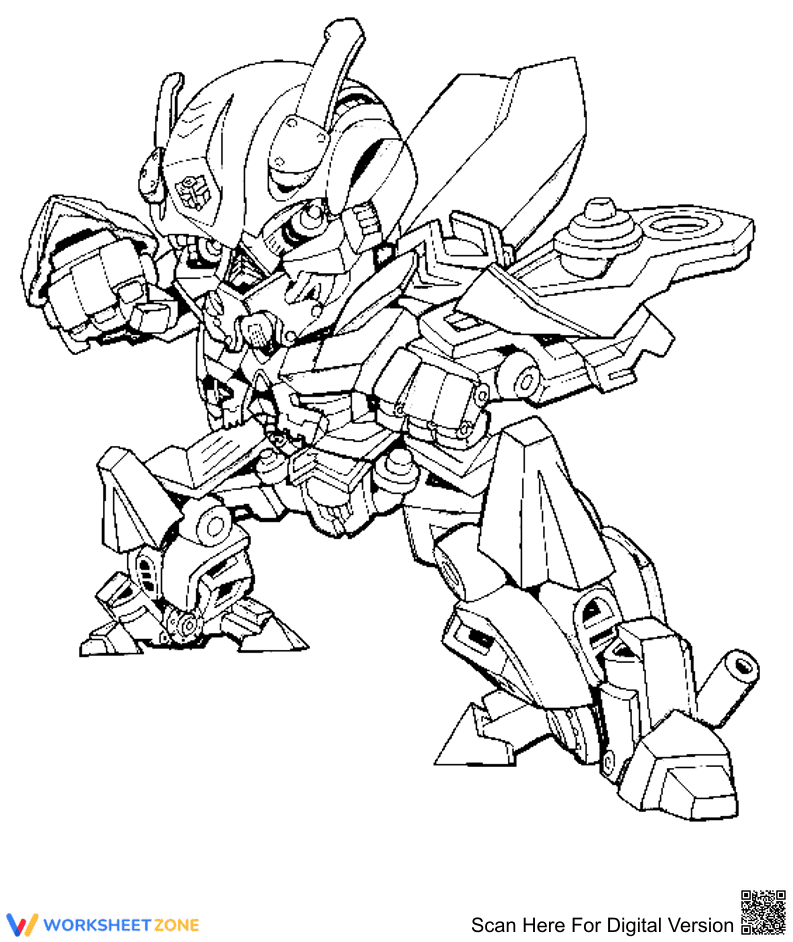

Bumblebee Coloring Page | Essential Grade K-2 Printable
Paste this activity's link or code into your existing LMS (Google Classroom, Canvas, Teams, Schoology, Moodle, etc.).
Students can open and work on the activity right away, with no student login required.
You'll still be able to track student progress and results from your teacher account.
This Bumblebee coloring page provides a high-interest activity for students to develop essential fine motor control and artistic expression. By engaging with the detailed line art of a popular character, learners practice precision and color selection, leading to improved hand-eye coordination. This resource serves as a functional tool for early childhood classrooms focusing on visual literacy and creative engagement.
At a Glance
- Grade: K-2 · Subject: Arts & Crafts
- Standard:
CCSS.ELA-LITERACY.SL.K.5— Add drawings or visual displays to descriptions to provide additional detail- Skill Focus: Fine motor precision and creative expression
- Format: 1 page · 1 task · Answer key N/A · PDF
- Best For: Morning work or early finisher activity
- Time: 15–20 minutes
Inside this PDF, you will find one high-resolution coloring sheet featuring Bumblebee and Charlie. The illustration uses clean, bold lines to help younger students stay within boundaries while offering enough detail to challenge older elementary learners. This single-page format is designed for immediate use without any additional teacher setup, complex instructions, or messy materials beyond basic coloring supplies.
The zero-prep workflow for this resource is designed for maximum efficiency in a busy classroom. First, print the single-page PDF (30 seconds). Second, distribute the sheets to students along with crayons, markers, or colored pencils (1 minute). Third, review the completed work to assess grip strength and color application (30 seconds). Total teacher preparation time is under two minutes, making it an ideal sub plan or transition activity for any elementary setting.
This activity aligns with `CCSS.ELA-LITERACY.SL.K.5`, which encourages students to use visual displays to enhance their communication and descriptions. While primarily an artistic task, it supports the development of the tripod grip necessary for writing standards and spatial awareness. This standard code can be copied directly into lesson plans, IEP goals, or district curriculum mapping tools to justify the use of creative time.
Use this worksheet during the "settling in" period at the start of the school day to calm the classroom environment and focus student attention. It also functions effectively as a formative assessment tool for observing pencil grasp and pressure control in Kindergarten students. Expect students to spend between 15 and 20 minutes completing the page depending on their individual attention to detail and artistic choices.
This resource is tailored for Preschool through Grade 2 students, particularly those who benefit from high-interest character-based motivation. It is an excellent pairing for a direct instruction lesson on primary and secondary colors or as a companion to a reading session involving Transformers-themed literature. The familiar characters help lower the affective filter for reluctant learners, encouraging them to participate in fine motor practice.
According to the Fisher & Frey (2014) framework for purposeful learning, high-interest visual tasks like coloring can bridge the gap between creative play and academic stamina. Research indicates that fine motor activities involving character recognition improve student engagement and task persistence in early childhood settings. The use of CCSS.ELA-LITERACY.SL.K.5 in this context ensures that even artistic endeavors remain grounded in developmental milestones. By providing a structured yet creative outlet, educators can support the physical development required for later writing proficiency. This worksheet meets the criteria for supplemental instructional materials that reinforce hand-eye coordination without increasing cognitive load during transition periods. The simplicity of the task allows for immediate success, which is a key factor in building student confidence according to recent NAEP findings on early learner motivation and classroom environment.


