


























Views
Downloads

Printable Letter B Tracing Worksheet | Grade 1
Paste this activity's link or code into your existing LMS (Google Classroom, Canvas, Teams, Schoology, Moodle, etc.).
Students can open and work on the activity right away, with no student login required.
You'll still be able to track student progress and results from your teacher account.
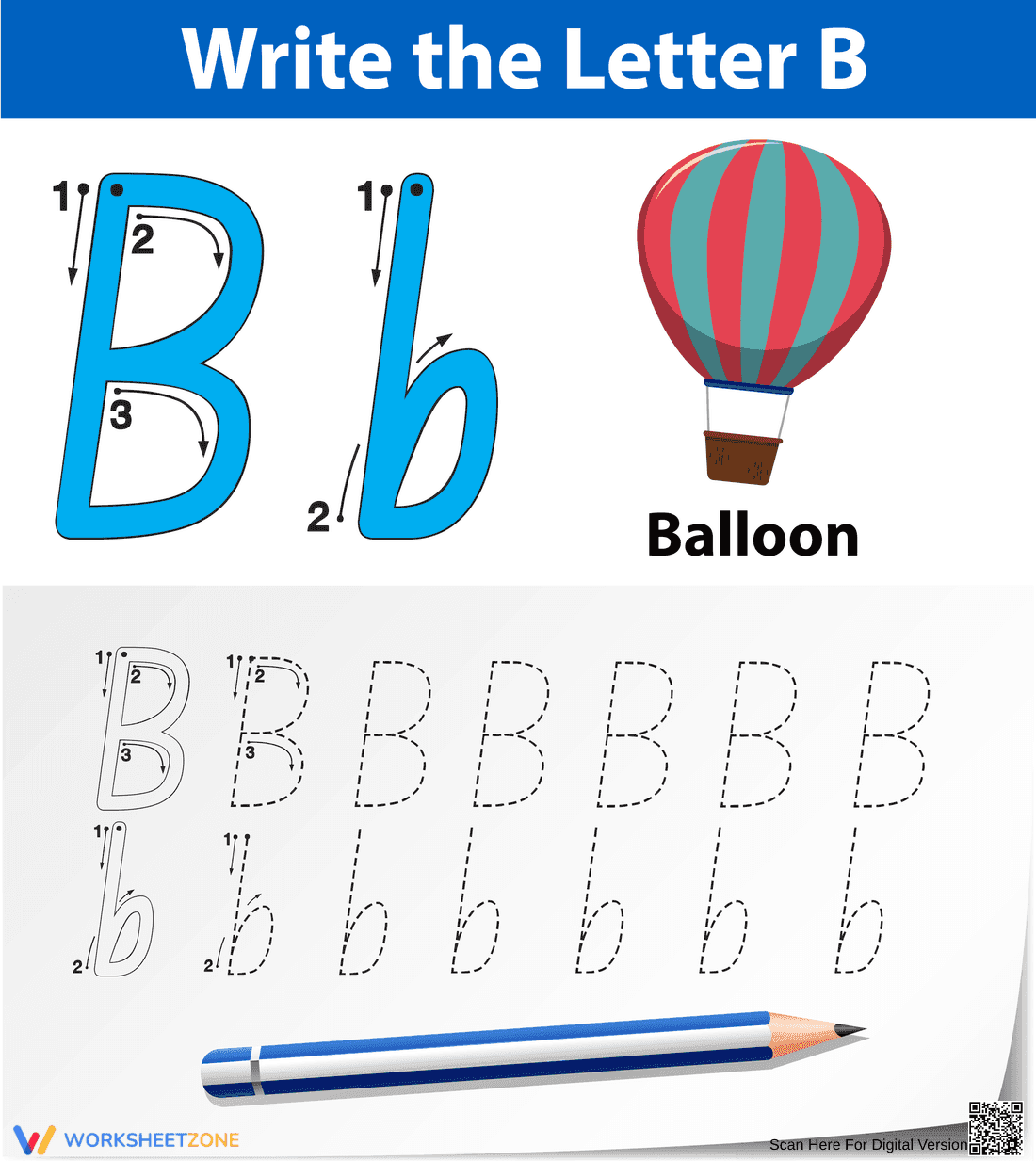
This printable Grade 1 handwriting worksheet provides focused practice on letter B formation. Students develop fine motor control and muscle memory by tracing both uppercase and lowercase letters. With clear directional arrows and a structured layout, this resource ensures early learners build foundational writing skills effectively.
At a Glance
- Grade: 1 · Subject: English
- Standard:
CCSS.ELA-LITERACY.L.1.1.A— Print all upper- and lowercase letters- Skill Focus: Letter B Formation
- Format: 1 page · 14 problems · No answer key · PDF
- Best For: Independent practice and centers
- Time: 10–15 minutes
This single-page resource features a large instructional model demonstrating the exact stroke order for uppercase and lowercase letter B. Below the model, students find 14 dashed tracing tasks organized into two rows. The first row focuses on the uppercase B, while the second provides practice for the lowercase b. A vibrant balloon illustration serves as a visual anchor to reinforce letter-sound correspondence.
- Guided practice: The worksheet begins with a large stroke-order guide, allowing teachers to model correct starting points and directional movements.
- Supported practice: Students trace 14 dashed letters, providing strict boundaries and visual scaffolding to build muscle memory.
- Independent practice: After completing the tracing rows, students can use the remaining blank space to attempt freehand letter formation.
This gradual-release approach ensures students move confidently from the I Do modeling phase to the You Do independent application.
This worksheet aligns directly with CCSS.ELA-LITERACY.L.1.1.A, requiring students to print all upper- and lowercase letters. By isolating the letter B and providing explicit stroke-order cues, the activity supports the foundational mechanics of early writing. The standard code can be copied directly into lesson plans, IEP goals, or district curriculum mapping tools.
Deploy this worksheet during morning work routines to give students immediate handwriting practice as they settle into the classroom. It also serves as an excellent literacy center activity following direct instruction. While students trace, teachers can conduct quick formative assessments by observing pencil grip and ensuring students start strokes from the top line. Expected completion time is 10 to 15 minutes.
This resource is designed for Grade 1 students mastering basic manuscript handwriting. For students struggling with fine motor skills, teachers can provide textured writing tools or have them trace the large model with their fingers first. Pair this worksheet with a phonics anchor chart or a read-aloud focusing on words starting with the letter B to reinforce the connection between symbol and sound.
Mastering explicit letter formation, such as printing all upper- and lowercase letters (CCSS.ELA-LITERACY.L.1.1.A), is a critical component of early literacy development. According to Fisher & Frey (2014), structured handwriting practice that incorporates clear directional cues significantly reduces cognitive load during subsequent writing tasks. When students do not have to expend working memory on how to form a letter B, they can allocate more mental resources to spelling, vocabulary, and sentence construction. This worksheet provides the exact visual scaffolding required to build automaticity and correct stroke sequence. By isolating the target letter and offering repeated, guided tracing opportunities, educators can effectively prevent common issues like letter reversals. Consistent, targeted practice ensures early learners develop the fluent, legible handwriting necessary for long-term academic success.


