




























Views
Downloads

Curious Hello Kitty Coloring Page | Essential Printable

Paste this activity's link or code into your existing LMS (Google Classroom, Canvas, Teams, Schoology, Moodle, etc.).
Students can open and work on the activity right away, with no student login required.
You'll still be able to track student progress and results from your teacher account.
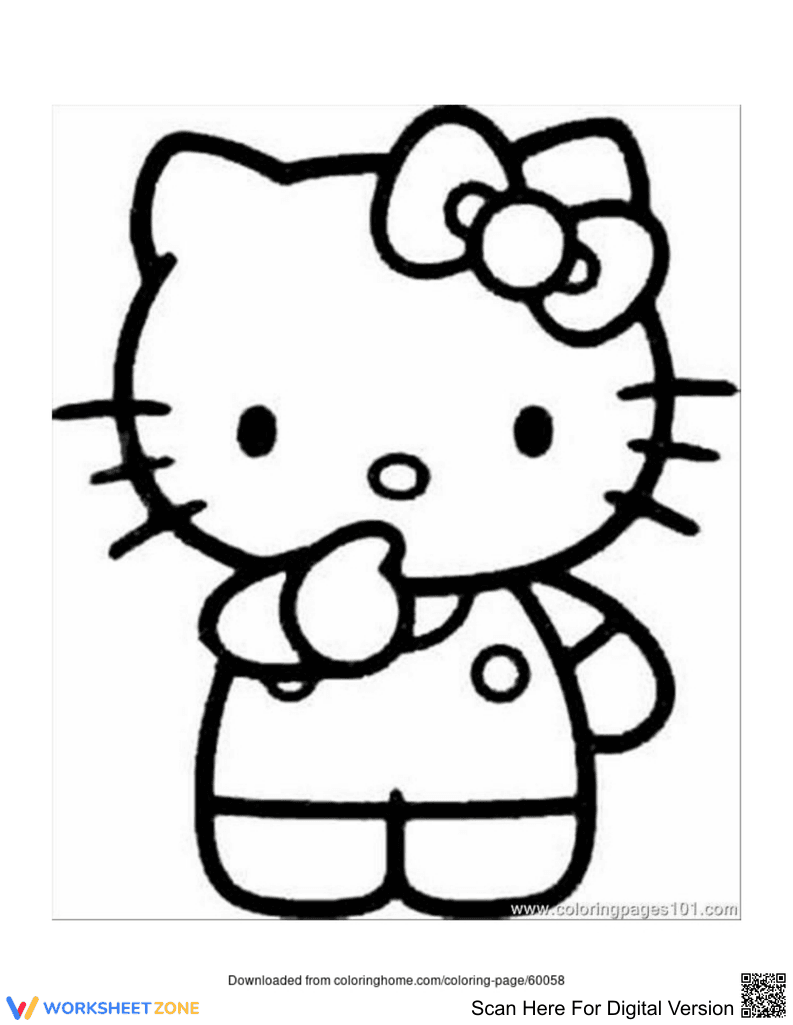
This Kindergarten coloring worksheet features a curious Hello Kitty character designed to help young learners develop essential fine motor control and artistic expression. By focusing on staying within the lines, students build the hand strength and coordination necessary for future writing tasks. This activity provides a high-interest, low-stress way to practice focus.
At a Glance
- Grade: Kindergarten · Subject: English
- Standard:
VA:Cr1.1.Ka— Engage in exploration and imaginative play with materials- Skill Focus: Fine motor control
- Format: 1 page · 1 task · No answer key required · PDF
- Best For: Early finishers and fine motor practice
- Time: 15–20 minutes
This resource consists of a single, high-quality PDF page featuring a large, bold-lined illustration of Hello Kitty in a thoughtful pose. The clear outlines are specifically designed for Kindergarten-aged children who are still refining their grip and spatial awareness. There are no complex backgrounds, ensuring the student remains focused on the primary character and color application.
The zero-prep design allows for an immediate classroom transition. First, print the single-page PDF (30 seconds). Second, distribute the sheets along with crayons or colored pencils to your students (1 minute). Third, review the completed work to provide positive reinforcement on color choice and boundary control (30 seconds). Total teacher preparation time is less than 2 minutes, making it an ideal sub plan or transition activity.
This worksheet aligns with VA:Cr1.1.Ka, which requires students to engage in exploration and imaginative play with various arts materials. Additionally, it supports the physical development goals often associated with CCSS.ELA-LITERACY.L.K.1.A by strengthening the pincer grip. Both standard codes can be copied directly into lesson plans, IEP goals, or district curriculum mapping tools.
Use this worksheet during morning arrival to settle students into a calm routine or as a rewarding activity for early finishers. It also functions well as a formative assessment tool; observe how students hold their coloring tools to identify those needing additional occupational therapy support. Expect students to spend approximately 15 to 20 minutes completing the page with care.
This activity is perfect for Kindergarten students, English language learners, and children with special needs who benefit from repetitive fine motor practice. It pairs naturally with a read-aloud story about curiosity or a direct instruction lesson on primary colors. The familiar character provides an immediate sense of comfort and engagement for all learners.
According to Fisher & Frey (2014), the development of fine motor control through activities like coloring is a foundational precursor to formal writing instruction in early childhood education. This Curious Hello Kitty worksheet provides a high-interest entry point for Kindergarten students to practice the precision and grip strength required for standard VA:Cr1.1.Ka. By engaging with familiar characters, learners are more likely to sustain attention on the task, leading to improved hand-eye coordination and spatial awareness. Research indicates that students who master these basic motor skills early on demonstrate greater fluency when transitioning to letter formation and sentence construction. This resource serves as a bridge between creative expression and the technical demands of the English classroom. The 1-page format ensures that the cognitive load remains focused on the physical act of coloring within defined boundaries, which is a critical milestone in the developmental progression toward academic writing readiness.


