




























Views
Downloads

Animal Habitat Sort — Printable Grade K Worksheet

Paste this activity's link or code into your existing LMS (Google Classroom, Canvas, Teams, Schoology, Moodle, etc.).
Students can open and work on the activity right away, with no student login required.
You'll still be able to track student progress and results from your teacher account.
This interactive science worksheet helps early learners distinguish between animals found in garden and jungle habitats. By engaging in a hands-on cut-and-paste activity, students build foundational classification skills. This resource simplifies complex life science concepts into a manageable task that ensures successful student comprehension of animal environments.
At a Glance
- Grade: Kindergarten · Subject: Science
- Standard:
K-ESS3-1— Represent relationships between animals and their habitats- Skill Focus: Habitat classification and fine motor sorting
- Format: 2 pages · 12 problems · PDF
- Best For: Independent practice or center rotation
- Time: 15–20 minutes
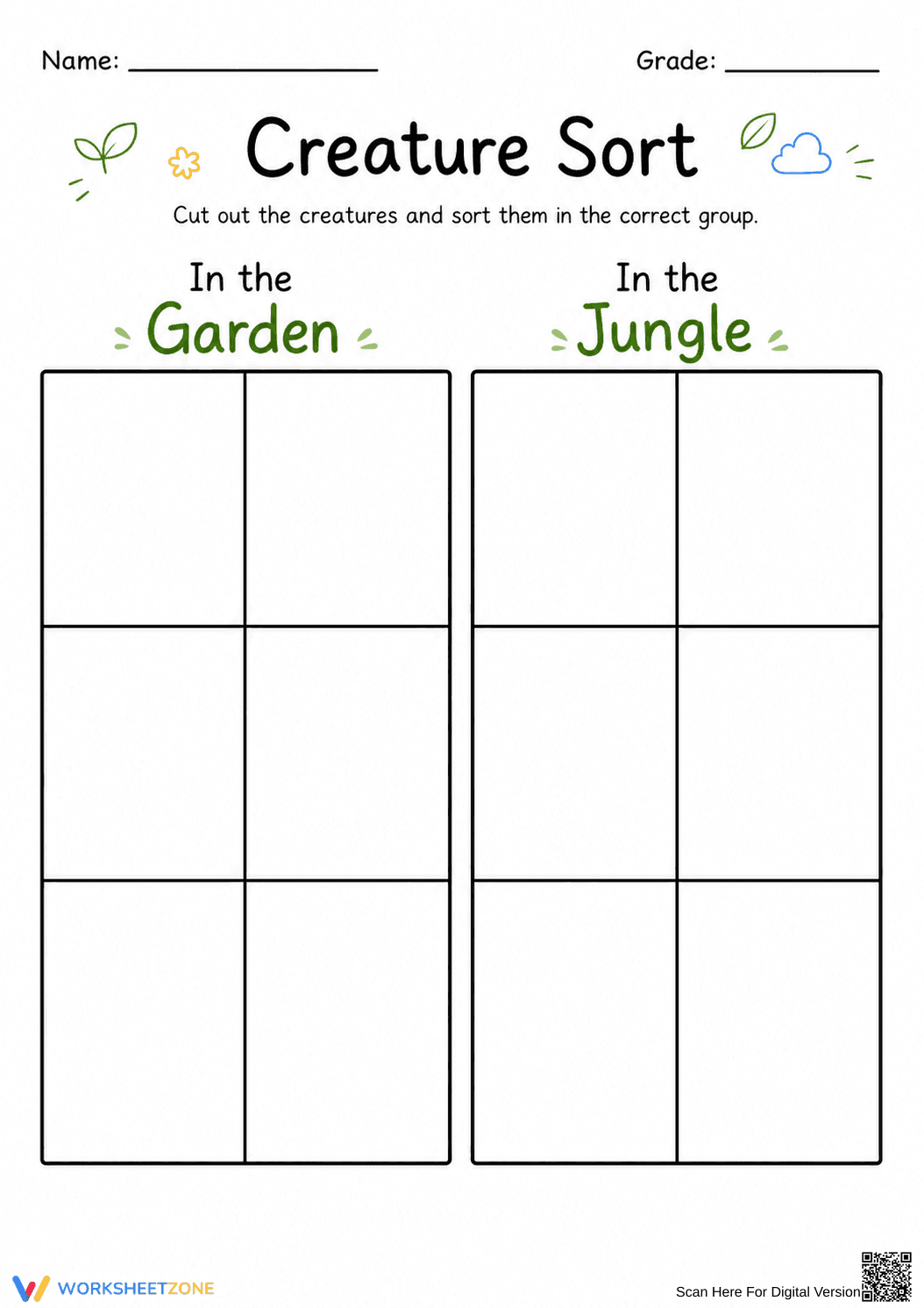
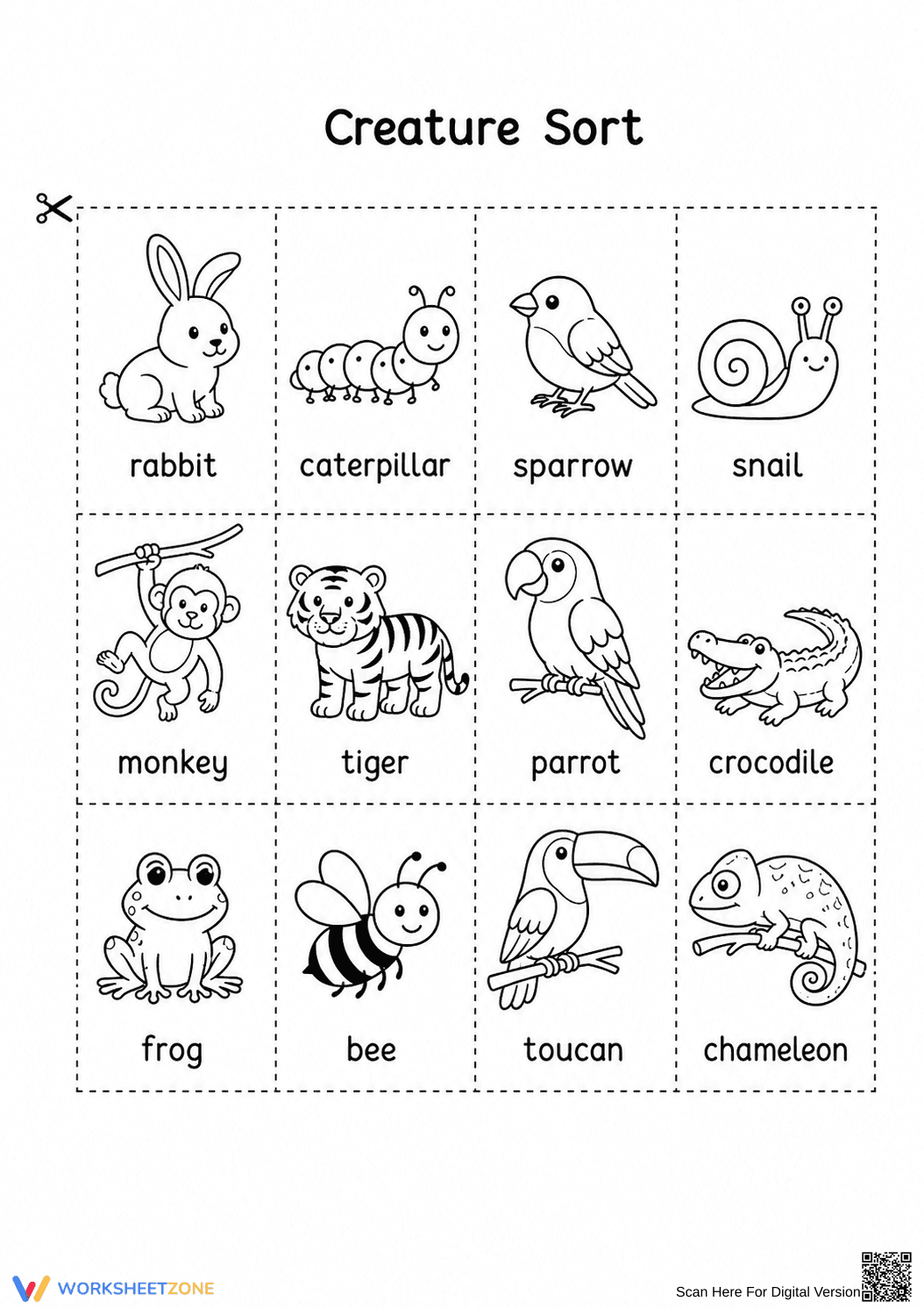
This two-page PDF set features a clean dual-column sorting board and a dedicated cut-out sheet. The first page provides "In the Garden" and "In the Jungle" categories with six blank slots each. The second page contains twelve distinct animal illustrations, such as a rabbit, tiger, and chameleon, complete with clear text labels. Each image is designed with simple dashed lines for easy cutting, supporting both scientific inquiry and fine motor development.
This resource is designed for immediate classroom implementation with a highly efficient workflow. First, print the two-page set (30 seconds). Second, distribute the sheets along with scissors and glue for independent student work (1 minute). Finally, use the clear visual layout for a quick whole-class review once the sorting is complete (1 minute). Total teacher prep time is under two minutes, making this activity highly suitable for emergency sub plans or quick science center setups.
The primary alignment for this activity is K-ESS3-1: "Use a model to represent the relationship between the needs of different plants or animals (including humans) and the places they live." By sorting creatures into their respective habitats, students demonstrate a clear understanding of where specific organisms thrive. Both standard codes can be copied directly into lesson plans, IEP goals, or district curriculum mapping tools.
Use this sorting activity as a concluding task after a whole-group lesson on living things and their environments. It also functions perfectly as an independent science center station. As a formative assessment observation tip, watch students as they sort to quickly identify any misconceptions about where specific animals live before they glue the pieces down. Expect a total completion time of approximately 15 to 20 minutes, including the cutting and gluing process.
This activity is ideally suited for Preschool, Kindergarten, and Grade 1 students. The clear illustrations and simple text labels provide excellent support for emerging readers, while the physical sorting process greatly benefits kinesthetic learners. It pairs naturally with a classroom read-aloud about animal homes or a large anchor chart displaying various global habitats.
Research from Fisher & Frey (2014) highlights the importance of scaffolded, hands-on activities in developing early scientific literacy and categorization skills. Sorting tasks like this K-ESS3-1 aligned creature sort provide the cognitive effort required to move students from simple identification to understanding the complex relationship between an organism and its environment. By physically manipulating the data—in this case, animal cut-outs—students are more likely to retain the conceptual differences between localized garden ecosystems and distant jungle habitats. Furthermore, integrating fine motor practice with content-area knowledge adheres to the best practices of developmentally appropriate instruction for early childhood learners. This worksheet provides the exact evidence-based structure needed for students to master basic habitat classification while building the prerequisite skills for more advanced ecological studies in later grades. It remains a staple for educators seeking high-quality, research-backed materials for early elementary science education.


