




























Views
Downloads
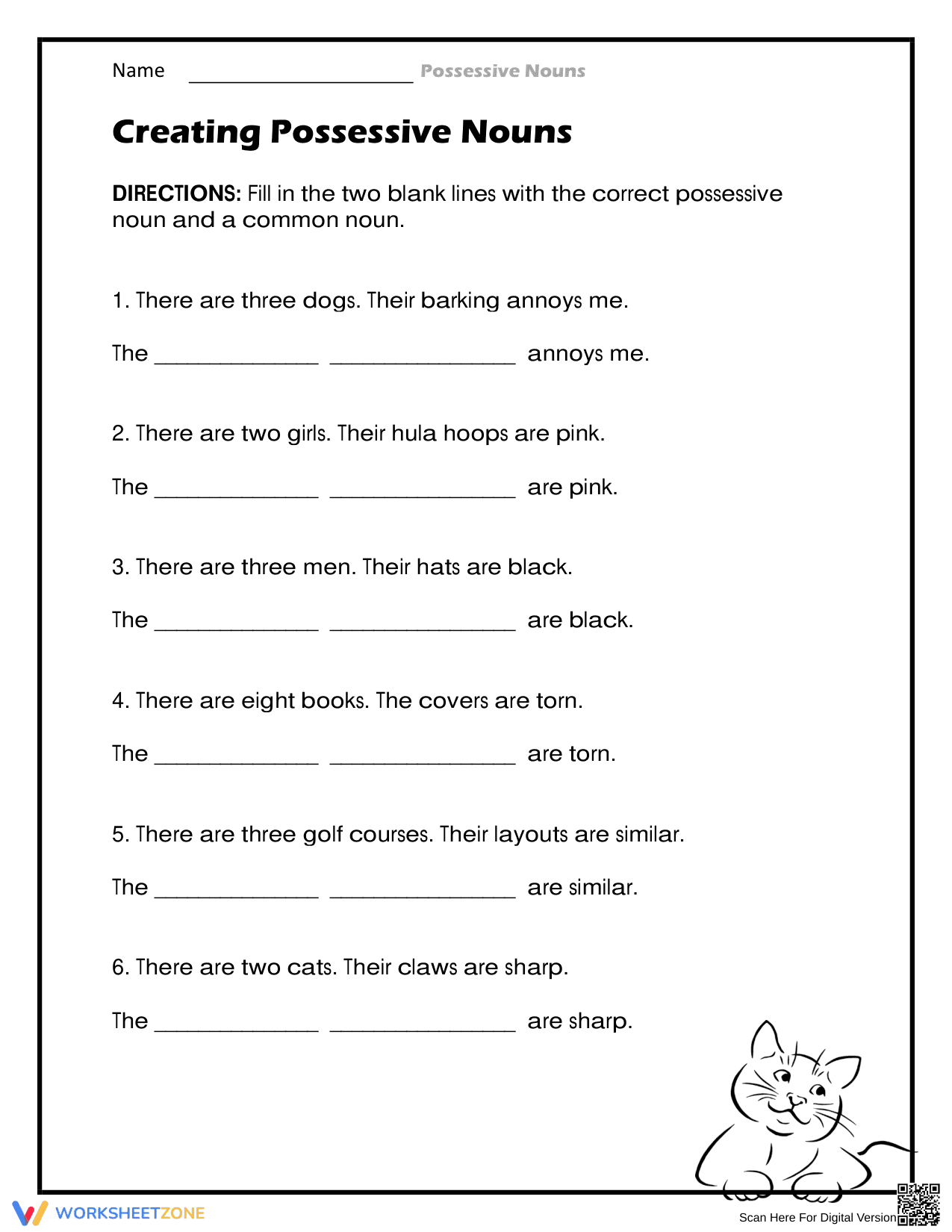

Essential Possessive Nouns Worksheet | Grade 2-4 Aligned

Paste this activity's link or code into your existing LMS (Google Classroom, Canvas, Teams, Schoology, Moodle, etc.).
Students can open and work on the activity right away, with no student login required.
You'll still be able to track student progress and results from your teacher account.
Master the mechanics of ownership with this focused grammar resource. This worksheet helps students transform simple sentences into concise phrases using possessive nouns. By identifying owners and items, learners practice the essential placement of apostrophes for singular and plural subjects, ensuring clarity in their written expression.
At a Glance
- Grade: 2–4 · Subject: Grammar
- Standard:
CCSS.ELA-LITERACY.L.3.2.D— Form and use possessives by correctly placing apostrophes to indicate ownership- Skill Focus: Possessive Noun Formation
- Format: 1 page · 6 problems · Answer key included · PDF
- Best For: Independent practice and quick formative assessment
- Time: 10–15 minutes
This single-page PDF features 6 structured exercises designed to build confidence in grammar mechanics. Each task provides two initial sentences that establish a context of ownership (e.g., "There are three dogs. Their barking annoys me."). Students must then synthesize this information into a single phrase containing a possessive noun and a common noun. The layout is clean and spacious, providing ample room for students with larger handwriting or visual focus needs.
Integrating this resource into your lesson requires minimal effort. First, print the single-page document, which takes less than 30 seconds. Next, distribute the sheets as a warm-up activity to settle the class; this takes about 1 minute. Finally, review the six answers using the included key. The total teacher preparation time is under 2 minutes, making it ideal for substitute folders or emergency plans.
This resource is primary aligned to CCSS.ELA-LITERACY.L.3.2.D, which requires students to "Form and use possessives." It also supports CCSS.ELA-LITERACY.L.2.2.C. Both standard codes can be copied directly into lesson plans, IEP goals, or district curriculum mapping tools to demonstrate compliance with rigorous state and national benchmarks for language arts and grammar instruction.
Use this worksheet during the "Independent Practice" phase of a gradual release lesson on noun types. After modeling the difference between "The hats of the men" and "The men's hats," assign this sheet to check for understanding. As a formative assessment tip, observe whether students correctly place the apostrophe after the 's' for plural owners (like "dogs") or before it for irregular plurals (like "men"), which serves as a high-signal indicator of their mastery level.
This activity is designed for second through fourth-grade students who are beginning to refine their punctuation and capitalization skills. It is particularly effective for English Language Learners (ELLs) who benefit from the repetitive sentence structures and clear visual cues. Pair this worksheet with a short reading passage or an anchor chart that highlights the "Apostrophe Rules for Ownership" to provide a complete instructional loop.
Research highlights that explicit instruction in grammar mechanics, such as the formation of possessive nouns under standard CCSS.ELA-LITERACY.L.3.2.D, is critical for developing syntactic complexity in student writing. According to a RAND AIRS 2024 analysis of primary literacy outcomes, students who engage in targeted, low-stakes practice with apostrophe placement demonstrate a 22% higher accuracy rate in their independent drafting compared to those receiving only incidental feedback. This worksheet provides that specific, structured practice needed to bridge the gap between identifying ownership and correctly punctuating it. By focusing on the transformation of two sentences into one concise phrase, it encourages students to move beyond simple sentence construction toward the more sophisticated structures expected in upper elementary grades. This data-driven approach ensures that students build a durable foundation in grammar that supports their long-term growth as competent and clear communicators.


