


























Views
Downloads



April Fool's Day Podcast Worksheet | Essential Grade 5 ELA
Paste this activity's link or code into your existing LMS (Google Classroom, Canvas, Teams, Schoology, Moodle, etc.).
Students can open and work on the activity right away, with no student login required.
You'll still be able to track student progress and results from your teacher account.
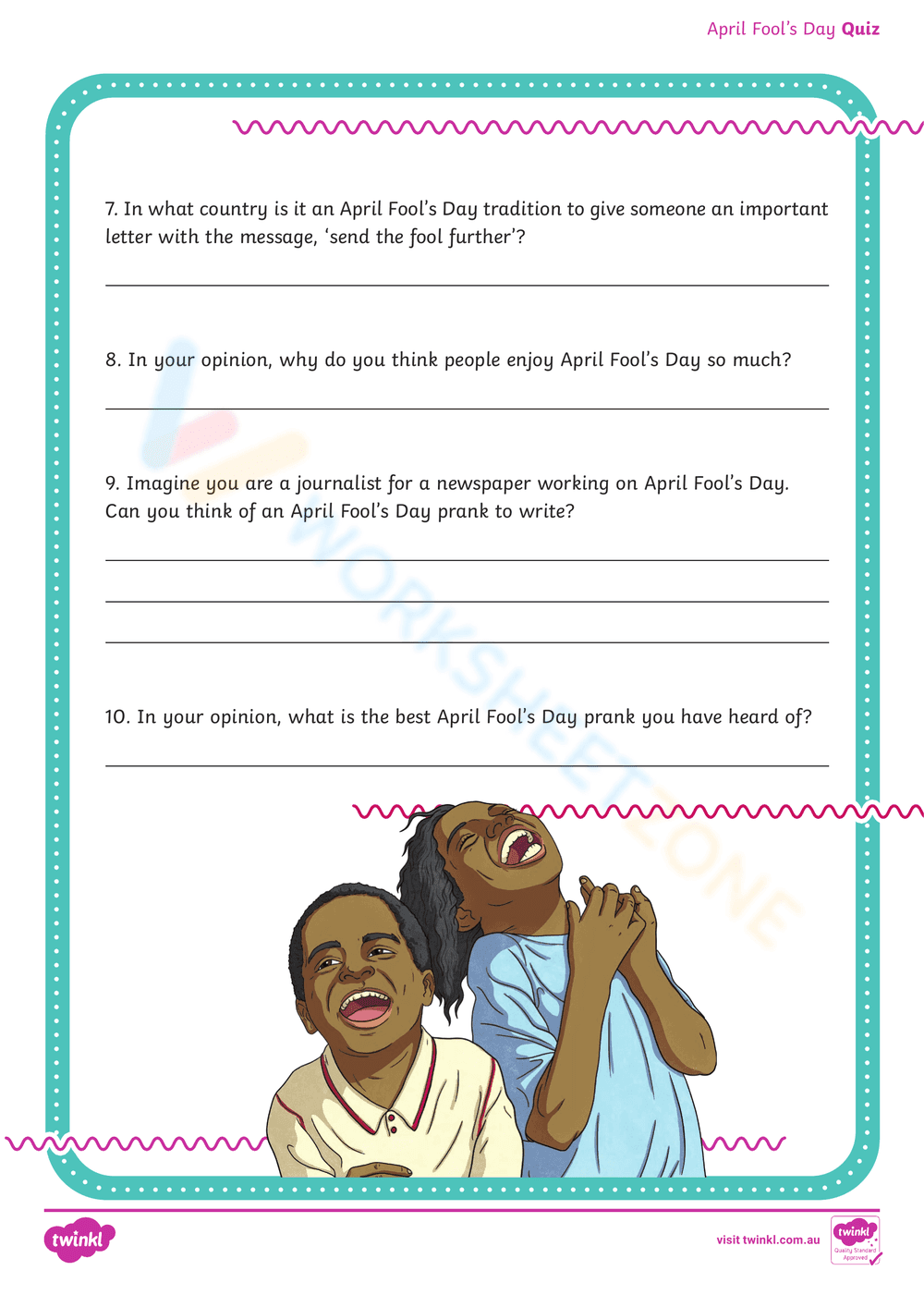
This Grade 5 ELA worksheet serves as a comprehensive companion to the April Fool's Day podcast, focusing on auditory processing and informational recall. Students engage with the history and global traditions of the holiday, transforming passive listening into active learning. The final outcome is a clear summary of cultural pranks and personal reflection.
At a Glance
- Grade: 5 · Subject: ELA
- Standard:
CCSS.ELA-LITERACY.SL.5.2— Summarize information presented in diverse media and formats, including visually and quantitatively- Skill Focus: Listening Comprehension
- Format: 3 pages · 10 problems · Answer key included · PDF
- Best For: Sub plans and listening centers
- Time: 20–30 minutes
What's Inside: This three-page PDF includes two pages of student tasks and a dedicated answer key. The 10 questions are structured to guide students through the podcast content, featuring literal comprehension questions, a summary task regarding the famous BBC spaghetti harvest prank, and open-ended opinion prompts. The layout provides ample writing lines for student responses.
Zero-Prep Workflow
Teachers can implement this resource with a total prep time of under 2 minutes. Step 1: Print the two task pages and the answer key (1 minute). Step 2: Distribute to students as they prepare to listen to the April Fool's Day podcast (30 seconds). Step 3: Review the 10 responses using the provided key for rapid grading or peer-review (30 seconds). This streamlined workflow makes it an ideal candidate for emergency sub plans or holiday-themed literacy blocks.
Standards Alignment
This resource is primarily aligned to `CCSS.ELA-LITERACY.SL.5.2`, which requires students to summarize a written text read aloud or information presented in diverse media and formats. It also supports `CCSS.ELA-LITERACY.RI.5.1` by requiring students to quote accurately from the auditory text when explaining what the text says explicitly. Both standard codes can be copied directly into lesson plans, IEP goals, or district curriculum mapping tools.
How to Use It
Use this worksheet during a whole-class listening session or as an independent station in a literacy center. For formative assessment, observe how students handle question 6; their ability to summarize the spaghetti harvest prank indicates their mastery of identifying main ideas in auditory texts. Expected completion time ranges from 20 to 30 minutes depending on the length of the podcast segment used.
Who It's For
This worksheet is designed for middle-grade students but is accessible for learners across the 3-12 spectrum due to its clear language. It is particularly effective for students who benefit from guided notes during listening tasks. Pair this resource with a short informational passage about the history of April 1st to provide a multi-modal learning experience.
This April Fool's Day podcast companion is designed to bridge the gap between auditory processing and written literacy. By requiring students to extract specific details and summarize complex historical pranks, the resource aligns with the CCSS.ELA-LITERACY.SL.5.2 standard for summarizing information presented in diverse media. According to Fisher & Frey (2014), the use of scaffolded listening tasks significantly improves student retention of informational content compared to passive listening alone. The worksheet provides 10 targeted questions that move from literal recall to evaluative opinion, ensuring a comprehensive check for understanding. This structured approach supports diverse learners by providing clear writing spaces and a logical progression of inquiry. Educators can utilize the included answer key for immediate feedback, making it a reliable tool for both formative assessment and independent practice in middle-grade classrooms. The inclusion of cross-cultural references, such as traditions from France and Spain, further enriches the informational text experience for all students.


