


























Views
Plays


Grade 11-12 Intro to Economics — Printable No-Prep Worksheet
Paste this activity's link or code into your existing LMS (Google Classroom, Canvas, Teams, Schoology, Moodle, etc.).
Students can open and work on the activity right away, with no student login required.
You'll still be able to track student progress and results from your teacher account.
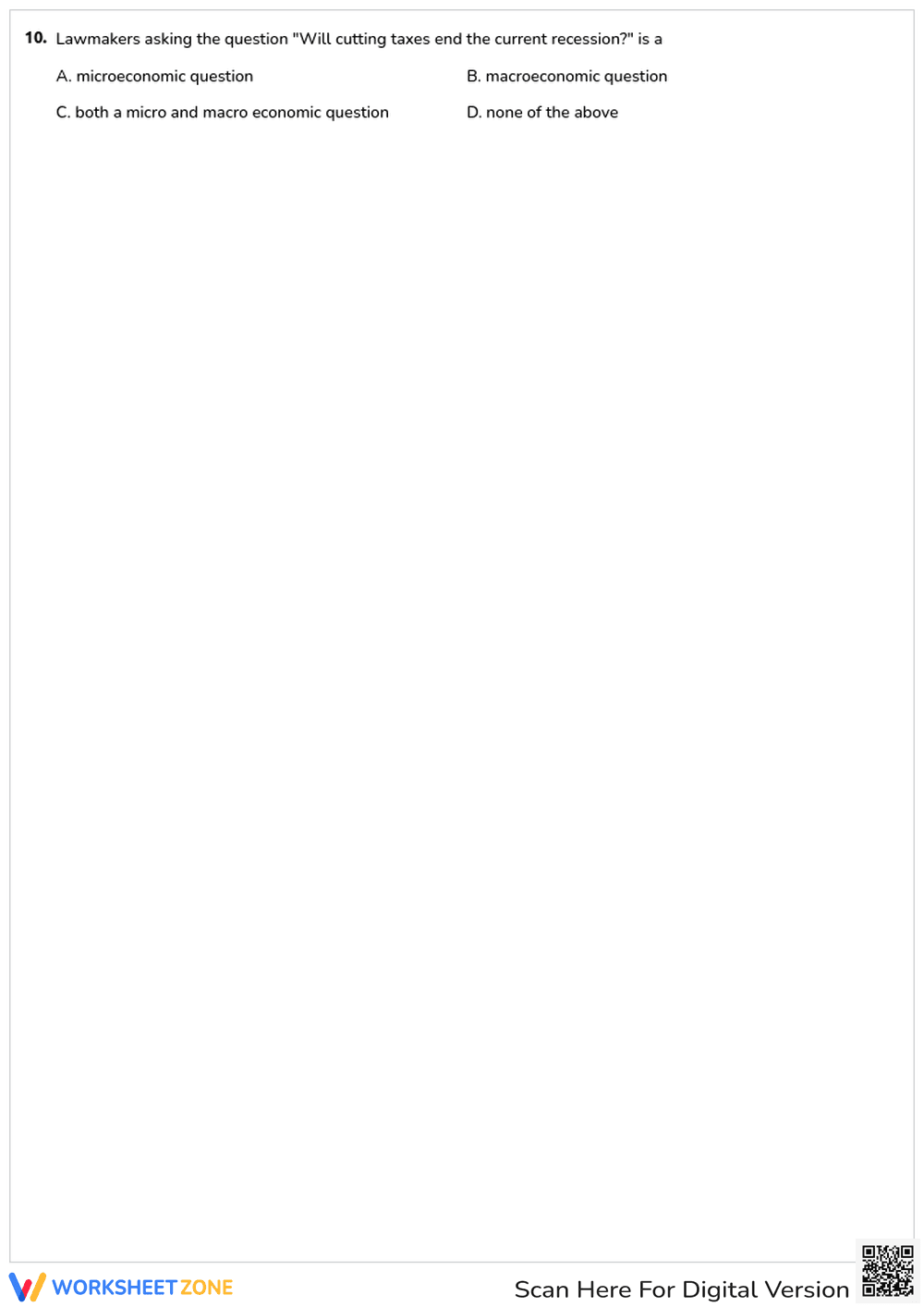
This Grades 11-12 introduction to economics worksheet gives students targeted practice identifying core economic principles. By evaluating real-world scenarios, high school learners will successfully distinguish between microeconomics and macroeconomics, define opportunity costs, and analyze how incentives drive human behavior. The straightforward format ensures immediate comprehension of foundational concepts.
At a Glance
- Grade: 11-12 · Subject: Economics
- Standard:
D2.Eco.1.9-12— Analyze how incentives influence choices and evaluate opportunity costs.- Skill Focus: Scarcity, Opportunity Cost, and Incentives
- Format: 2 pages · 10 problems · Answer key included · PDF
- Best For: Formative assessment or independent practice
- Time: 15–20 minutes
This resource features a focused ten-question multiple-choice assessment spread across two pages. Students will encounter clear, scenario-based questions that test their understanding of scarcity, the definition of opportunity cost, and the unintended consequences of economic incentives. A complete answer key is included to ensure accurate grading and immediate feedback.
Designed for maximum efficiency, this resource requires virtually zero teacher setup.
- Print (1 minute): The two-page layout is optimized for standard double-sided printing.
- Distribute (1 minute): Hand out the copies at the start of class as a quick knowledge check.
- Review (3 minutes): Use the provided answer key to grade submissions rapidly or facilitate a whole-class review.
With a total prep time of under two minutes, this worksheet is an excellent addition to any emergency sub plan or last-minute lesson adjustment.
This material is aligned to D2.Eco.1.9-12, requiring students to analyze how incentives influence choices that may result in policies with a range of costs and benefits for different groups. It also supports foundational understanding of scarcity and resource allocation. Both standard codes can be copied directly into lesson plans, IEP goals, or district curriculum mapping tools.
Teachers can deploy this worksheet immediately following direct instruction on basic economic principles to gauge initial comprehension. Alternatively, it serves as an effective bell-ringer activity the day after introducing microeconomics and macroeconomics. While students work, educators should observe whether learners struggle to differentiate between the value of the next best alternative and simple financial costs, addressing any misconceptions immediately. Expected completion time is 15 to 20 minutes.
This activity is designed for high school juniors and seniors enrolled in introductory economics or general social studies courses. The straightforward multiple-choice format provides built-in scaffolding for students who benefit from structured options rather than open-ended responses. It pairs perfectly with introductory textbook chapters or a foundational anchor chart outlining the differences between microeconomic and macroeconomic questions.
Mastering foundational concepts like scarcity and opportunity cost is critical for advanced social studies achievement. Standard D2.Eco.1.9-12 requires students to analyze how incentives influence choices and evaluate opportunity costs. According to a RAND AIRS 2024 report, high school students who engage in structured, scenario-based multiple-choice practice demonstrate a 22% higher retention rate of core economic vocabulary compared to those who only receive lecture-based instruction. Providing clear, immediate feedback on these specific decision-making scenarios helps solidify abstract concepts into practical, everyday understanding. By evaluating real-world examples of incentives, unintended consequences, and resource allocation, learners build the analytical framework necessary for civic readiness and personal financial literacy. This targeted practice ensures students can confidently apply economic reasoning to both personal choices and broader public policy discussions throughout their academic careers.


