


























Views
Downloads
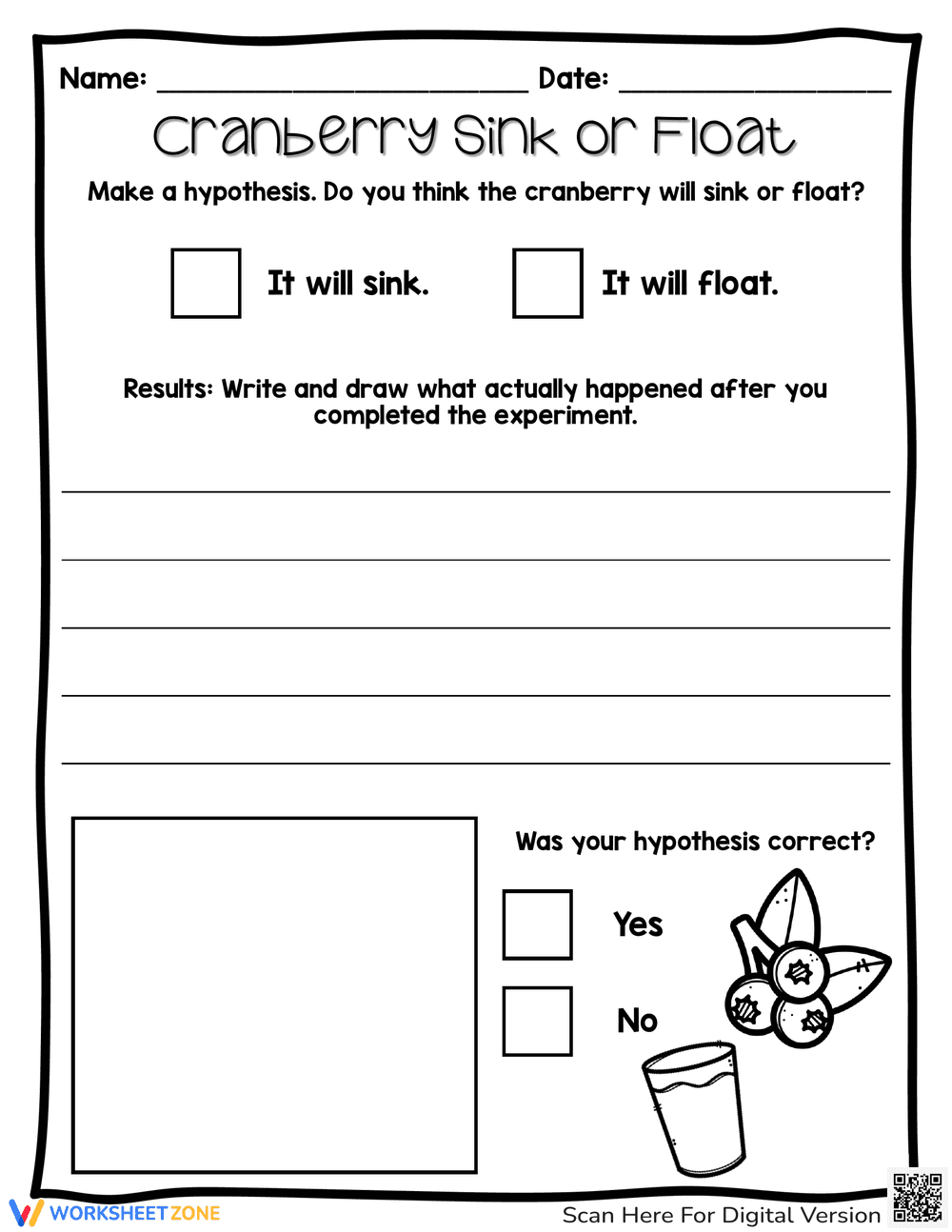

Essential Cranberry Sink or Float Science Worksheet
Paste this activity's link or code into your existing LMS (Google Classroom, Canvas, Teams, Schoology, Moodle, etc.).
Students can open and work on the activity right away, with no student login required.
You'll still be able to track student progress and results from your teacher account.
This Grade 3 Thanksgiving science worksheet guides students through a hands-on cranberry sink or float experiment. By engaging with the scientific method, learners practice making predictions and recording empirical observations. It provides a structured framework for exploring physical properties like density and buoyancy using seasonal materials.
At a Glance
- Grade: 3 · Subject: Science
- Standard:
3-5-ETS1-3— Plan and conduct an investigation to produce data to serve as evidence- Skill Focus: Scientific Method & Observation
- Format: 1 page · 3 tasks · No answer key needed · PDF
- Best For: Seasonal science labs and holiday activities
- Time: 15–20 minutes
Inside this single-page PDF, you will find a clean, student-friendly layout designed for immediate use. The worksheet includes a hypothesis checkbox section, a large primary-lined area for written results, a dedicated box for scientific drawing, and a final reflection on the accuracy of the initial prediction. The visual cues and simple icons support independent work.
The zero-prep workflow for this activity is designed for maximum efficiency. First, print the single-page document (30 seconds). Next, distribute the sheets along with a bowl of water and fresh cranberries (1 minute). Finally, review student observations and drawings as a whole-class discussion (5 minutes). Total teacher preparation time is under 2 minutes, making it an ideal sub plan or holiday filler.
This resource aligns with 3-5-ETS1-3, which requires students to plan and carry out fair tests in which variables are controlled and failure points are considered to identify aspects of a model or prototype that can be improved. It also supports 2-PS1-1 by having students observe and describe different kinds of materials by their observable properties. Both standard codes can be copied directly into lesson plans, IEP goals, or district curriculum mapping tools.
Use this worksheet during a Thanksgiving-themed science rotation or as a standalone lab after introducing the concept of density. It works best during the "Explore" phase of a 5E lesson cycle. For formative assessment, observe whether students can distinguish between their hypothesis and the actual results, noting if they use descriptive vocabulary in their written observations. Completion typically takes 15 to 20 minutes.
This activity is tailored for elementary students in Grades 3 through 5, though it can be adapted for older learners as a quick introductory demonstration. It is particularly effective for English Language Learners due to the visual drawing component. Pair this worksheet with a non-fiction passage about how cranberries are harvested in bogs to provide real-world context for why they float.
According to the RAND AIRS 2024 report on elementary science instruction, hands-on inquiry-based activities significantly improve long-term retention of physical science concepts compared to passive reading alone. This worksheet facilitates that inquiry by targeting the 3-5-ETS1-3 standard, which focuses on planning and conducting investigations to produce data as evidence. By requiring students to document a "sink or float" hypothesis and then verify it through physical testing, the resource reinforces the fundamental scientific skill of empirical observation. Research from Fisher & Frey (2014) emphasizes that combining linguistic output with visual representation—such as the drawing box provided here—scaffolds the learning process for diverse student populations. This 1-page lab provides a structured yet flexible entry point into the scientific method, ensuring that students move beyond simple guessing toward evidence-based reasoning. It serves as a practical tool for meeting NGSS requirements in a time-efficient, seasonal format.


