


























Views
Downloads

Printable Fruit Counting Game | Grade K Math Essential
Paste this activity's link or code into your existing LMS (Google Classroom, Canvas, Teams, Schoology, Moodle, etc.).
Students can open and work on the activity right away, with no student login required.
You'll still be able to track student progress and results from your teacher account.
This interactive fruit counting game helps kindergarten students develop essential number sense and cardinality skills. By engaging with colorful visuals, learners practice counting objects to ten, matching quantities to numerals, and solving foundational addition problems. This resource ensures students build the confidence needed for early mathematical success.
At a Glance
- Grade: Kindergarten · Subject: Elementary Mathematics
- Standard:
K.CC.B.5— Count to answer "how many?" questions about up to 20 objects in various arrangements- Skill Focus: Counting and Cardinality plus Foundation Addition
- Format: 4 pages · 15 specific problems · Full answer key included · High-quality PDF
- Best For: Independent math centers, morning work, or early finisher activities
- Time: 15–20 minutes of focused engagement
What's Inside
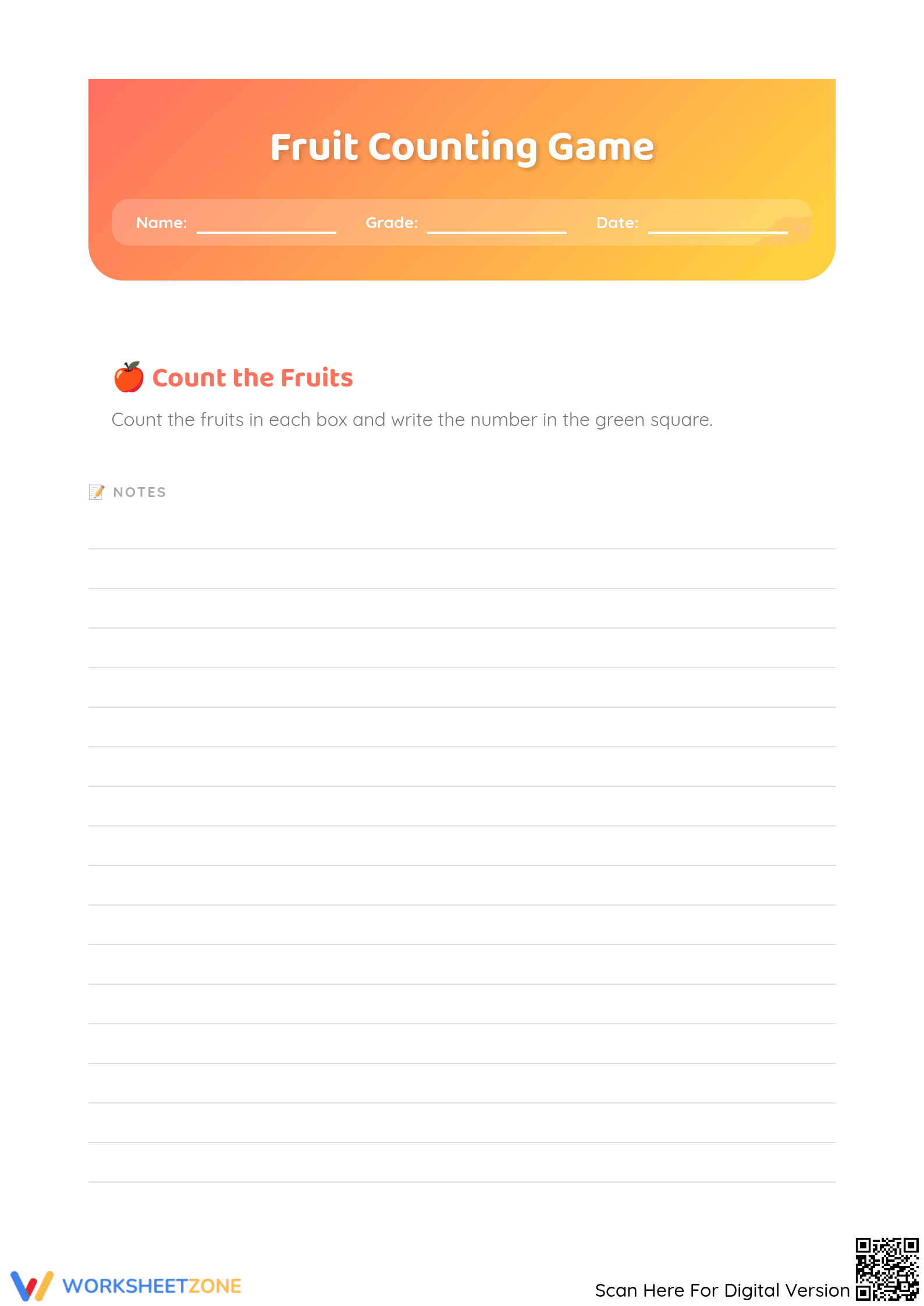
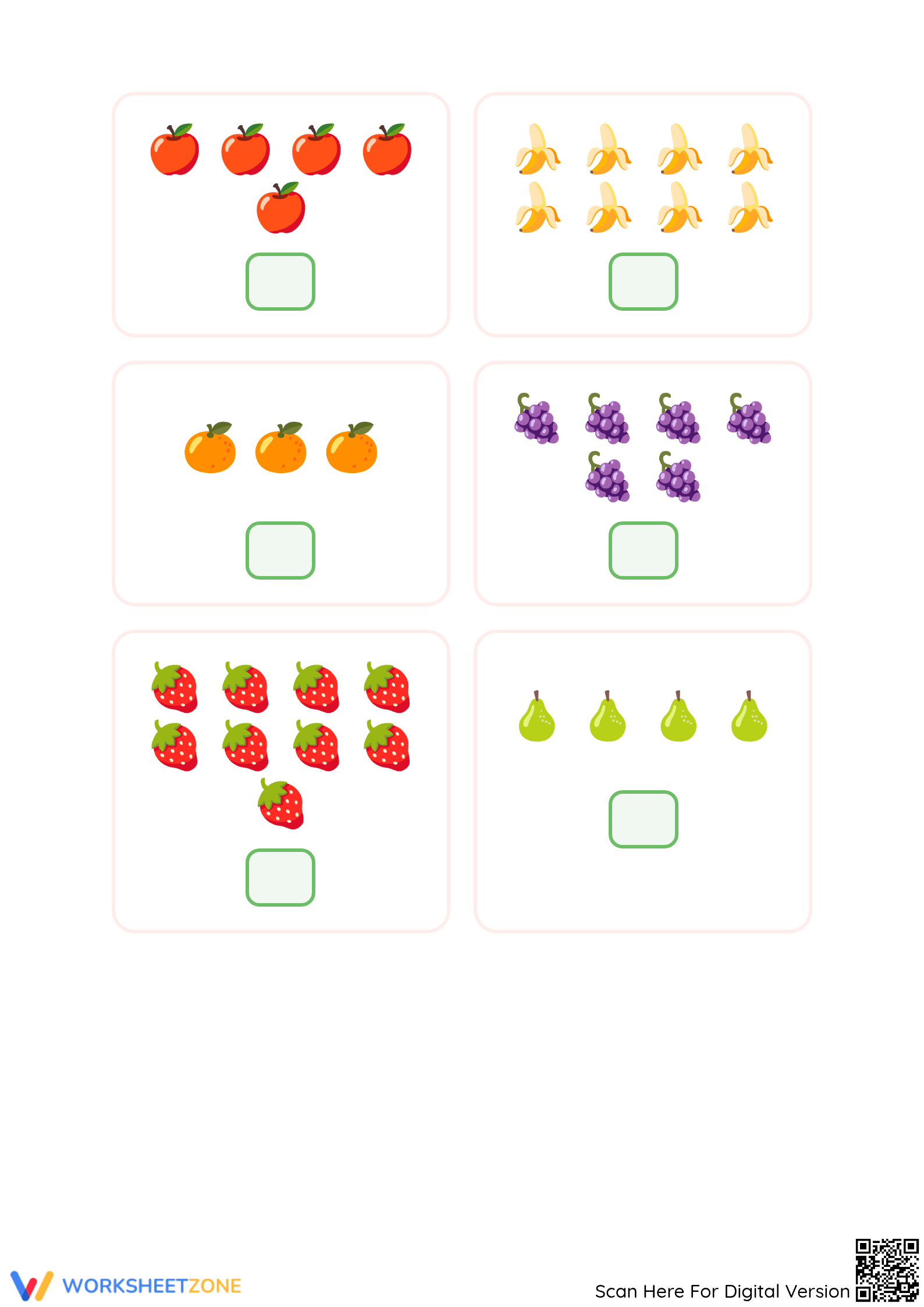
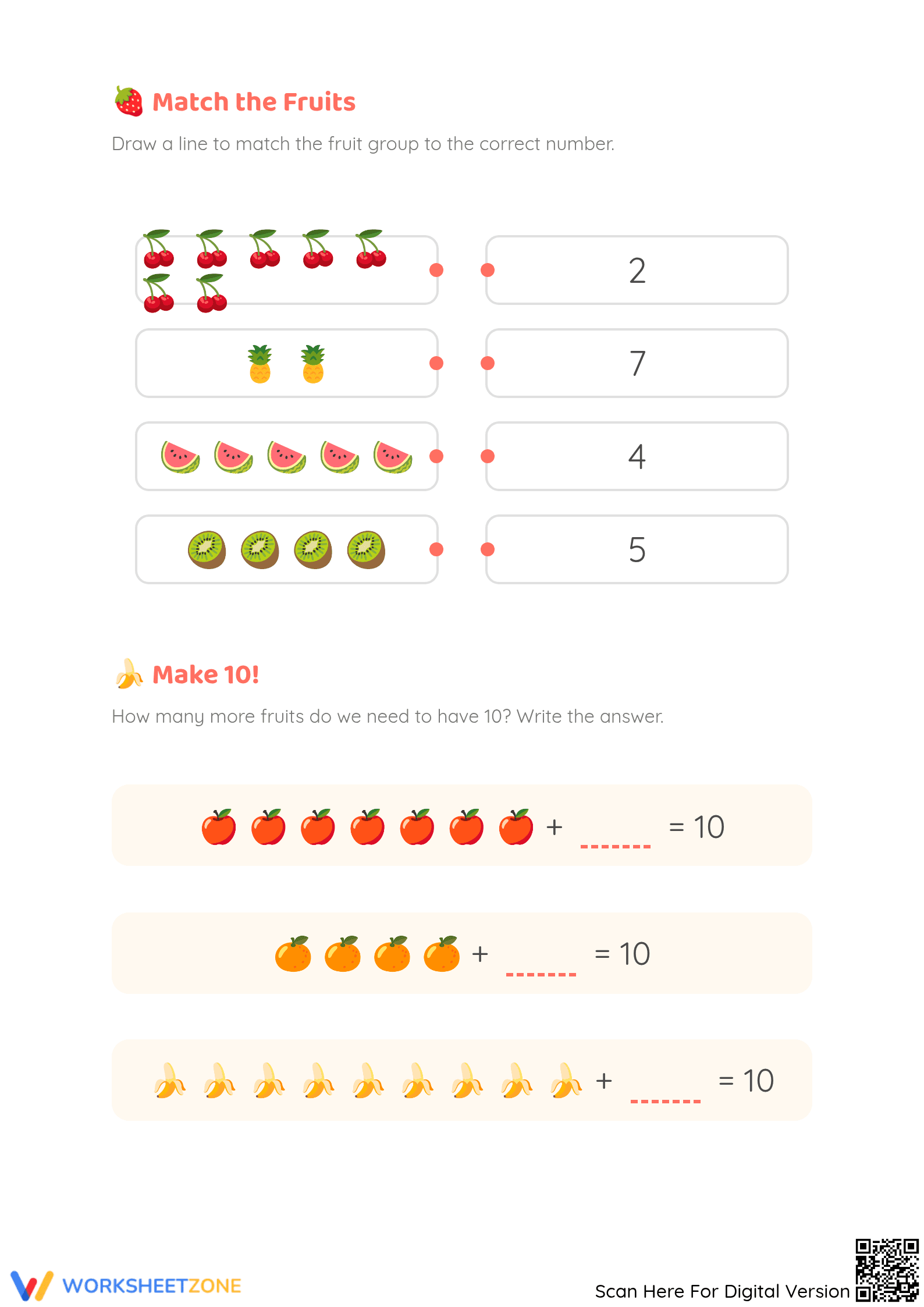
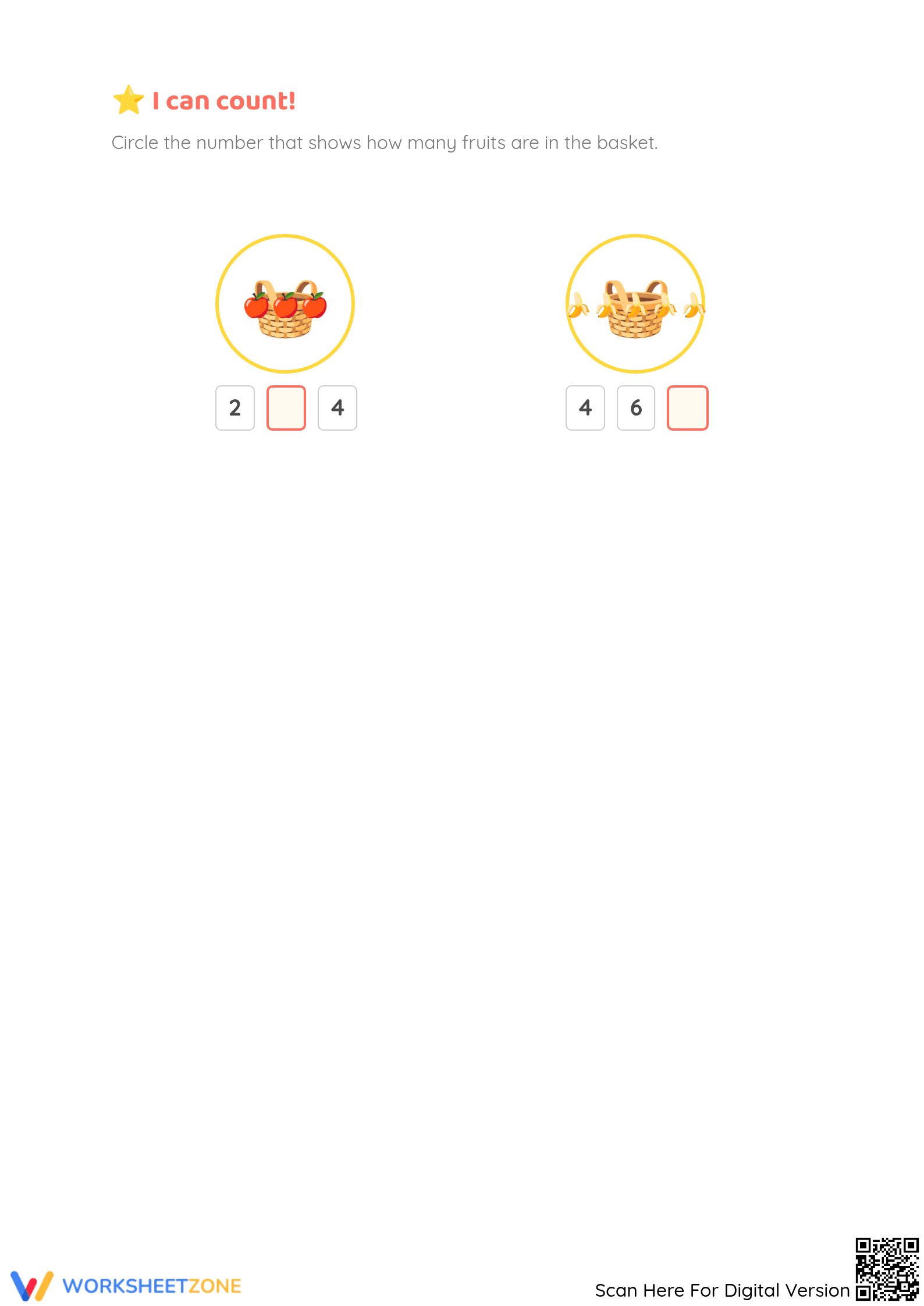
This four-page math packet includes a variety of engaging activities designed to keep young learners focused. Students will encounter six counting-and-writing boxes, a matching section for four fruit groups, three foundational "Make 10" addition frames, and a final "I Can Count" assessment section. The clear layout features ample space for writing and includes a full answer key to facilitate quick grading or student self-correction.
Zero-Prep Workflow
This resource is designed for a seamless classroom experience. First, print the four-page PDF in seconds for your entire class. Next, distribute the worksheets with no additional setup required; the instructions are simple enough for students to follow independently. Finally, review the work using the included answer key in under two minutes. With a total teacher prep time of less than two minutes, this zero-prep workflow makes it an ideal choice for emergency sub plans or last-minute lesson extensions.
Standards Alignment
The primary alignment for this worksheet is K.CC.B.5, which requires students to count to answer 'how many?' questions about things in a line, array, or circle. Additionally, the 'Make 10' section supports K.OA.A.4, helping students find the number that makes 10 when added to a given number. Both standard codes can be copied directly into lesson plans, IEP goals, or district curriculum mapping tools.
How to Use It
Use this worksheet during the independent practice portion of a lesson on counting and cardinality. It works exceptionally well as a quiet morning work activity to settle students as they arrive. Teachers should observe students as they count the larger fruit groups to check for one-to-one correspondence—a critical formative assessment marker. Expect most kindergarten students to complete the full set of activities within 15 to 20 minutes.
Who It's For
This resource is tailored for kindergarteners and advanced pre-schoolers bridging the gap between objects and numerals. It provides necessary scaffolding through clear visual cues, suitable for ELL students. Pair this worksheet with physical counters or a number line anchor chart to provide a multi-sensory learning experience during direct instruction.
According to the RAND AIRS 2024 report, high-quality visual representations are essential for developing early number sense in primary learners. This worksheet utilizes clear, distinct icons to reduce cognitive load while students practice the complex task of one-to-one correspondence. By integrating the K.CC.B.5 standard through multiple modalities—writing, matching, and circling—the resource reinforces the mathematical concept that the last number name said tells the number of objects counted. Research from Fisher & Frey (2014) emphasizes that such guided practice allows students to transition from procedural counting to conceptual understanding. This printable pack serves as a robust tool for educators aiming to meet NAEP benchmarks for early numeracy. The 15 structured tasks provide sufficient repetition for mastery without causing learner fatigue. Educators can reliably use these pages to document student progress toward foundational algebraic thinking goals in a standardized, classroom-ready format.


