


























Views
Downloads



Printable Counting Backwards & Addition | Grade 1 Math
Paste this activity's link or code into your existing LMS (Google Classroom, Canvas, Teams, Schoology, Moodle, etc.).
Students can open and work on the activity right away, with no student login required.
You'll still be able to track student progress and results from your teacher account.
This comprehensive math worksheet helps Grade 1 students master the essential strategy of counting backwards to solve both subtraction and addition problems. By moving beyond basic rote counting, learners develop a deep internal number line as a foundation for mental math. The engaging 'blast off' theme keeps students motivated throughout the five-page sequence.
At a Glance
- Grade: 1 · Subject: Math
- Standard:
CCSS.MATH.CONTENT.1.OA.C.5— Relate counting to addition and subtraction by counting on or counting back- Skill Focus: Counting backwards and subtraction strategies
- Format: 5 pages · 22 problems · Answer key included · PDF
- Best For: Early elementary math centers and homework practice
- Time: 25–40 minutes
What's Inside
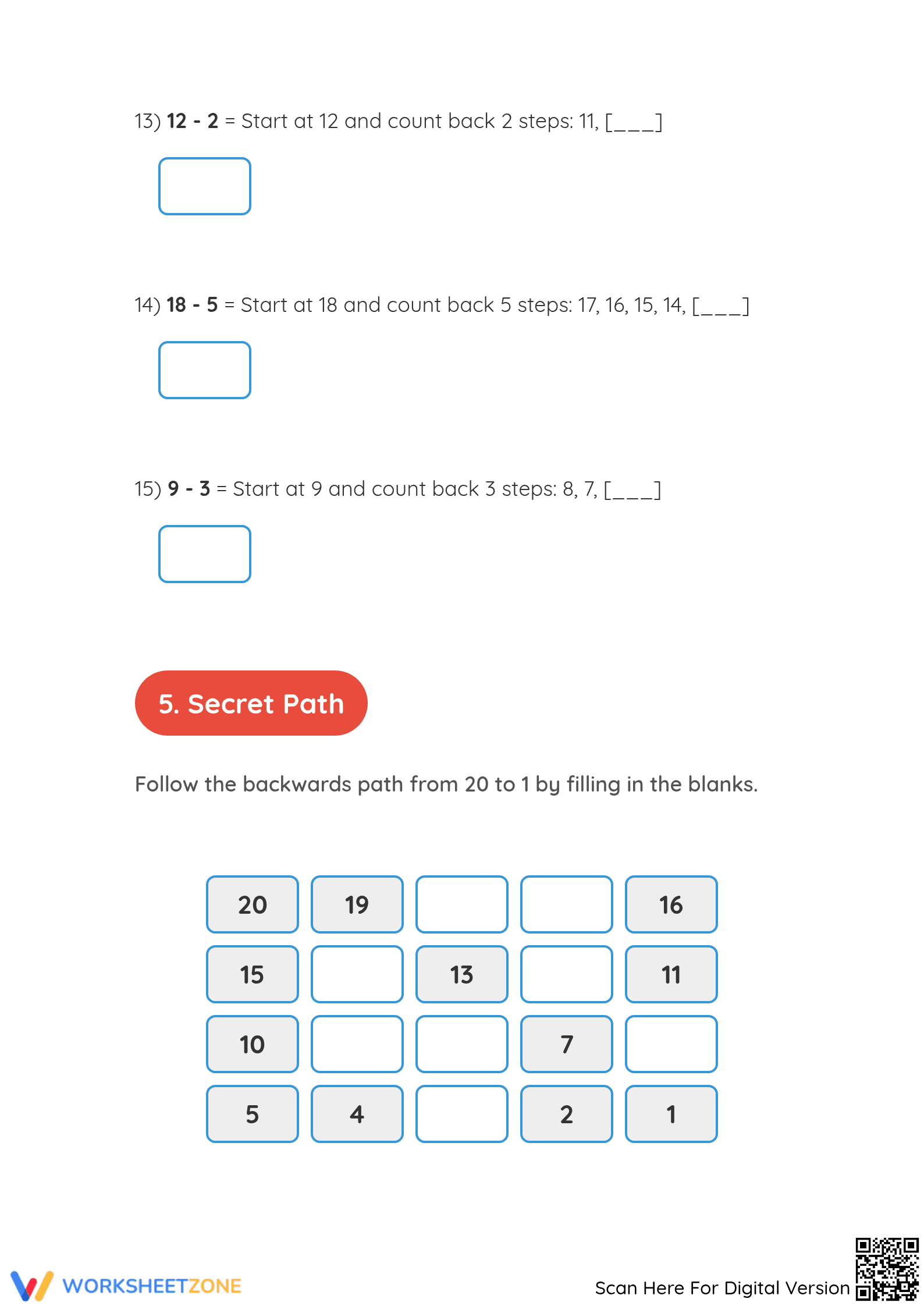
Inside this 5-page PDF, you will find a structured progression of number sense activities. It begins with a visual reference chart (1-20) and simple missing-number sequences. The difficulty increases with 'Blast Off Challenges' featuring numbers up to 50, followed by addition word problems and explicit instruction on the count-back strategy. A final 'Secret Path' maze reinforces number order in a playful format.
Skill Progression
- Guided Practice: Students use the 1-20 chart to fill missing sequences, establishing the rhythm of counting backwards from various points.
- Supported Practice: Learners transition to numbers up to 50 and word problems, applying number sense to real-world phrasing while working in a structured framework.
- Independent Practice: Students apply the 'counting back' strategy to subtraction equations and a number maze, demonstrating mastery of the core concept.
The sequence follows a gradual-release model, moving from visual aids to mental math calculation.
Standards Alignment
This resource is primarily aligned to `CCSS.MATH.CONTENT.1.OA.C.5`: 'Relate counting to addition and subtraction (e.g., by counting on 2 to add 2).' It also supports `CCSS.MATH.CONTENT.1.NBT.A.1` by requiring students to count to 120 and represent numbers with written numerals. Both standard codes can be copied directly into lesson plans, IEP goals, or district curriculum mapping tools.
How to Use It
Use this worksheet during your subtraction unit to introduce 'counting back' as an alternative to drawing dots. It works excellently as a formative assessment tool; observe students as they work through Section 4 to see if they are still finger counting or if they can mentally hold the starting number. Expected completion is 30 minutes, ideal for independent center work.
Who It's For
This resource is designed for Grade 1 students, though it provides excellent remedial support for Grade 2 learners who still struggle with subtraction fluency. It is particularly effective for students who benefit from visual scaffolds like number lines and charts. Pair this worksheet with a physical number line or a 'blast off' themed picture book for a cohesive lesson.
The 'counting backwards' strategy is a pivotal milestone in early mathematics, moving students from 'counting all' to sophisticated mental operations. According to Fisher & Frey (2014), the gradual release of responsibility—mirrored in this worksheet's progression from guided charts to independent solving—is essential for internalizing mathematical procedures. Research from RAND AIRS 2024 emphasizes that providing multiple representations of number sequences, such as the grids and word problems in this PDF, significantly improves retention of base-ten concepts. By explicitly linking counting backwards to subtraction in `CCSS.MATH.CONTENT.1.OA.C.5`, this worksheet addresses the cognitive gap learners face when transitioning to abstract equations. This five-page set provides the high-repetition practice required to move number sequences from short-term memory into fluent mental math skills. This resource effectively bridges the gap between concrete counting and abstract arithmetic for early learners in various educational settings.


