




























Views
Downloads
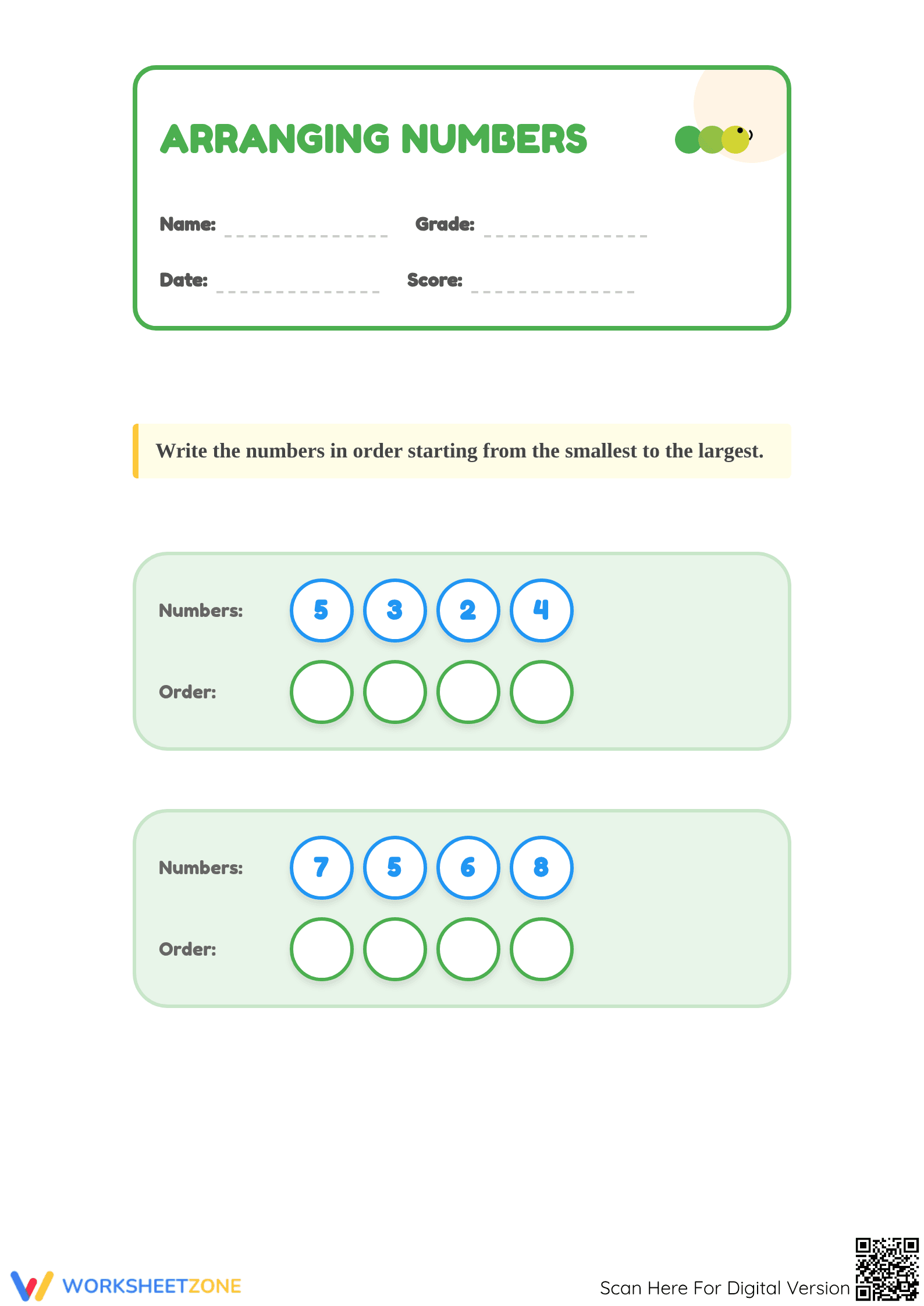
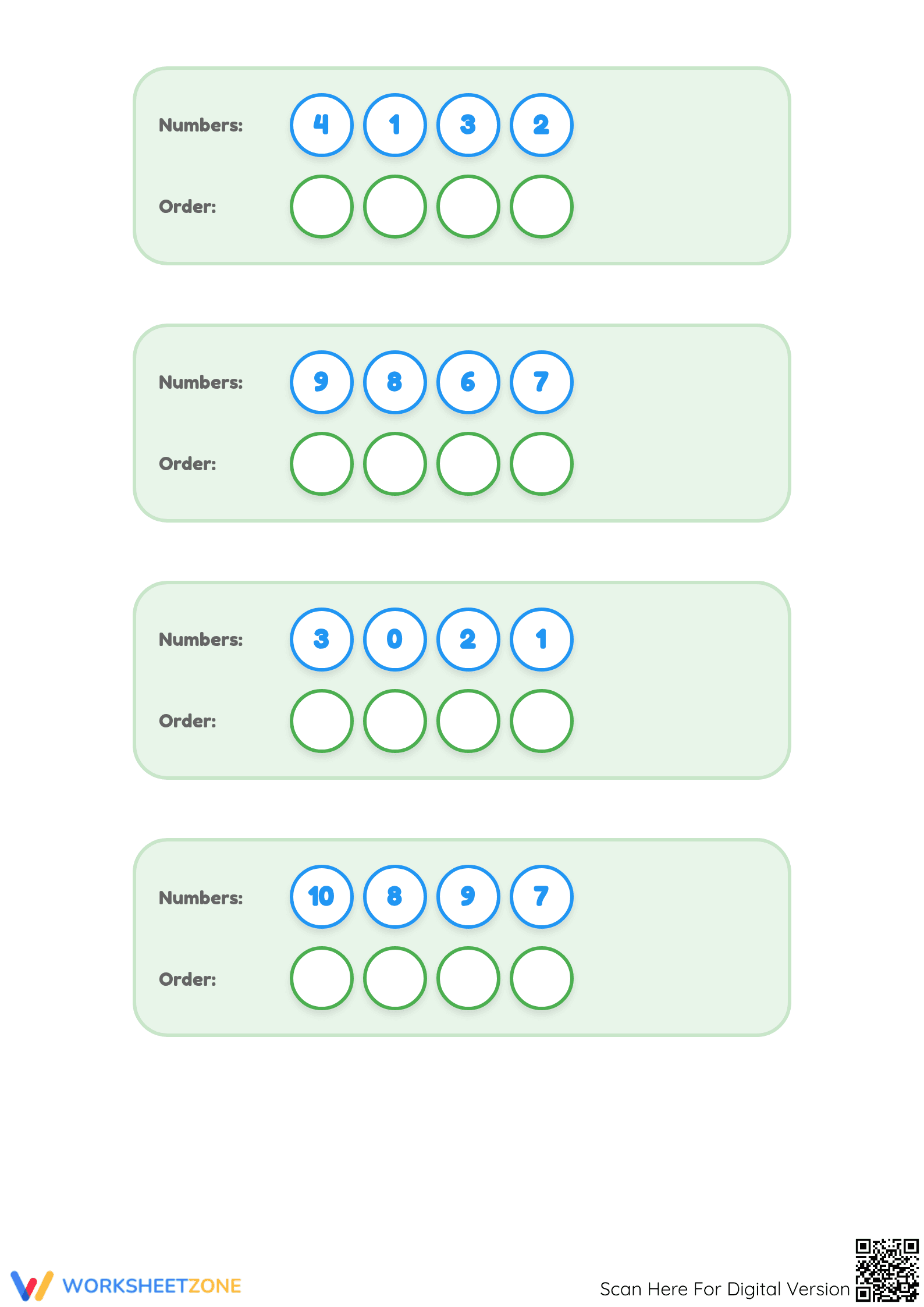


Grade K Ordering Numbers — Printable No-Prep Worksheet

Paste this activity's link or code into your existing LMS (Google Classroom, Canvas, Teams, Schoology, Moodle, etc.).
Students can open and work on the activity right away, with no student login required.
You'll still be able to track student progress and results from your teacher account.
This Kindergarten math worksheet focuses on the fundamental skill of arranging numbers in sequence from smallest to largest. By providing structured practice with number sets up to 20, students develop the strong number sense required for more complex mathematical operations. It is an ideal resource for mastering the "counting on" strategy and understanding numerical relationships.
At a Glance
- Grade: Kindergarten · Subject: Math
- Standard:
K.CC.A.2— Count forward starting from any number within a known sequence- Skill Focus: Ordering and sequencing numbers
- Format: 3 pages · 9 problems · Answer key included · PDF
- Best For: Independent practice or math center rotation
- Time: 15–20 minutes
What's Inside
This 3-page PDF resource contains nine distinct number-set tasks, including a "Bonus Challenge" section to push student thinking. Each task presents four numbers in circles, with corresponding empty circles for students to write the correct order. The layout is clean and high-contrast, designed specifically for early learners with ample space for writing digits. A complete answer key is included for rapid grading.
Zero-Prep Workflow
The zero-prep workflow for this resource is designed for maximum efficiency. Print the 3-page document (30 seconds). Distribute sheets to students or upload to a digital platform via the QR code link (1 minute). Use the visual answer key to review student work in under 2 minutes. This streamlined process makes it perfect for emergency sub plans or last-minute classroom transitions.
Standards Alignment
The primary focus of this worksheet is standard `K.CC.A.2`: "Count forward beginning from a given number within the known sequence (instead of having to begin at 1)." By requiring students to order varying sets of numbers, the activity reinforces the cardinal sequence and the concept of relative magnitude. This resource also supports `K.CC.A.3` as students write numerals to represent the sequence. Both standard codes can be copied directly into lesson plans or IEP goals.
How to Use It
Incorporate this worksheet during the "You Do" phase of a lesson on number lines. It serves as an excellent formative assessment tool to check for common sequencing errors, such as confusing digits like 6 and 9. Expected completion time for the full packet is roughly 20 minutes, making it a reliable choice for morning work or a focused math station rotation.
Who It's For
Designed for Kindergarten, this is also appropriate for Pre-K learners or 1st-grade students needing remedial support. It pairs naturally with physical manipulatives like number tiles or a classroom number line. Students struggling with fine motor skills can use stamps or stickers to place numbers in the correct circles, allowing for easy differentiation within a single group instruction model.
According to the RAND AIRS 2024 report on early childhood numeracy, consistent exposure to non-sequential number sets is critical for moving beyond rote counting toward true mathematical fluency. This worksheet addresses that need by forcing students to analyze numerical value rather than simply reciting a memorized string. By isolating the sequencing task, the resource reduces cognitive load, allowing learners to focus entirely on the magnitude of the digits provided. Research from Fisher & Frey (2014) emphasizes that such targeted practice is most effective when paired with immediate feedback, which the provided answer key facilitates. Standardized benchmarks from the NAEP suggest that early mastery of the K.CC.A.2 standard is a strong predictor of success in first-grade operations and algebraic thinking. This worksheet provides the high-repetition, low-stress environment necessary for students to build the mathematical foundation required for lifelong numeracy.


