What It Is:
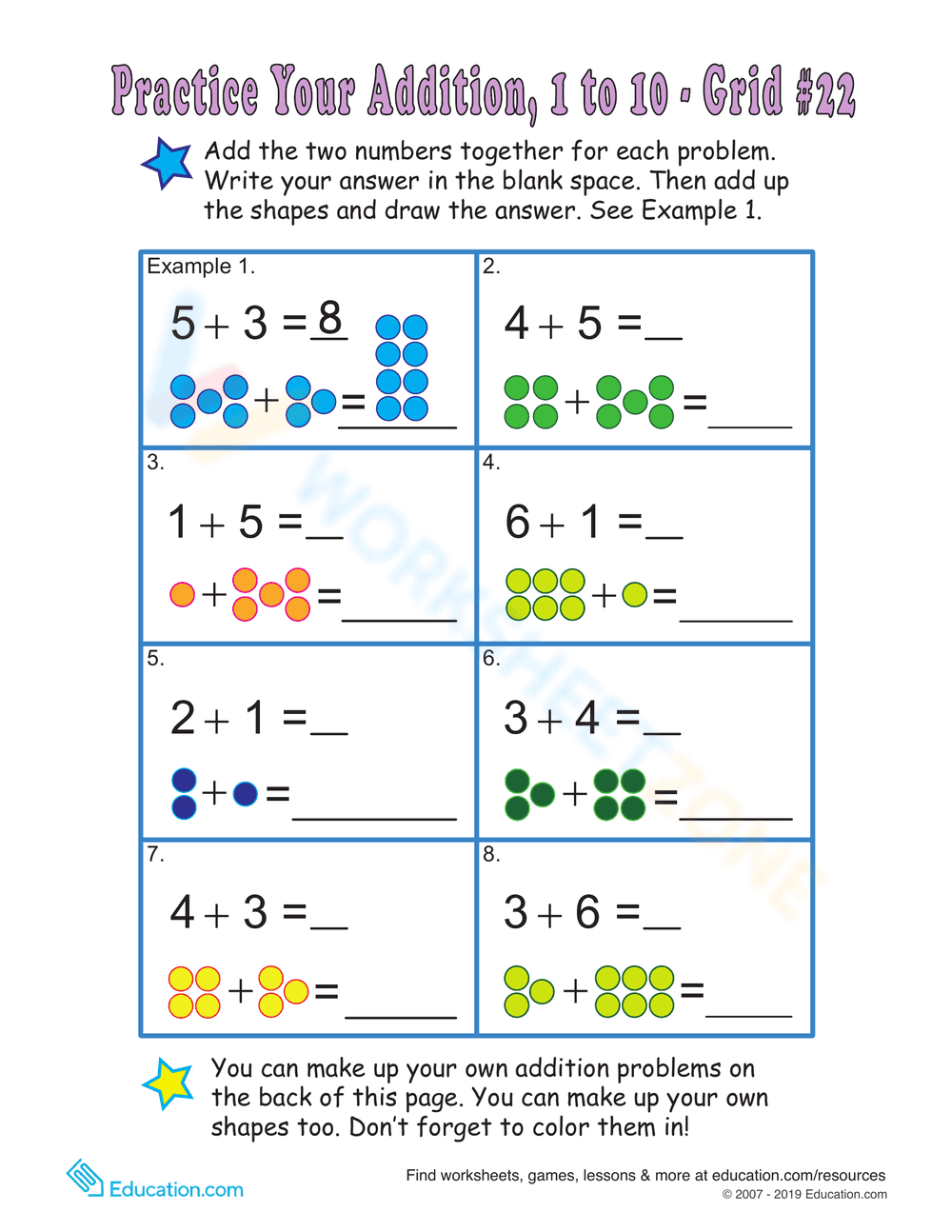
This is an addition worksheet titled 'Practice Your Addition, 1 to 10 - Grid #22'. It presents eight addition problems (e.g., 5+3, 4+5) where the numbers range from 1 to 10. Each problem includes a space for the answer and a visual representation of the addition using colored shapes. The first problem is provided as an example. The worksheet encourages students to write the numerical answer and then visually represent the sum by drawing the corresponding number of shapes.
Grade Level Suitability:
This worksheet is suitable for Kindergarten and 1st grade. The addition problems are simple, involving numbers 1-10, and the use of shapes provides a visual aid for understanding the concept of addition, which is appropriate for early learners.
Why Use It:
This worksheet reinforces basic addition skills. The visual representation using shapes helps children understand the concept of addition concretely. It encourages both numerical and visual problem-solving skills. It provides practice in writing numbers and drawing to represent mathematical concepts.
How to Use It:
Students should first solve the addition problem and write the numerical answer in the blank space provided. Then, they should draw the correct number of shapes to represent the total. The example problem can be used as a guide. The back of the page can be used to create additional problems and shapes.
Target Users:
This worksheet is designed for young learners, specifically Kindergarten and 1st-grade students, who are learning basic addition skills. It is also suitable for students who benefit from visual aids in mathematics.